
Table of Contents
TL;DR
- Arkansas dash cam laws contain no camera-specific ban or permission for private vehicles.
- Mount the camera where it does not obstruct your view or safe operation. Arkansas defines no universally approved position.
- Recording a covered conversation generally requires you to participate in it or secure one party’s prior consent.
- After an incident, stop automatic overwrite and preserve the native file, metadata, storage media, and an unedited copy.
Arkansas dash cam laws do not include a statute written specifically for cameras in private vehicles. Instead, Arkansas applies its windshield obstruction, audio recording, evidence, discovery, and preservation rules to how you install and use one.
This guide draws on source excerpts reported by a research tool; we have not independently checked the full source texts. The practical answer starts with the mounting rules: a camera cannot block the driver’s view or interfere with safe operation. Audio raises a separate consent question, and footage tied to a crash or police encounter may need immediate preservation.
SEO title: Arkansas Dash Cam Laws Govern Mounting and Audio
SEO description: Learn where to mount a dash cam, when audio consent matters, and how to preserve Arkansas footage for a crash or police encounter.
Arkansas Dash Cam Setup Check
Answer four questions to identify mounting, audio, and evidence-preservation issues in your setup. This quiz provides practical issue-spotting, not a legal determination.
Your setup profile
Your tailored checklist
This result does not decide whether your installation or recording is lawful, whether footage is admissible, or whether you must produce it. Those questions depend on the facts, the proceeding, and the applicable law.
Legal basis used by this quiz
Arkansas has no dash-cam-specific statute identified in the cited research. Arkansas Code §§ 27-37-302 and 27-37-304 instead address material that obstructs the driver’s view or safe operation of the vehicle. The 4.5-inch language in § 27-37-304 is not an unconditional safe harbor.
Arkansas Code § 5-60-120 generally permits covered recording when the recorder is a party or one party gave prior consent. Privacy remains context-dependent, and a violation of that section is classified as a Class A misdemeanor.
Potential evidence may require relevance, authentication, and proof that it has not been materially altered. Arkansas evidence rules generally favor preserving the original recording, while civil procedure can require preservation and production of relevant electronically stored information.
DashOne Pro: Check the Merchant’s Current Offer
DashOne Pro enters this guide only after the legal answer because buying a camera does not settle whether a particular installation or recording complies with Arkansas law.
Verify the live price and package before purchase
The merchant page is the live source for the current price, shipping terms, package contents, and return terms. The editor reviewed that page on October 13, 2026, but those details can change.
Check the current DashOne Pro offer before purchasing.
Treat specifications as merchant claims
Any camera characteristic displayed on the linked page comes from the merchant. We have not independently tested the DashOne Pro, and we make no separate claim about its image quality, reliability, recording performance, or suitability as evidence.
arkansas dash cam laws: Are Dash Cams Legal to Use?
Yes, a private driver can generally use a dash cam in Arkansas, provided the installation does not obstruct the driver’s view or safe operation. The reviewed sources reveal no statute that specifically licenses or bans private dash cams.
No camera-specific statute was identified
The legal question turns on generally applicable rules. Arkansas Code §§ 27-37-302 and 27-37-304 regulate material attached to vehicle glass and the obstruction it creates.
That distinction matters. A camera’s legality does not flow from its label or purpose.
Section 27-37-302 covers obstructive material on vehicle windows
Arkansas Code § 27-37-302 bars driving with nontransparent material on the front windshield, sidewings, side windows, or rear window when it obstructs the operator’s view or safe vehicle operation. The section excludes certificates or papers that the law requires drivers to display.
A dash cam or its mount may fall within that obstruction analysis when attached to covered glass. Inspect the installation from the driver’s normal seated position, including the cable and mounting hardware.
Section 27-37-304 makes qualifying violations Class C misdemeanors
Section 27-37-304 reaches certain material attached to the windshield or either front-door window when it obstructs the operator’s view or safe operation. A violation constitutes a Class C misdemeanor.
The offense depends on the statutory conditions. The mere presence of a camera does not answer whether the installation violates the section.
Where Arkansas Dash Cam Mounting Rules Apply
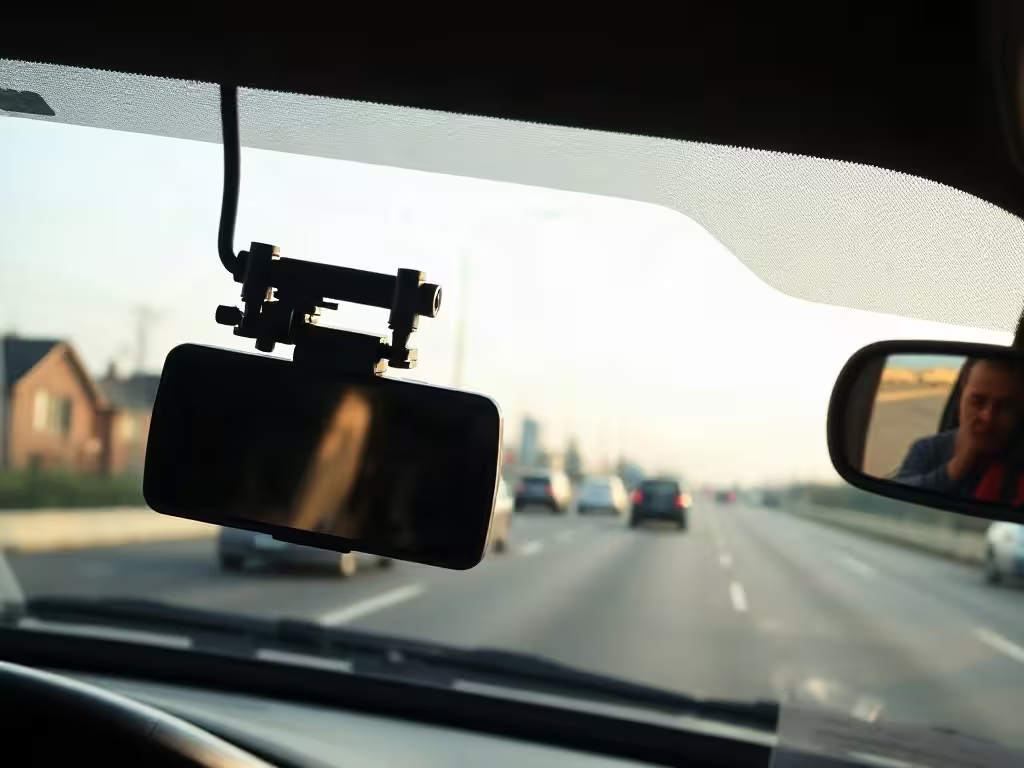
Arkansas law identifies covered surfaces and an obstruction standard. It does not name a universally lawful dash-cam position.
Windshield attachments and the 4.5-inch provision
Section 27-37-304 addresses windshield material attached more than 4.5 inches above the windshield’s bottom when it obstructs the driver’s view or safe operation. That measurement does not create an unconditional safe harbor below the line.
Sections 27-37-302 and 27-37-304 still make actual obstruction central. A low-mounted camera can interfere with a driver’s sightline, while a different installation may leave it clear.
Side, rear, and front-door window restrictions
Section 27-37-302 covers nontransparent material on the front windshield, sidewings, side windows, and rear window when obstruction results. Section 27-37-304 separately addresses material on either front-door window, except qualifying manufacturer-attached material, when it obstructs sight or safe operation.
The statutory exceptions do not create a dash-cam zone. They concern required displays, certain vehicles registered in other states under the provision’s tinting language, and compliant factory tinting.
Why Arkansas defines no universally safe mounting position
Vehicle geometry changes the result. Seat height, windshield angle, mirror placement, camera size, and cable routing determine what the driver can see.
The reviewed law does not declare the dashboard, passenger side, space behind the mirror, or any other camera location lawful in every vehicle. Check the full road view and the path of every control before driving.
The limited support for a rearview-mirror mount
In Giron v. City of Alexander, a federal district court predicted that Arkansas §§ 27-37-302 and 27-37-304 address material attached to vehicle glass, not objects hanging from a rearview mirror. The dispute involved air fresheners and rosary beads, not dash cams, and the ruling did not come from an Arkansas appellate court.
A mirror-mounted device may avoid attaching the camera to glass. It must still leave the driver’s view and safe operation unobstructed.
Audio Recording Rules for Arkansas Dash Cams
For communications covered by Arkansas Code § 5-60-120, recording generally requires the recorder to participate in the conversation or obtain one party’s prior consent. A camera setting cannot replace that legal requirement.
When one-party consent applies
Arkansas Code § 5-60-120 covers listed wire, landline, oral, telephonic, and wireless communications. It bars interception and recording unless the recorder is a party or one party gave prior consent.
This is commonly called one-party consent. The statute also contains specific provisions concerning law enforcement acting under color of law, telecommunications services, amateur radio, and police scanners.
Conversations inside the vehicle
If you participate in a covered conversation inside your vehicle, your participation may satisfy the statute’s party requirement. If your unattended camera records occupants while you are absent, that basis may disappear.
The facts control. When a camera may capture passengers, rideshare customers, employees, or other speakers, consult a civil-rights attorney in your state about the particular recording arrangement.
Nearby speech and reasonable expectations of privacy
Location alone does not settle whether a conversation carries a reasonable expectation of privacy. Volume, distance, barriers, the presence of other people, and steps taken to keep the exchange private can change the analysis.
In Graham v. Butterball, LLC, a federal court in the Western District of Arkansas found no justified expectation of privacy for workplace conversations held in common areas, where they could be overheard and the speakers made no effort to keep them private. That fact-specific ruling does not establish that every conversation inside or near a vehicle lacks privacy.
Criminal and civil consequences are distinct
A violation of § 5-60-120 constitutes a Class A misdemeanor, subject to the statute’s exceptions. Civil intrusion upon seclusion asks a different question: whether someone intruded in a highly offensive manner into a matter in which another person held a legitimate expectation of privacy.
One recording can raise separate criminal, evidentiary, and civil issues. Get advice tied to your facts before publishing or distributing sensitive audio.
DashOne Pro Audio Features: Verify the Merchant’s Claims
Check the DashOne Pro merchant offer for its current audio controls and package details. Any microphone, mute function, recording mode, or related specification shown there remains a merchant claim.
A setting does not decide whether you are a party to a conversation, whether another speaker consented, or whether someone had a reasonable expectation of privacy. Review the controls before driving, then apply Arkansas law to the conversation and circumstances.
When Arkansas Courts Can Use Dash-Cam Footage
A court may admit dash-cam footage when it satisfies the applicable evidence rules. Existence alone does not make a recording admissible.
Relevance and authentication
Rule 402 of the Arkansas Rules of Evidence generally admits relevant evidence while excluding irrelevant material, subject to other statutes and rules. A separate rule may still keep relevant footage out.
Rule 901 requires enough evidence to support a finding that the recording is what its proponent claims. A witness, file history, metadata, device records, or other foundation may help establish that the file is genuine and probably has not been materially altered.
Original files, accurate duplicates, and alteration disputes
Arkansas evidence rules treat video tapes and motion pictures as photographs. Rule 1002 generally requires an original to prove a recording’s contents, subject to recognized exceptions.
Rule 1003 generally permits an accurate duplicate unless someone raises a genuine authenticity question or substitution would be unfair. Under Rule 1004, loss or destruction without bad faith may support an exception, but that rule does not make every copy admissible.
Keep the native file. A compressed upload, edited compilation, or screen recording may discard information that helps establish authenticity.
Why admissibility depends on the contents and purpose
A technically authentic video may still contain hearsay, testimonial statements, privileged material, or content whose unfair prejudice or constitutional problems outweigh its permitted use. The reason a party offers the footage matters.
Courts decide admissibility. Police, attorneys, insurers, witnesses, and device custodians may collect, request, explain, authenticate, or challenge the file, but they do not bind the judge merely by accepting it.
What McNeil-Lewis does and does not establish
In McNeil-Lewis v. State (2023), 2023 Ark. 54, docket CR-22-433, decided March 30, 2023, the Arkansas Supreme Court held that the circuit court erred by admitting police dash-cam video containing an absent eyewitness’s statements. The court affirmed because it found the error harmless beyond a reasonable doubt.
The decision concerned recorded witness statements and the defendant’s confrontation rights. It does not create a blanket rule against silent crash footage or decide every authentication question.
How to Preserve Arkansas Dash-Cam Evidence
When footage may relate to a crash, claim, arrest, citation, or lawsuit, preserve it before loop recording erases it. Reasonable preservation protects the file and your ability to explain where it came from.
Disable overwrite and save the native file
Take these steps promptly:
- Stop loop recording or remove the camera from service without overwriting the relevant segment.
- Retain the original storage card when practical.
- Export the native file using the manufacturer’s ordinary process.
- Save a separate, unedited working copy.
- Keep footage from before and after the central event when it supplies necessary context.
Do not trim, filter, enhance, rename, or convert the only copy.
Preserve metadata and an unedited copy
Retain timestamps, location data, device identifiers, event logs, associated clips, and other metadata the system created. Document any clock error rather than rewriting the original file.
A duplicate may prove useful, but an authenticity dispute can make the native file and metadata more significant. Preserve both.
Record who handled each copy
Start a simple log showing:
- Who removed or accessed the storage media
- When each transfer occurred
- Which file was copied
- Where the native file and copies were stored
- Whether software changed the filename or format
This record does not guarantee admission. It can support the chain of custody and answer later alteration claims.
Do not delete or alter foreseeable litigation evidence
Arkansas Rule of Civil Procedure 37(e) addresses electronically stored information that should have been preserved for anticipated or ongoing litigation. Courts may order curative measures when relevant information is lost through a failure to take reasonable steps, and the rule permits stronger sanctions after a finding of intent to deprive another party of its use.
Phinney v. Greenwood Motor Lines supplies a recent federal illustration from Arkansas. In pending commercial trucking litigation, the court addressed the loss of requested driving clips, event data, and metadata after a retroactive retention change. Its federal procedure and fleet setting limit its reach, but the practical lesson holds: suspend automatic deletion when a recording concerns a foreseeable dispute.
Who Can Request or Compel Dash-Cam Footage in Arkansas?
The requester’s identity and legal process matter. A request for cooperation, a search warrant, an investigative subpoena, and civil discovery carry different consequences.
Police requests and judicial search warrants
An officer may ask you to consent to a search or voluntarily provide footage. Consent raises questions about voluntariness and scope.
Ordinary police officers cannot issue their own subpoenas under the Arkansas Supreme Court’s decision in Lewis v. State (2017), 2017 Ark. 211. A judicial officer may issue a particularly described search warrant on the required showing of reasonable cause, and its application to a camera, storage card, or file depends on the warrant’s language and facts.
Prosecutorial subpoenas in criminal investigations
Arkansas Code § 16-43-212 authorizes prosecuting attorneys and their deputies to issue subpoenas in criminal matters they are investigating. That authority belongs to prosecutors under the statute and does not grant ordinary officers unrestricted subpoena power.
A recipient should read the document, preserve the requested material, and obtain legal advice about scope, objections, deadlines, and compliance. Do not destroy a file because a demand may be disputed.
Rules 34 and 45 in civil cases
In pending Arkansas civil litigation, Rule 34 lets a party request electronically stored photographs, sound recordings, images, and other data within the permitted discovery scope. The request can specify a production format.
Rule 45 can compel a nonparty to produce electronically stored information. Objections, protective orders, privilege, service requirements, relevance, and undue-burden limits may apply.
Your insurer, an adverse insurer, and policy cooperation
Arkansas Insurance Department Rule 43 requires insurers to investigate claims and help first-party claimants comply with policy conditions and reasonable requirements. Your own policy may impose cooperation duties, so review its text before refusing or supplying footage.
An adverse insurer does not gain unrestricted seizure or subpoena power merely by asking for your file. Voluntary disclosure can still affect a comparative-fault argument, while litigation or valid court process may create a different obligation. Consult an attorney before releasing the only native copy.
Sharing or Posting Arkansas Dash-Cam Footage
Public posting can change how footage gets used. Preserve the native file first, and separate evidentiary needs from the version you might later share.
Why public posting can affect a claim
A public clip may omit the seconds before an impact, compress detail, expose a statement, or invite arguments about speed, distraction, and comparative fault. A post can also spread beyond your control before counsel, an insurer, or an investigator reviews it.
Keep the complete recording private while a foreseeable claim or proceeding remains unresolved. Sharing a copy does not replace preservation of the original.
The narrow scope of Arkansas video-voyeurism law
Arkansas Code § 5-16-101 addresses narrowly defined conduct, including surreptitious recording for the purpose of viewing another person’s body, without consent, under circumstances involving a reasonable expectation of privacy. Distribution or internet posting can raise the offense level when the underlying recording satisfies the statute’s specific elements.
That law does not automatically reach routine exterior footage of traffic visible from a public road. Interior recordings or unusual camera placement can present different facts.
When to consult an Arkansas civil-rights or evidence attorney
Seek fact-specific advice when footage captures a private conversation, the interior of another person’s space, a police encounter likely to produce charges, or an incident that may lead to civil litigation. Counsel can assess consent, privacy, warrant, subpoena, discovery, privilege, and preservation issues together.
Act before editing or posting. Those steps can be difficult to reverse.
DashOne Pro: Verify Price, Shipping, and Return Terms
Use the DashOne Pro merchant page to verify the live price, shipping, package contents, specifications, and return terms. The editor last checked the page on October 13, 2026.
All product details displayed there remain merchant claims. We have not independently established the camera’s performance, reliability, legal compliance, or evidentiary quality.
Key takeaways
Arkansas drivers can use dash cams, but generally applicable rules control the installation and recording. Keep the camera, mount, and cable outside your sightline, and remember that the 4.5-inch language does not guarantee a lawful installation.
Review the audio controls before carrying passengers or leaving a camera running unattended. After a crash or police encounter, stop overwrite, retain the storage media, preserve the native file and metadata, make an unedited copy, and record every transfer before sharing anything.
A dash cam helps only when its placement, audio settings, and retained files comply with the rules governing how the recording was made and later used.
Related Reading on Audit Faction
Verified internal URLs were not supplied for the planned topics of civilian recording, preserving video evidence, police requests for device access, and body-camera evidence. Add three to five descriptive internal links after confirming their live destinations in the Audit Faction CMS.
This post may contain affiliate links. If you click them, I might earn a small commission (it costs you nothing and helps me keep shipping quality articles every day for your reading pleasure).