
Table of Contents
TL;DR
- Idaho dash cam laws do not create a specific mounting zone. Your camera must preserve a clear view of the road, intersecting highways, vehicle controls, and mirrors.
- Cabin conversations protected by a justified expectation against interception generally fall under Idaho’s one-party consent rule. One participant must consent before recording begins.
- Preserve the original file after a crash or traffic dispute. Idaho courts require relevant, authenticated evidence and ordinarily favor an original or accurate duplicate.
Idaho dash cam laws regulate cameras through rules on driver visibility, audio interception, privacy, and evidence. The cited statutes do not expressly authorize private dash cams, but they do not categorically prohibit them either.
In practical terms, you can use a forward-facing or cabin-facing camera when the installation does not obstruct your view or interfere with vehicle control. Audio needs separate attention because a lawful video can still contain unlawfully intercepted speech.
Check the current DashOne Pro package, price, and terms. The merchant controls those details, so confirm them before purchasing.
Check DashOne Pro before deciding
Check Your Idaho Dash Cam Setup
Answer five questions to review mounting, audio consent, privacy, and evidence preservation. This checker provides general information, not legal advice.
Your setup profile
Your tailored checklist
Idaho Dash Cam Laws Apply Through Clear-View Rules
Idaho does not designate a statutory dash-cam mounting area. Instead, Idaho Code §§ 49-943 and 49-612 govern whether an installation obstructs the driver’s view or control.
Section 49-943 restricts material that obstructs the highway view
Idaho Code § 49-943 bars a driver from operating a vehicle with nontransparent material on the front windshield, side wings, or side or rear windows when that material obstructs a clear view of the highway or an intersecting highway.
A camera, adhesive mount, cable, or screen could fall within that practical concern if it blocks part of the required view. The statute turns on obstruction, not the product label attached to the object.
Section 49-612 prohibits obstructions that impair view or vehicle control
Section 49-612 prohibits driving when a load or front-seat condition obstructs the view to the front or sides, or interferes with control of the vehicle. The provision addresses loads and occupants rather than cameras by name.
Together, the statutes require an installation-specific judgment. A position that works in one vehicle may block the road in another because windshield angles, mirror housings, dashboards, and driver height differ.
A violating installation can produce an infraction and driver points
Idaho Code § 49-236 classifies violations of Chapters 6 through 9 as infractions unless another provision supplies a different penalty. Those chapters include §§ 49-612 and 49-943.
Idaho’s traffic-law points chart, updated in December 2023, assigns three points to a conviction under § 49-612. The available provisions do not establish a single current monetary total for every camera-related obstruction citation, so we do not quote one.
Dash Cam Placement Must Preserve the Driver’s View
Check the camera from your normal seated position before driving. Look through the full windshield, toward intersecting roads, along both sides of the vehicle, and through the rearview mirror.
Windshield hardware must not block the road or intersecting highways
Idaho law does not create an automatic windshield safe harbor for dash cams. A windshield mount remains subject to the clear-view restriction in § 49-943.
Keep the camera body, suction cup, adhesive plate, hanging cable, and display outside the sightline you use to scan the highway. A small device can still block a pedestrian, motorcycle, traffic signal, or vehicle at an intersection.
Dashboard placement remains lawful only when it preserves visibility and control
A dashboard mount may reduce windshield coverage, but the dashboard does not function as an expressly approved zone. The camera must remain low enough to preserve the forward and side views, and its cable must not interfere with the steering wheel, pedals, shifter, or other controls.
Secure the unit so ordinary braking does not send it across the dashboard. Idaho’s governing provisions focus on the condition of the vehicle while you drive.
Behind-mirror placement cannot impair the required rearward view
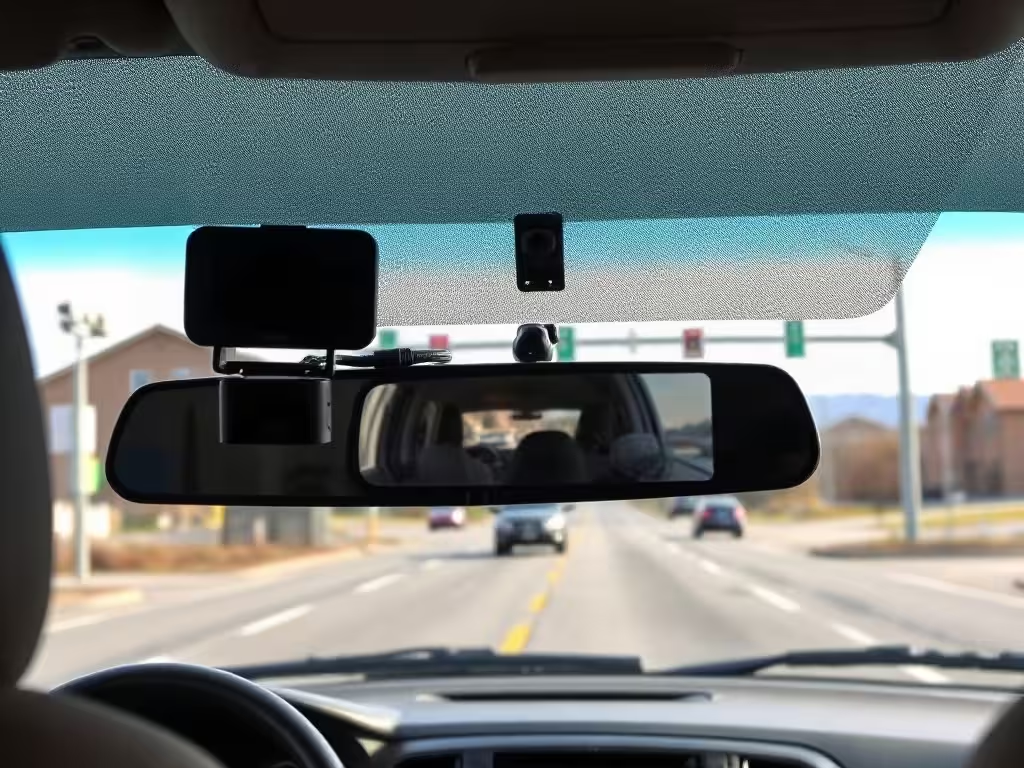
Mounting a compact camera behind the rearview mirror may keep hardware outside the central sightline. That position remains a recommendation rather than a statutory guarantee.
Check the placement from the driver’s seat. The camera and its wiring must preserve the roadway view and the mirror’s function.
The rearview mirror must provide at least 200 feet of visibility
The March 2025 Idaho Driver’s Handbook states that a vehicle’s rearview mirror must show the highway for at least 200 feet behind the vehicle. It also instructs drivers to keep windows and windshields free from objects placed or hung in the vehicle that block them.
If the camera, rear unit, screen, or cable cuts into that view, reposition it before driving.
Audio Recording Rules Require One-Party Prior Consent in Idaho
Idaho Code § 18-6702 generally makes interception lawful when one party to a wire, electronic, or oral communication has given prior consent. Prior consent means consent must exist before the interception, not after a dispute begins.
The statute applies only when the captured speech qualifies as a protected oral communication. Idaho defines that category around a speaker’s expectation against interception when the circumstances justify that expectation.
A participating driver or occupant can provide the required consent
A driver who participates in a conversation can supply the one party’s prior consent. An occupant participating in the same conversation can do so as well.
A silent recorder left in a vehicle raises a different issue if the person who activated it does not participate in the captured conversation. The one-party rule requires consent from a party to that communication.
A justified expectation against interception determines whether speech is protected
A microphone may capture road noise, radio audio, casual remarks, phone calls, and private passenger conversations in the same file. The legal analysis turns on the communication and its circumstances.
Do not assume that visibility of the camera settles the audio question. A lens on the windshield may reveal video recording without clearly communicating that a cabin microphone is active.
Notice can reduce disputes when passengers or customers enter the vehicle
Tell passengers when cabin audio runs and obtain consent before recording begins. A clear verbal notice or visible notice can document expectations, especially when rideshare customers, employees, or recurring passengers enter the vehicle.
Idaho’s cited statute does not create separate consent rules for those groups. Other employment, contractual, or out-of-state laws may affect a recording, so consult a civil-rights attorney in your state when the vehicle crosses jurisdictions or records as part of a business.
Willful unlawful interception can trigger criminal and civil consequences
A willful unlawful interception, use, or disclosure can constitute a felony under § 18-6702. The statute authorizes up to five years in state prison, a fine of up to $5,000, or both, subject to its exceptions.
Idaho Code § 18-6709 also creates a civil claim for a person whose protected communication was unlawfully intercepted, disclosed, or used. Available relief can include actual damages subject to a statutory minimum, punitive damages, attorney fees, and litigation costs.
If you do not need cabin audio, disabling the microphone avoids collecting speech that adds little to a roadway video.
Review the DashOne Pro merchant’s current camera package and return terms. Confirm whether the listed configuration meets your video and audio needs before ordering.
Match the camera to the recording rules
Review the current package, then confirm mounting and audio rules before recording in your state.
Privacy Rules Limit What a Dash Cam May Record
Ordinary roadway video and targeted recording inside a private place raise different privacy concerns. Idaho Code § 18-6605 defines protected places for its video-voyeurism offense, including places where a reasonable person could undress privately or expect safety from casual or hostile imaging-device surveillance.
Protected locations can carry a reasonable expectation of privacy
Section 18-6605 reaches specified recordings made without knowledge or consent in protected places and with the intent listed in the statute. Its definition can cover more than a bedroom or restroom because it also addresses places protected from casual or hostile surveillance.
Do not aim a parked camera into private spaces merely because the lens can see them from a road or parking area. Visibility alone does not resolve every privacy question.
Public exposure does not create unlimited permission to record or disclose
The video-voyeurism statute excludes images involving voluntary exposure in public or commercial settings. That limited exception belongs to a particular criminal statute and does not grant blanket permission to record, publish, or exploit every person visible from a vehicle.
Context still matters. Recording a public road during a trip differs from targeting a person in circumstances that carry a reasonable expectation of privacy.
Recording police in public remains protected when the driver does not interfere
Ninth Circuit precedent recognizes a First Amendment right to photograph and record law-enforcement officers performing official duties in public places. Idaho falls within the Ninth Circuit.
You may record a traffic stop or other public police encounter from a place where you may lawfully remain. Keep your hands visible when practical, do not physically obstruct an officer, and avoid movements that could be mistaken for reaching toward a weapon or control.
Lawful safety orders and location restrictions still apply
The right to record does not grant entry to private, secured, or restricted areas. It also does not excuse interference with official duties or disregard of a lawful safety order.
An order to step back may regulate your position without necessarily requiring you to stop recording. Follow the lawful location or safety instruction while keeping the camera running from the permitted position.
Idaho Courts Require Dash Cam Footage to Be Relevant and Authentic
Dash cam video may be offered in an Idaho court, but recording an event does not guarantee admission. The proponent must satisfy the applicable Idaho Rules of Evidence and any other governing rules.
Relevance connects the recording to a disputed fact
Under Idaho Rule of Evidence 401, evidence qualifies as relevant when it tends to make a consequential fact more or less probable. A recording might show vehicle position, signal timing, road conditions, a spoken statement, or the sequence of a traffic stop.
The link to the disputed fact should remain clear. Hours of unrelated driving do not strengthen the relevant segment.
Authentication shows that the file is what its proponent claims
Rule 901 requires enough evidence to support a finding that the exhibit matches its description. A witness with knowledge may identify the recording, or evidence about the camera’s process or system may show that it produced an accurate result.
In State v. Davis, Docket No. 51350, filed March 12, 2025, the Idaho Court of Appeals described dash cam video as corroborating testimony about whether a driver could have merged safely. The unpublished decision cannot be cited as authority, but it shows an Idaho court considering dash cam footage as part of the factual record.
Completeness can require related portions of a recording
Rule 106 lets an opposing party require the simultaneous introduction of another part of a recorded statement when fairness calls for considering the portions together.
Preserve the surrounding footage. A short export may omit the lead-up to a collision, an officer’s preceding instruction, or the words that give a response its meaning.
The original-file rules favor an original or an accurate duplicate
Rule 1002 ordinarily requires the original recording to prove its content. Rule 1003 generally admits an accurate duplicate unless a genuine authenticity question arises or admitting it would be unfair.
Rule 1004 permits other evidence of content in specified circumstances, including when originals were lost or destroyed without bad faith by the proponent. Relying on that exception creates avoidable disputes when the original file could have been saved.
Preserving the Original File Protects Its Evidentiary Value
Treat a relevant recording as evidence as soon as a crash, traffic dispute, arrest, or likely claim occurs. Ordinary loop recording can erase the useful segment without any deliberate deletion.
Loop recording must be stopped after a relevant incident
Lock the incident file if the camera supports that function. Then stop the vehicle safely and copy the relevant file before continued recording overwrites it.
Do not rely solely on an in-camera event flag. Confirm that the complete file opens and includes the minutes before and after the incident.
An unmodified original should remain separate from working copies
Retain the original file in its native format. Create a secure backup, then use copies for playback, clipping, redaction, annotation, or submission.
Editing a copy preserves the source file for authentication. Renaming, transcoding, compressing, or trimming the only file can discard metadata or prompt questions about what changed.
Dates, device details, location data, and file provenance support authentication
Record the incident date, time, location, camera model, memory card, vehicle, and person who retrieved the file. Preserve available GPS, timestamp, and device data alongside the recording.
Keep a simple log showing when each copy was made and who received it. Those details help connect the exhibit to the event and explain its chain of custody.
Deletion or alteration can harm the party relying on the footage
Under Idaho spoliation doctrine, intentional destruction by an opposing party can support an inference that the missing evidence would have been adverse. Idaho precedent also recognizes a possible jury inference when a party deliberately or negligently destroys evidence, depending on the facts and procedural posture.
Once litigation is pending or reasonably anticipated, prevent loop overwrite and preserve all relevant portions. Destructive editing, selective deletion, or failure to secure the file can weaken the position of the party who controlled it.
The DashOne Pro Offer Requires a Live Terms Check
Check the live DashOne Pro offer immediately before ordering. The merchant page carries the current commercial terms.
The merchant page supplies the current package details
The DashOne Pro merchant presents the camera offer and package information. Treat every product characteristic on that page as a merchant claim, not as an independent test result.
Match those claims against your vehicle and intended use. In particular, check the physical mounting arrangement and audio controls because Idaho compliance depends on the finished installation and how you operate the microphone.
Price, shipping, contents, and return terms can change before purchase
Confirm the current price, shipping charge, package contents, and return terms on the checkout path. Do not rely on an older screenshot or quoted offer.
A package name alone does not establish which mounts, storage media, cables, or accessories come in the box. Verify each item you need before paying.
Before you buy
Verify the package before you rely on it
- Confirm what the current package includes
- Check shipping and return terms
- Test storage and footage retrieval after delivery
Idaho Dash Cam Laws Govern Mounting, Audio, and Evidence
Install the camera only after sitting in the driver’s position and checking the full windshield, side view, controls, and the mirror’s 200-foot rearward view. Then decide whether cabin audio serves a real purpose. If it does, secure prior consent from a participant before recording protected conversations.
After an incident, stop loop overwrite, keep the native file untouched, and work from copies. If privacy, employment, interstate audio, or litigation issues could affect the recording, consult an Idaho attorney before disclosing or editing it.
This post may contain affiliate links. If you click them, I might earn a small commission (it costs you nothing and helps me keep shipping quality articles every day for your reading pleasure).