
Table of Contents
TL;DR
- Massachusetts dash cam laws reach your camera through four separate rule sets: windshield obstruction under Chapter 90, Section 9D, the hands-free device guidance, the wiretap statute at Chapter 272, Section 99, and the Massachusetts Guide to Evidence.
- Secretly recorded conversations can draw a fine of up to $10,000, up to five years in state prison, and a civil suit under Chapter 272, Section 99.
- A mount that blocks the driver’s view invites a citation, while a dashboard or center-console position keeps the windshield clear.
- Silent video of a public road, and of police working in public, carries constitutional protection. A camera aimed at someone’s home does not.
No Massachusetts statute names a private dash camera as permitted or prohibited. The rules that decide your situation were written for other things: windshields, phones, wiretaps, and evidence.
Those four rulebooks pull in different directions. A mount that passes inspection can still carry a live microphone into a private conversation, and a camera that records nothing but asphalt can produce the single most useful file in a crash claim. Sorting the four apart is the whole job.
A dash camera that records video of the road ahead and sits out of your sight line runs into no Massachusetts prohibition. The trouble starts with the mount and the microphone.
If you want to compare a dedicated unit against running a phone app, the DashOne Pro merchant page carries the current camera offer and package details. You can check the live price, shipping, and return terms at the DashOne Pro offer page before deciding whether a separate camera earns its place on your dashboard.
Compliance check
Massachusetts dash cam compliance check
Four questions. Each answer returns the Massachusetts rule that governs it, in plain language, with the section cited. Mounting runs through Chapter 90, Section 9D and 540 CMR 4. Audio runs through Chapter 272, Section 99. Recording an officer on duty runs through the Glik and Gericke line. Getting footage into court runs through Section 901 authentication.
General information, not legal advice. We do not know the facts of your case. Any question about recording audio belongs with a civil-rights attorney licensed in your state.
Built from Massachusetts primary sources: the General Laws, Registry of Motor Vehicles regulations, the District Court model jury instruction on wiretapping, and the Massachusetts Guide to Evidence adopted February 1, 2026. Where a summary and the underlying text differ, the text controls.
Check DashOne Pro before deciding
massachusetts dash cam laws govern more than the camera itself
Four sets of rules touch a dashboard camera, and none of them mentions the device by name.
The Massachusetts State Police hands-free guidance, effective February 23, 2020, lets drivers 18 and older touch an electronic device only to start hands-free mode. The device must sit properly mounted on the windshield, dashboard, or center console without obstructing vehicle operation. The page never says “dash cam,” yet it sets the state’s posture: a device in a car is fine when it stays put and out of the way.
Chapter 90, Section 9D bars operating a vehicle on a public way with a sign, poster, or sticker affixed to the front windshield in a manner that obstructs, impedes, or distorts the operator’s vision. The inspection standard at 540 CMR 4 goes further and covers any item attached to the windshield that obstructs the operator’s vision.
That gap between the two texts drives the analysis. A camera body and a suction cup are items attached to a windshield, and the inspection standard reaches them without listing them. The statute’s enumerated list covers signs, posters, and stickers, and it stops there.
Massachusetts mounting rules require an unobstructed view
The rule that settles most mounting disputes never mentions cameras. If an item on your windshield blocks what you need to see, you have a problem under 540 CMR 4 and, depending on how the item is characterized, under Chapter 90, Section 9D.
A windshield mount must preserve the driver’s forward view
Chapter 90, Section 9D contains exactly one windshield allowance: transparent material in the uppermost six inches, as long as the strip does not encroach on the driver’s direct forward viewing area. That exception covers film and tint. Nothing in the text extends it to a camera bracket, and the six-inch strip is not a dash-cam safe harbor.
Dashboard placement can reduce obstruction risk
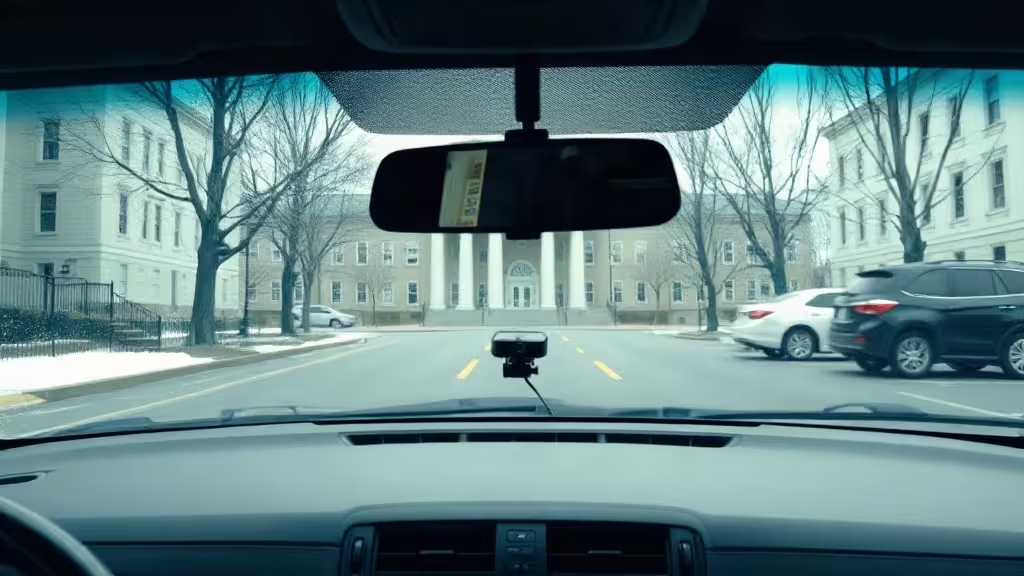
A camera that rests on the dashboard or clips to the center console leaves the windshield clear, and the hands-free guidance lists both surfaces as acceptable mounting points for an electronic device.
Placement still has to leave your view of the road, the mirrors, and the instruments intact. No Massachusetts source designates a specific patch behind or beside the rearview mirror as approved for a camera, so anyone calling one particular windshield spot “legal” is asserting more than the published guidance supports.
Wiring must not impede vision or vehicle operation
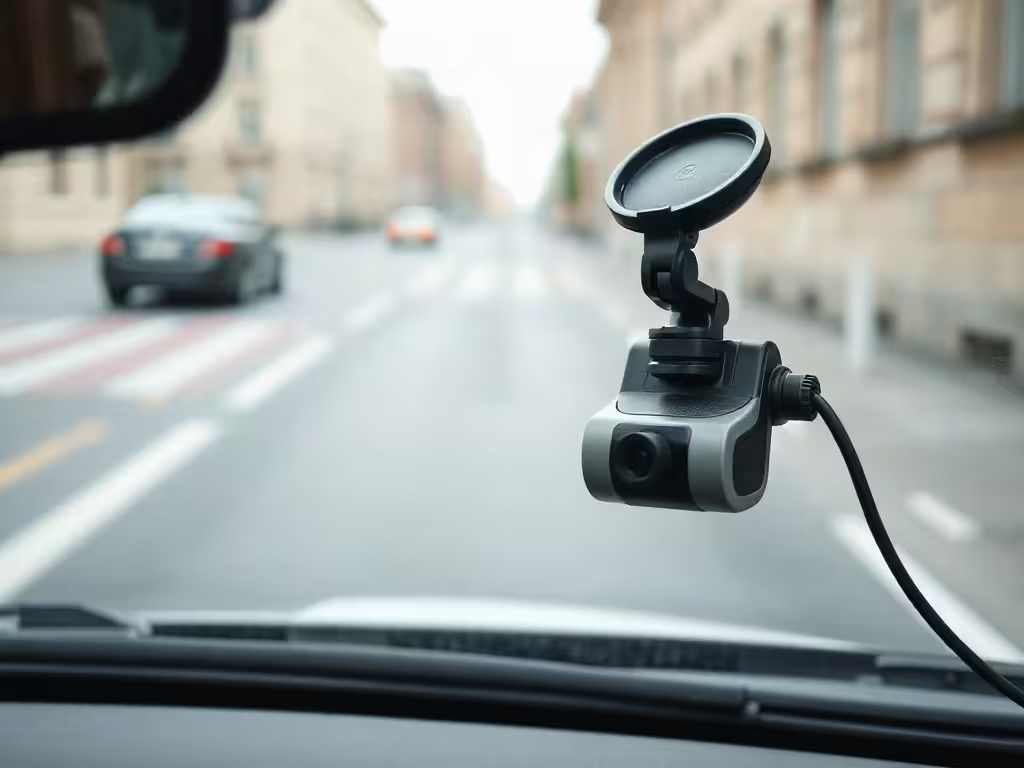
Power cables follow the same analysis as the camera. A cord that crosses the windshield, drapes over the instrument cluster, or loops near the pedals falls under the obstruction language, and the hands-free guidance ties mounting to the operation of the vehicle.
Route the cable along the headliner and down the A-pillar, or power the unit from the console. The question disappears when nothing hangs in your sight line.
Audio Recording Rules require every participant to know about recording
Massachusetts requires prior authority from all parties before anyone secretly records an oral communication, which is why the state is usually described as an all-party consent jurisdiction. The statute reaches further than most drivers expect.
Chapter 272, Section 99 defines an interception as secretly hearing or recording the contents of an oral communication through an intercepting device, by a person without prior authority from all parties. A dash camera with a live microphone and a passenger talking beside it becomes an intercepting device for that conversation.
Secret audio can trigger criminal and civil consequences
The Massachusetts District Court criminal model jury instruction on wiretapping, issued February 2024, defines secrecy by awareness: a person records secretly when the people recorded are unaware or not on notice. The same instruction states that a recording made with the actual knowledge of all parties is not an interception, even if nobody affirmatively consented.
A willful unlawful interception carries a fine of up to $10,000, up to five years in state prison, or up to two and a half years in a jail or house of correction, or both a fine and one of those terms. Section 99 also hands an aggrieved person a civil cause of action for interception, disclosure, or use that the statute does not authorize.
A 2026 Massachusetts legal update on body-worn cameras and the wiretap statute, built around Commonwealth v. Grimaldi, puts the willfulness element plainly: the state must show an intent to record secretly, not merely an intent to record. In that case the police had placed a large, reflective sign advising that the area was being audio and video recorded, and the analysis weighed that signage as evidence against secrecy.
Visible notice can show that recording was not secret
Notice is the lever the statute leaves open. When everyone in the vehicle knows the camera is capturing sound, the recording is not secret under the model instruction, and the interception definition does not reach it.
Still, effectiveness depends on circumstances. The Grimaldi analysis turned on conspicuous signage at a checkpoint, and the source prescribes no universal notice format for a car. Say it out loud as well, and the record gets harder to dispute than a sticker alone.
Disabling audio avoids recording vehicle conversations
For a driver who wants crash video and nothing else, the cleanest path is a camera that captures no sound. Silent video of the road carries none of the Chapter 272 exposure that a live microphone does.
Passengers, coworkers, and rideshare customers each bring a separate conversation into the cabin. A muted camera sidesteps the question of who knew what.
If cabin conversations are a regular part of your driving day, settle the microphone question before you settle the hardware. The DashOne Pro product page lists the package contents the seller ships, so you can see what the unit includes before ordering.
Match the camera to the recording rules
Review the current package, then confirm mounting and audio rules before recording in your state.
Public-road video and private-space recording follow different rules
Two questions get tangled here. Whether you may photograph a public street is a privacy question. Whether you may capture the words spoken on it is a wiretap question, and Section 99 applies on its own terms.
Chapter 214, Section 1B gives a person a right against unreasonable, substantial, or serious interference with privacy. A record of the October 12, 2021 meeting of the Massachusetts Law Enforcement Body Camera Task Force captures the working distinction: an open public street generally carries no reasonable expectation of privacy, while private property gets trickier, particularly when an officer stands outside a home.
The Supreme Judicial Court drew a related line in a 2020 decision summarized in the Massachusetts Digital Evidence Guide as Commonwealth v. Mora. Pole cameras aimed at public streets the defendants frequented raised no warrant requirement, because the defendants had no reasonable expectation of privacy in those places. The same cameras aimed at their homes, run without a warrant, amounted to an unlawful search under Article 14 of the Massachusetts Constitution.
Mora addressed police surveillance, and it does not decide what a private driver may record. Its value for a dash-cam owner sits in the distinction: streets and homes occupy different categories, and a lens pointed through a window lands in the second one.
One more boundary matters. The model instruction states that secrecy does not depend on a reasonable expectation of privacy, so a conversation on a public sidewalk can still be intercepted when it is recorded without the participants’ knowledge.
Massachusetts decisions protect recording police performing public duties
The law on filming officers is settled at the federal appellate level and repeated in the state court system’s own summary of recording cases.
Glik v. Cunniffe (1st Cir. 2011) held that a constitutional right to videotape police carrying out their duties in public exists. Gericke v. Begin (1st Cir. 2014) carried the point to traffic stops, rejecting the argument that a stop falls outside the right to film.
Project Veritas Action Fund v. Rollins (1st Cir. 2020) removed the wiretap shadow for a defined set of circumstances. The Massachusetts Court System summary states that people may not be criminally charged under Section 99 for secretly recording police doing their work.
The limits are real. Glik and Gericke protect recording of officers performing public duties, subject to legitimate safety concerns and actual interference with police work. Private settings and non-police officials sit outside the summaries quoted here. Audio captured inside your own cabin remains a separate question governed by Chapter 272, Section 99.
Massachusetts evidence rules can admit properly supported dash-cam footage

Section 402 of the Massachusetts Guide to Evidence, adopted February 1, 2026, makes relevant evidence admissible unless the U.S. Constitution, the Massachusetts Constitution, a statute, or the common law of evidence bars it. Irrelevant evidence stays out. A crash video is usually relevant, and no Massachusetts rule excludes dash-cam footage as a category.
Authentication must show that the footage is what its proponent claims
Section 901 requires the proponent to produce evidence sufficient to support a finding that the item is what the proponent claims. For video, that typically means an eyewitness testifying the footage fairly and accurately depicts what the witness saw, testimony about recording and storage procedures, or circumstantial characteristics such as appearance, contents, and internal patterns.
Alteration arguments go to weight. Section 1119 states that the mere possibility digital evidence was altered is not, without more, a reason to exclude it.
Illegal audio can jeopardize the accompanying video
When a recording carries audio that was unlawfully intercepted, the wiretap remedy can swallow the pictures. Massachusetts case guidance states that where police secretly make a warrantless audiovisual recording in violation of the wiretap act, the video must be suppressed along with the audio.
A 2024 Supreme Judicial Court decision summarized in the Digital Evidence Guide as Commonwealth v. Du applied that logic to an unlawful audiovisual recording: the suppression remedy covers the recording in its entirety, because the footage shows the speakers and reveals the existence of the communication. Neither source declares that a silent dash-cam video is itself an interception. That distinction is where a muted camera sits.
Original files and metadata should remain unaltered
Section 1119 lets a judge, on the request of the opposing party or on the court’s own initiative, order a party to preserve the original digital evidence without alteration, including its metadata and the device that holds it. Section 1102 lets a judge sanction spoliation, whether negligent or intentional.
Copy the file once and keep the card. Do not trim, stabilize, or add overlays to the original. A loop setting that overwrites the clip is one way this evidence disappears before anyone asks for it.
A prompt insurance claim can include safely documented crash evidence
The Massachusetts Division of Insurance advises drivers to photograph the vehicles and surrounding area with an in-vehicle camera or a phone, if that can be done safely, and to file the claim promptly. The guidance does not promise that an insurer will treat footage as conclusive.
Send the original file when your insurer asks, and note who recorded it and on what device. A court asks for the same information at authentication.
The DashOne Pro merchant page lists the current offer terms
Every product detail in this section is the seller’s description of the current offer, published on takedashonepro.com.
The merchant page presents the camera offer with its package details and carries the live price, shipping terms, package contents, and return policy. Those terms change, so confirm them at checkout rather than relying on any summary, including this one.
The page tells you what the kit includes and what it costs. Whether the camera fits your windshield is a separate question, and the rules above answer it: measure your sight line, not the box.
Before you buy
Verify the package before you rely on it
- Confirm what the current package includes
- Check shipping and return terms
- Test storage and footage retrieval after delivery
Three decisions cover most of what Massachusetts asks of a dash-cam owner
Three decisions cover most of what Massachusetts asks of a dash-cam owner.
- Mount: pick a position that leaves your forward view clear. The dashboard and center console carry explicit hands-free approval for electronic devices, while a windshield patch behind the mirror carries no Massachusetts-specific blessing, so test it against 540 CMR 4 rather than a forum post.
- Audio: mute the microphone, or tell every person in the car that sound is recording. Actual knowledge by all parties defeats the secrecy element under the February 2024 model instruction.
- Preservation: after a collision, pull the file off the card before the loop overwrites it, keep the original untouched with its metadata, and hand over a copy.
The statutes, regulations, and case summaries cited here were reviewed on November 16, 2026. Audio questions that turn on your own facts, such as a rideshare passenger who never saw a notice, belong with a Massachusetts civil-rights attorney or a lawyer who handles wiretap claims.
If a preservation deadline is already running, a court order under Section 1119 of the Massachusetts Guide to Evidence is the step that stops the overwrite. Ask counsel for it early, and keep the card in your hand until that order issues.
This post may contain affiliate links. If you click them, I might earn a small commission (it costs you nothing and helps me keep shipping quality articles every day for your reading pleasure).