
Table of Contents
TL;DR
- Alabama dash cam laws generally let private drivers use dashboard cameras.
- Alabama Code § 32-5-215(a) applies an actual-obstruction test. It does not name a universally lawful mounting position.
- Recording a private conversation generally requires consent from at least one participant.
- Footage may support a claim or court case, but Alabama Rule of Evidence 901 requires authentication.
- We reviewed the cited law and primary sources on October 27, 2026.
Alabama dash cam laws generally permit private drivers to run a camera, with four limits attached: the mount has to keep the driver’s clear view, private audio needs its own analysis, invasive recording can reach Alabama privacy law, and footage offered in court needs a proper foundation.
We reviewed the governing rules and the cited decisions on October 27, 2026. What follows is general information, not legal advice for a particular recording or dispute.
DashOne Pro’s merchant page lists an offer for drivers considering a camera. The price, shipping, package contents, and return terms are merchant claims, not findings from an Audit Faction product test. Publication requires the editor to insert the approved /v/ link before this CTA goes live.
Check DashOne Pro before deciding
What alabama dash cam laws allow private drivers to do
The general rule
The sources we reviewed disclose no blanket Alabama ban on owning or operating a dash cam. They also identify no separate permit requirement for a private driver.
That does not make every use lawful. Alabama regulates the circumstances around the camera through its windshield, eavesdropping, and privacy laws.
The restrictions that change the answer
Four questions control the practical answer:
- Does the camera or mount obstruct your clear view?
- Does the device capture a private oral communication?
- Does the recording involve trespass, secret observation, or conduct protected by a reasonable expectation of privacy?
- Can you preserve and authenticate the file if a dispute follows?
A camera that records the road may comply while its audio setting or mounting position creates a separate problem. Treat each function on its own terms.
Where an Alabama dash cam can be mounted
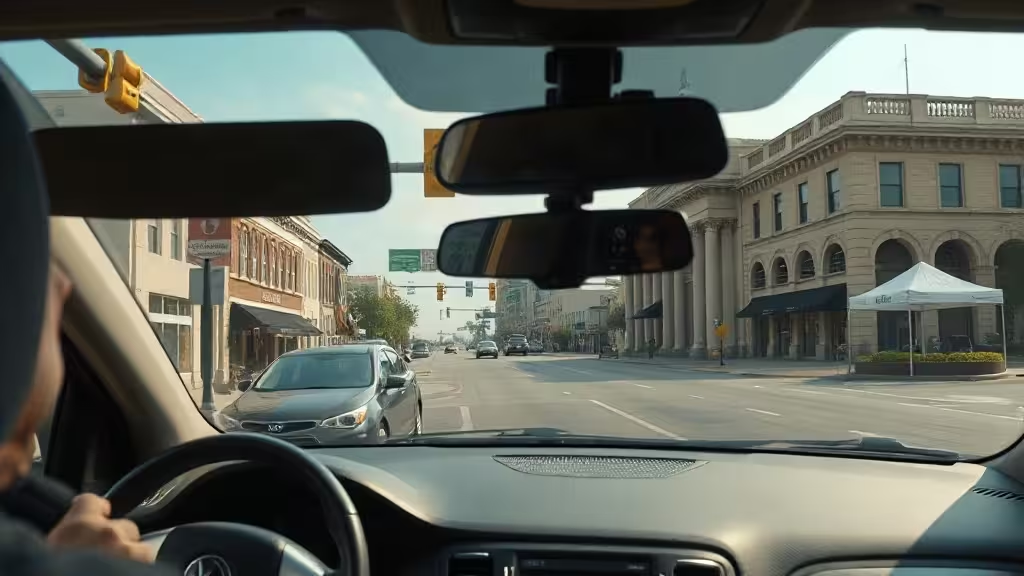
The clear-view test under § 32-5-215(a)
The 2025 text of Alabama Code § 32-5-215(a) bars driving with nontransparent material on the windshield or specified windows when that material obstructs the driver’s clear view of the highway or an intersecting highway.
The key word is obstructs. The statute runs a functional test: what does the equipment actually block from the driver’s position?
Why no mounting position is automatically lawful
The statute does not declare the dashboard, the area behind the rearview mirror, or a windshield corner universally lawful. It also does not say that every windshield attachment violates Alabama law.
Check the whole installation, not just the lens: the camera body, the suction cup, the adhesive pad, the bracket, the hanging cable. A small camera can still block part of the road depending on the windshield, the seat height, and the mounting angle.
A dashboard installation may reduce the risk of blocking the windshield. The statutory question does not change: does the setup obstruct the driver’s clear view? Test the highway, the intersections, the pedestrians, and the cross traffic from the normal driving position.
How the 2017 GPS ruling informs dash-cam placement
In United States v. Joel Vazquez Lopez, Criminal No. 16-0235-WS, the U.S. District Court for the Southern District of Alabama dealt with a device mounted high near the center of a windshield. The court’s January 25, 2017 suppression order found that the GPS or phone obstructed the driver’s view and fell within § 32-5-215(a).
That ruling involved an obstructing GPS, not a dash cam. It supports applying the same clear-view test to a camera and its hardware. It does not create a categorical ban on windshield-mounted electronics.
Audio Recording Rules for Alabama Dash Cams
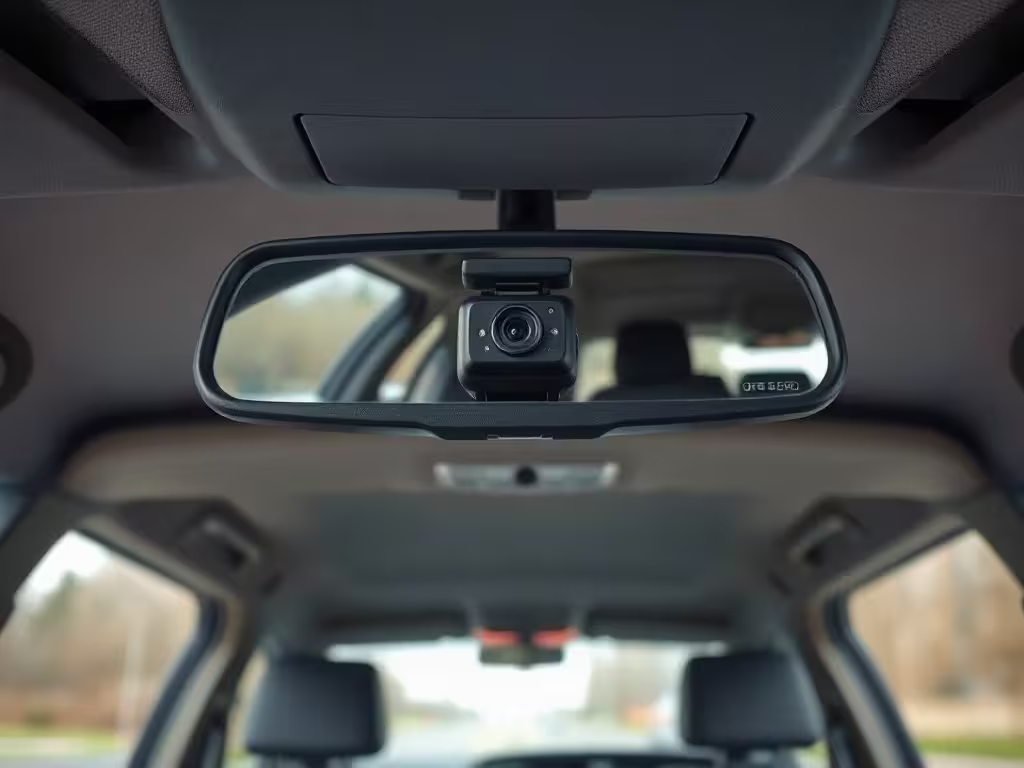
Video and audio require separate legal analysis. A camera may lawfully face a public road while its microphone captures a private conversation inside the vehicle.
Alabama Code §§ 13A-11-30(1) and 13A-11-31 govern criminal eavesdropping. The Alabama Judicial System’s official instruction defines eavesdropping as recording or otherwise intercepting the private communication of others without consent from at least one participant, and the offense requires intentional use of a device.
When the driver is part of the conversation
A participating driver may supply the consent required by Alabama’s one-party consent rule. That does not settle whether another state’s law applies when the conversation crosses state lines. It also does not answer every question about disclosure or later publication.
If the facts span states or involve sensitive communications, consult a civil-rights attorney in your state before relying on the one-party rule.
When no recorded participant has consented
An unattended dash cam cannot borrow consent from an owner who is absent from the conversation. When the device intentionally records a private discussion among other people, at least one person engaged in that discussion must consent unless another legal exception applies.
Turning off cabin audio can prevent that issue when no participating person will monitor the recording. Confirm what the camera does in parking mode, too.
Privacy inside a vehicle depends on the circumstances
A closed vehicle can support an expectation of privacy. That does not make every conversation inside every vehicle private. The setting, the speakers, the volume, the access, and the method of recording all matter.
The brief identified Hudson v. Hudson, 534 So. 2d 617 (Ala. Civ. App. 1988), a federal Title III dispute involving a voice-activated recorder hidden in an automobile without the occupants’ knowledge. We have omitted a case-specific legal analysis because the supplied links do not meet this article’s primary-source linking requirement.
DashOne Pro’s merchant page is the live source for its current offer. Any price, shipping term, package description, or return condition shown there comes from the merchant and should be checked through the editor-supplied /v/ link immediately before purchase. Audit Faction has not independently tested those claims.
Match the camera to the recording rules
Review the current package, then confirm mounting and audio rules before recording in your state.
Privacy limits on Alabama dash-cam video
Public roads and publicly accessible places
Ordinary outward recording on a public road generally lacks the statutory elements of Alabama criminal surveillance. Alabama Code §§ 13A-11-30 and 13A-11-32 define surveillance as secret observation undertaken to spy on and invade another person’s privacy, and the offense requires intentional surveillance while trespassing in a private place.
A private place excludes an area open to the public or to a substantial group. So a dash cam capturing vehicles, buildings, and people visible from the public roadway raises a different question than a hidden camera placed inside a restricted space.
Trespassing and secret observation in a private place
Under § 13A-11-32, criminal surveillance requires:
- intentional surveillance;
- conduct while trespassing; and
- a private place.
Entering or remaining on property without authorization to conduct secret observation can supply elements that routine road footage lacks. Mounting a camera on someone else’s private property raises issues that recording through your own windshield on a public street does not.
Separate rules for deliberately invasive recording
Alabama also addresses narrower conduct. Section 13A-11-33 concerns intentionally installing an eavesdropping device in a private place without permission from the owner and any lessee, tenant, or guest for hire.
Aggravated criminal surveillance under § 13A-11-32.1 requires intentional surveillance without prior consent where the observed person reasonably expects privacy, coupled with a sexual-gratification purpose. First-degree voyeurism under § 13A-11-41 likewise targets specified nonconsensual filming of intimate areas for sexual gratification.
Those elements should not be attached to incidental road video. They matter when the placement, the subject, the purpose, and the expectation of privacy turn the recording into deliberately invasive conduct.
Can Alabama dash-cam footage be used as evidence?
Dash-cam footage may be offered in an Alabama insurance claim or court proceeding, but admission is not automatic. The proponent must establish that the recording is what the proponent claims it is, and other objections may still apply.
Authentication under Alabama Rule of Evidence 901
Alabama Rule of Evidence 901 requires sufficient evidence to support a finding that the item is what its proponent claims. The rule lists testimony from a knowledgeable witness and evidence describing a reliable process or system among the possible methods.
For dash-cam evidence, the foundation may address:
- which camera made the recording;
- whether the system operated correctly;
- when and where the file originated;
- whether anyone changed, added, or deleted content;
- how the file was preserved and copied; and
- who or what appears in the recording.
Why authentication does not settle every objection
Rule 901 clears the authentication threshold and nothing more. Relevance, hearsay, completeness, and other evidentiary rules can still keep some or all of a recording out.
An insurer may also weigh footage without a court formally admitting it. How much weight the file gets depends on whether it clearly shows the event and whether anyone can check its origin and integrity.
What the 2026 federal crash case illustrates
In White v. Pro Transport Savannah, Inc., No. 2:25-cv-00128, the U.S. District Court for the Northern District of Alabama considered dash-cam frames and an expert’s review during civil crash litigation. The camera captured one frame per second before, during, and after the collision.
The May 18, 2026 decision shows that dash-cam images can enter the factual record of an Alabama crash case. It does not hold that every recording automatically qualifies for admission or proves liability.
Who can obtain the recording after a crash or dispute?
A police officer, insurer, or opposing party does not gain automatic access merely because a camera recorded an incident. Access may arise through the owner’s consent or a documented legal process.
Consent and insurance requests
You may voluntarily send footage to an insurer, attorney, or investigator. Before you do, preserve the original and understand that the recording may contain material that helps or hurts your position.
A request from an insurer is not itself a court order. Policy terms and claim duties can affect whether refusal carries contractual consequences, so obtain advice about a disputed request before deleting, editing, or selectively producing a file.
Civil discovery and subpoenas
Alabama Rule of Civil Procedure 34 lets a party request electronically stored images and recordings within another party’s possession, custody, or control and within the permissible discovery scope. Objections and court orders can shape production.
Rule 45 permits a subpoena for electronically stored information held by a nonparty. Notice, objections, protections against undue burden, and other procedural requirements may limit or delay production.
Search warrants in criminal investigations
Under Alabama Rule of Criminal Procedure 3.8, law enforcement may seek a search warrant when probable cause supports believing that the property constitutes, or will constitute, evidence of an Alabama offense.
The probable-cause requirement is the point. An officer’s interest in a recording does not, by itself, erase the rules governing warrants or other lawful seizure.
How to preserve dash-cam footage for an Alabama claim
Move quickly when a collision or disputed stop occurs. Many cameras write over older files during routine operation, so continued use may erase the segment you need.
Protect the original before the camera overwrites it
Follow this sequence:
- Stop routine overwriting when litigation or a claim becomes foreseeable.
- Retain the original recording on its original storage medium.
- Make a separate working copy without modifying the source.
- Preserve the period before and after the event, not only a shortened clip.
- Record the date, time, device, storage card, and steps used to copy the file.
Do not trim, enhance, relabel, or export over the only original.
Preserve metadata and document each copy
Keep creation dates, timestamps, location data, and other available metadata intact. Note whether the camera clock matched the actual time, and document any known discrepancy rather than correcting the original file.
In Powell v. State, decided May 3, 2024, the Alabama Court of Criminal Appeals described the silent-witness foundation for recordings. Relevant points include the reliability of the recording process, the correctness of the result, the absence of changes, and the manner of preservation.
A witness who directly saw the recorded event may support a different pictorial-communication foundation. Either route benefits from an untouched source file.
Keep a record of access and avoid alterations
Write down who removed the storage card, who copied the file, where each copy went, and whether anyone played or processed it. That record helps explain the chain of custody.
In Russell v. East Alabama Health Care Authority, decided August 21, 2015, the Alabama Court of Civil Appeals distinguished purposeful or wrongful destruction of known relevant evidence from merely negligent routine overwriting. Once you reasonably foresee a dispute, preserving the recording cuts down on evidentiary gaps and on spoliation arguments.
DashOne Pro offer: what the merchant asks buyers to verify
Current merchant price and shipping
The DashOne Pro merchant page is the live place to check the current price and shipping terms. The editor reviewed that page on October 13, 2026, but those details can change.
The approved CTA must use Audit Faction’s existing /v/ cloaked link. No slug was supplied with this brief, so the editor must insert and verify it before publication.
Merchant-listed package contents and return terms
Check the same merchant page for the package contents and current return terms. Treat each description as a merchant claim and save a copy of the terms that apply when you order.
What Audit Faction has not independently tested
Audit Faction has not independently tested DashOne Pro. We make no independent claim about its image quality, recording reliability, storage behavior, durability, warranty, or legal suitability.
Before you buy
Verify the package before you rely on it
- Confirm what the current package includes
- Check shipping and return terms
- Test storage and footage retrieval after delivery
Keep the camera and every piece of mounting hardware outside the driver’s clear field of view
Keep the camera and every piece of mounting hardware outside the driver’s clear field of view. Alabama law applies an actual-obstruction standard. It does not guarantee a particular windshield corner or the space behind the mirror.
Handle the microphone separately. A participating driver can generally provide one-party consent for a private conversation, while an unattended camera recording other speakers may lack any consenting participant.
After a crash or disputed encounter, lock the relevant file. Preserve the original medium and metadata, make a documented copy, and record who handled it. If the footage enters litigation, expect questions about authentication and a discovery request, subpoena, warrant, or other lawful process.
A lawful dash cam becomes useful evidence only when its placement, audio settings, and original files withstand scrutiny after the drive ends. Consult an Alabama civil-rights or evidence attorney when a specific recording, disclosure request, or multistate conversation raises doubt.
Related reading on Audit Faction
No verified Audit Faction URLs were supplied for this block. Before publication, the editor should add three to five confirmed internal links covering civilian recording, dash-cam evidence, recording traffic stops, or preserving digital evidence. Targets should not be invented.
This post may contain affiliate links. If you click them, I might earn a small commission (it costs you nothing and helps me keep shipping quality articles every day for your reading pleasure).