
Table of Contents
TL;DR
- New York dash cam laws do not expressly prohibit private drivers from using forward-facing or cabin-facing cameras.
- A mount cannot obstruct the driver’s windshield view or prevent a clear and full rearward view.
- In-car audio turns on who records the conversation, who participates, and whether the recorder is present.
- Relevant, authenticated footage may reach a New York court.
New York dash cam laws let private drivers record the road, but that answer carries three separate limits. Where you mount the camera, whether it captures conversations, and what you do with a file after an incident each trigger a different legal question.
New York regulates installation through general vehicle-equipment law rather than a statute that expressly approves or bans private dash cams. An exposed license plate also lacks a reasonable expectation of privacy under a narrower search-and-seizure ruling, but that case does not settle every privacy issue involving identifiable people or later publication.
The documented New York rules address mounting, audio, privacy, and evidence, but the reviewed authorities do not settle every legal consequence of ordinary roadway video.
New York Dash Cam Rules
Informations générales sur les new york dash cam laws, et non avis juridique. Les circonstances, les règles locales et les lois d’un autre État peuvent modifier l’analyse.
DashOne Pro Offer After the Legal Answer
You can check the current DashOne Pro offer for the live price, shipping, package contents, and return terms. Those details come from the merchant and may change.
Audit Faction has not independently tested this camera. Any feature shown on the linked page remains a merchant claim, not our test result.
New York Dash Cam Laws for Private Drivers and New York City
What state law regulates
New York does not expressly classify private dash cams as prohibited equipment. Instead, Vehicle and Traffic Law § 375 regulates how equipment affects the driver’s view while a motor vehicle operates on a public highway.
That distinction matters. The camera itself does not trigger the central mounting rule. Its position does.
What the available sources establish about New York City
Vehicle and Traffic Law § 1604 generally blocks local rules that conflict with state rules governing motor-vehicle use on public highways. It also preserves local authority to license and regulate vehicles offered to the public for hire.
The sources reviewed do not identify a New York City rule aimed expressly at dash cams used by private drivers. They also do not prove that no authorized city rule could apply in a particular setting. Taxi, limousine, and other for-hire operators should check the rules tied to their vehicle class and license.
Roadway video, identifiable people, vehicles, and exposed license plates
Ordinary roadway video will often capture faces, vehicles, storefronts, and license plates.
In People v. Bushey (2017), the New York Court of Appeals held that a driver had no reasonable expectation of privacy in an exposed license plate number. The decision addressed constitutional search and associated DMV information, so it should not be stretched into a blanket ruling on every collection, publication, or commercial use of roadway video.
Limits of People v. Bushey and Penal Law § 250.45
Penal Law § 250.45 targets specified forms of unlawful surveillance, including surreptitious recording in bedrooms, changing rooms, restrooms, hotel rooms, and other circumstances defined in the statute. It does not declare that every person appearing in routine street footage must consent.
Context still controls. A road-facing camera and a camera aimed surreptitiously into a private setting raise different legal questions, even if both devices sit inside a vehicle.
Where New York Drivers May Mount a Dash Cam
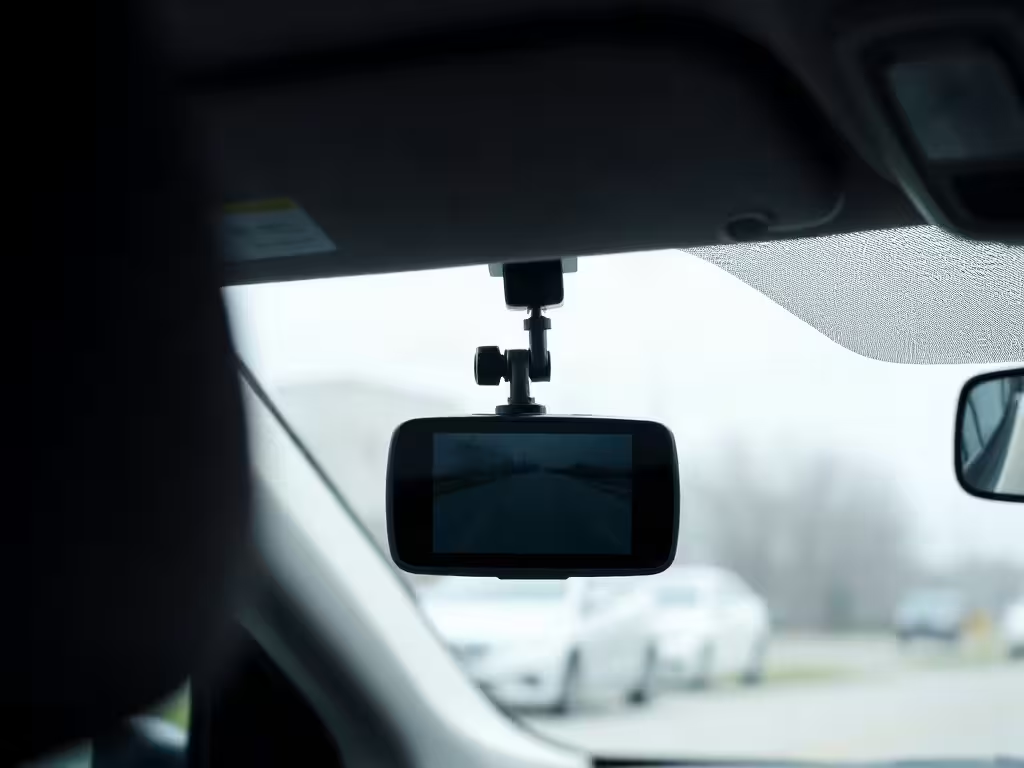
The obstruction test under Vehicle and Traffic Law § 375(30)
Section 375(30) prohibits operating a vehicle with an object positioned in a way that:
- Obstructs or interferes with the operator’s view through the windshield; or
- Prevents a clear and full view of the road and traffic behind the vehicle.
A windshield, dashboard, mirror-area, or other interior mount can violate the rule if its actual position causes either effect. The statute focuses on the resulting obstruction.
Why New York law does not name a universally safe mounting spot
Section 375(30) supplies no dash-cam safe harbor based on a particular corner, distance, or height. A location that leaves a clear view in one vehicle may block sightlines in another because windshield dimensions, mirror placement, camera size, and seating position vary.
Before driving, sit in your normal position and check the full windshield and rearward view. Keep the camera body, screen, cable, adhesive pad, and hanging wire out of both sightlines.
The secondary-enforcement limit on a § 375(30) summons
A summons under § 375(30) may issue only when there is reasonable cause to believe the driver committed another violation of New York law. That limits enforcement of this subdivision, but it does not make an obstructing mount lawful.
Dash-Cam Screens, Traffic Charges, and Maximum First-Offense Penalties
The unresolved status of an ordinary dash-cam preview screen
Section 375(24) prohibits operating a vehicle on a public highway with a television receiving set operating within the driver’s view or located within that view. The reviewed authority does not decide whether every ordinary dash-cam preview screen fits that statutory term.
Device design and use could affect the analysis. Turning off a live display while the vehicle moves reduces distraction and avoids treating an unresolved classification question as settled law.
DMV charge codes for visible screens and obstructed views
The New York DMV traffic charge table separately lists:
- VTL 375(24), “UNLAWFUL USE OF TV RECEIVING SET”; and
- VTL 375(30), “DRIVERS VIEW OBSTRUCTED.”
The charge table confirms that both provisions have traffic-violation codes. It does not decide whether a particular dash-cam display qualifies under § 375(24), and it does not state the fine assessed in an individual case.
What the default penalty statute allows
When the Vehicle and Traffic Law supplies no different penalty, § 1800 sets the first-conviction ceiling at a fine of up to $150, imprisonment for up to 15 days, or both. Later convictions within the statutory period carry higher maximums.
That is a statutory ceiling, not a prediction of the sentence or fine in a particular case.
Audio Recording Rules for New York Dash Cams
When the driver is present and participating
Under Penal Law § 250.00, “mechanical overhearing of a conversation” requires recording without at least one party’s consent by a person who is not present.
A driver who remains present and participates in the conversation does not fall within that definition merely because every passenger received no notice. That conclusion addresses this New York criminal definition. It does not settle another state’s law, an employment policy, a contract, or legal questions created by later use or publication.
When the dash-cam owner is absent
The analysis changes when an unattended camera records occupants while its owner is away. To avoid satisfying the quoted mechanical-overhearing definition, at least one actual party to the conversation must consent.
Ownership of the camera does not make its absent owner a party to a conversation. For cross-border travel or fact patterns involving confidential, workplace, or professional communications, consult a civil-rights attorney in your state.
Passenger notice as a privacy precaution rather than the stated statutory threshold
Penal Law § 250.00 states a one-party consent threshold for the defined conduct. It does not require notice to every passenger when the present recorder participates in the conversation.
Giving clear notice can still prevent disputes and respect passenger privacy. That precaution should not be confused with a universal all-party-consent requirement under the cited New York provision.
Class E felony exposure and exclusion under CPLR § 4506
A person commits eavesdropping under Penal Law § 250.05 by unlawfully engaging in wiretapping, mechanical overhearing, or interception or access of an electronic communication. The offense is a class E felony.
CPLR § 4506 generally bars communications obtained through conduct constituting criminal eavesdropping from New York trials, hearings, grand-jury proceedings, and proceedings before state or local bodies. The statute contains an exception for a proceeding against the person who committed or allegedly committed the eavesdropping.
Check the Current DashOne Pro Package and Terms
Before purchasing, review the live DashOne Pro terms. Confirm the current price, shipping terms, package contents, and return conditions directly with the merchant.
The linked page describes the seller’s offer. Audit Faction has not documented an independent product test, so any listed feature remains the merchant’s representation.
Can New York Dash-Cam Footage Be Used as Evidence?
Relevant dash-cam footage may be considered when it is properly authenticated. Authentication alone does not settle hearsay, completeness, unlawfully captured audio, unfair-prejudice concerns, or other objections.
Relevance and authentication
The 2026 Guide to New York Evidence states that a trial judge may admit a relevant video after proper authentication. Admission remains within the judge’s discretion.
In West v. Callender (2026), the court explained that a witness or videographer may authenticate dash-cam video by testifying that it shows what the person saw and was not altered or edited. Other testimony, including expert testimony, may establish that the video accurately depicts what stood before the camera.
Witness, equipment, expert, and chain-of-custody methods
New York’s evidence guide identifies several possible foundations:
- Testimony from a witness to the recorded events;
- Testimony from an operator, installer, or equipment maintainer;
- Expert or other testimony establishing an accurate depiction; or
- A witness plus other evidence demonstrating accuracy.
A chain of custody can support authenticity and integrity. Within reasonable limits, people who handled the file may identify it and testify about custody and unchanged condition. These methods are illustrative rather than exclusive.
Civil discovery and voluntary delivery to police
In Cupeles v. Carballosa (2022), defendants produced dash-cam footage after the plaintiff’s discovery demands in litigation arising from a Cross Bronx Expressway crash. Both sides relied on the recording, so authenticity and admissibility were not disputed there.
In People v. Wisneski (2026), a complainant voluntarily gave private dash-cam footage to police, and a detective used it during the investigation. That decision illustrates voluntary delivery and investigative use. It does not create a universal duty to surrender footage whenever an officer asks.
The reviewed sources do not separately establish special standards for an insurance adjustment or every traffic-court proceeding.
Why use in an investigation does not guarantee admission at trial
Investigators may review a recording that a court later excludes or limits. Trial use still depends on relevance, authentication, evidentiary objections, and any issue with the audio.
A video can also reach court without its sound. New York’s evidence guide states that audio is not required for a video to qualify for admission.
How to Preserve Dash-Cam Footage Without Overstating the Law
When a preservation obligation may arise
An incident alone does not create a universal retention duty. New York spoliation sanctions require proof that the controlling party had an obligation to preserve the evidence when it was destroyed, acted with a culpable state of mind, and destroyed material relevant to a claim or defense.
A duty may arise when litigation is pending or reasonably anticipated, or when you receive notice of a specific claim. If a crash, arrest, insurance dispute, or civil claim may produce litigation, preserve the recording promptly and obtain fact-specific advice.
Why the native file and metadata can matter
Keep the native file rather than relying only on a clipped, compressed, or social-media copy. Avoid renaming, editing, or exporting over the original.
In LaBuda v. LaBuda (2019), loss of a phone prevented examination of metadata and whether other photographs or videos existed. A separate body-worn-camera decision, People v. Rodriguez (2024), described metadata as automatically generated information about creation or modification and explained its possible relevance when authenticity, access, or receipt dates are disputed. That police-discovery case does not impose a universal private dash-cam protocol, but it shows why metadata may matter.
Continuity, surrounding footage, and chain of custody
A sound preservation routine follows the evidence rather than an invented statutory checklist:
- Stop the device from overwriting the event.
- Retain the native file and, when practical, the original storage medium.
- Preserve relevant footage before and after the incident.
- Make a working copy without modifying the source.
- Record who copied, received, or handled each version.
New York permits an authenticated compilation when the court has no reason to find it incomplete or unsatisfactory. Keeping surrounding footage helps answer completeness questions, though the reviewed authorities prescribe no universal number of minutes.
What the sources do not establish about informal requests or retention periods
The authorities reviewed do not set a universal dash-cam retention period. They also do not establish that every informal request from an insurer or police agency compels production.
A discovery demand in filed litigation, a subpoena, and a court order present different questions from an informal request. The available sources do not supply a complete procedure for each, so seek New York counsel before deleting, withholding, or producing disputed footage.
How Your Own Dash-Cam Recording Can Be Used Against You
Speed and roadway position
A recording captures more than another driver’s conduct. It may show your lane position, following distance, traffic signal, reaction time, and any speed displayed by the camera system.
In Ezzi v. Domino’s Pizza LLC (2021), a split-screen recording showed the cab, the roadway ahead, sound, and the vehicle’s displayed speed. The court used that evidence when assessing the recording driver’s conduct.
Cabin conduct and off-road glances
The Ezzi court also examined two off-road glances totaling about 2 to 2.5 seconds within a roughly 12-second video. That was a case-specific assessment, not a general rule that every glance proves distraction or fault.
Cabin footage may capture phone use, hand position, seat-belt use, fatigue, or attention. Whether any recorded act carries legal weight depends on the surrounding facts and the issues before the court.
Statements captured by the microphone
Audio may preserve admissions, warnings, timing cues, or passenger statements. It may also record language that damages the owner’s position.
Before relying on the sound, confirm that it was captured lawfully and consider hearsay or other evidentiary limits. Helpful video does not cure unlawful or inadmissible audio.
Verify the DashOne Pro Offer Before Buying
Verify the current DashOne Pro offer with the merchant before placing an order. Check the live price, shipping, included items, and return terms rather than relying on an earlier description.
Those terms and any product features shown there are merchant representations. No independent Audit Faction test is documented.
Key takeaways
Run four checks before you drive or preserve a recording:
- Placement: Position the camera, mount, and cable so they do not obstruct the windshield or prevent a clear and full rearward view.
- Screen visibility: Turn off or reposition a live preview that sits within your view, since the reviewed law does not settle whether every dash-cam screen qualifies as a television receiving set.
- Audio: Determine who was present, who participated, and whether at least one actual party consented when the recorder was absent.
- File preservation: When a claim or case is reasonably anticipated, retain the unedited native file, available metadata, surrounding footage, and a record of who handled each copy.
Ask a qualified New York attorney about disputed audio, compelled production, subpoenas, cross-border recording, or a fact-specific preservation duty.
Related reading on Audit Faction
No verified internal Audit Faction titles or URLs were supplied for this article. We have left this block free of invented links so an editor can add three to five confirmed resources covering civilian recording, preserving video evidence, traffic-stop recording, body-camera evidence, or public-record requests.
This post may contain affiliate links. If you click them, I might earn a small commission (it costs you nothing and helps me keep shipping quality articles every day for your reading pleasure).