
Sommaire
TL;DR
- California dash cam laws permit a device that qualifies as a “video event recorder,” subject to narrow windshield-mounting and storage rules.
- The camera, mount, cables, and display cannot obstruct the driver’s clear view, and an operating screen may trigger separate restrictions.
- Recording a confidential conversation requires every party’s consent. A visible passenger notice also applies to a qualifying video event recorder.
- Footage may serve as evidence, but relevance, authentication, completeness, and other evidentiary rules still control admission.
California dash cam laws permit certain recorders, but the device, placement, display, audio settings, and handling of the file all matter. A camera mounted in the wrong corner or left recording a confidential passenger conversation can create legal problems before the footage ever reaches an insurer or courtroom.
We reviewed the cited California statutes and opinions on October 17, 2026. The clearest statutory mounting permission covers a narrowly defined video event recorder, so drivers should not assume that every consumer camera sold as a dash cam falls within that definition.
After checking those rules, readers considering DashOne Pro can review the merchant’s current offer. The merchant supplies the product and package claims. Audit Faction has not independently tested the camera, and buyers should verify that its operation fits California Vehicle Code §26708.
Check DashOne Pro before deciding
California dash cam laws: Are dash cams legal in 2026?
Yes, California Vehicle Code §26708 expressly permits a qualifying video event recorder in designated windshield zones. The permission covers a device that continuously loops audio, video, and G-force data but saves video only after a qualifying trigger or driver activation, with strict event-storage limits. It does not automatically cover every consumer dash cam.
What California means by a video event recorder
The definition in California Vehicle Code §26708 controls this particular windshield exception. The device must continuously record audio, video, and G-force levels in a digital loop while monitoring driver performance to improve safety.
That definition is narrower than the ordinary retail meaning of “dash cam.” A product name or merchant category cannot establish statutory compliance.
The triggering and 30-second storage limits
The qualifying recorder saves video when unusual motion or a crash triggers it, or when the driver activates it to monitor driver performance. Section 26708 limits storage to no more than 30 seconds before and 30 seconds after the triggering event.
A continuously saved trip archive may operate differently. The available authority does not establish that such a camera receives the same windshield exception.
Why legality depends on installation and operation
A qualifying device can still violate other rules if it blocks the driver’s view, sits outside an authorized zone, or runs a prohibited display. Audio recording brings Penal Code §632 into the analysis.
Compliance therefore turns on what the camera does and how you use it.
Where California dash cam mounting rules allow a recorder
Section 26708 identifies three windshield zones for a qualifying recorder.
| Permitted zone | Maximum statutory area | Additional condition |
|---|---|---|
| Lower corner farthest from the driver | 7-inch square | Must remain within that corner zone |
| Lower corner nearest the driver | 5-inch square | Must sit outside an airbag deployment zone |
| Uppermost center of the interior windshield | 5-inch square | Must remain at the uppermost center |
These measurements describe permitted square areas. The text supplied for review does not explain whether every projecting edge of a bracket, suction cup, or adjustment arm counts when measuring the mount.
Lower corner farthest from the driver
For a left-hand-drive vehicle, this generally points to the lower passenger-side corner. The statute grants a 7-inch-square zone there, but the general clear-view rule still applies.
Lower corner nearest the driver
The driver-side lower corner receives a smaller 5-inch-square zone. The device must also remain outside the airbag deployment area.
Check the vehicle manual before installing hardware near a pillar or dashboard airbag. Section 26708 does not map those deployment zones for each model.
Uppermost center of the windshield
A qualifying recorder may occupy a 5-inch square at the uppermost center of the interior windshield. A low-hanging camera or loose cable can still reduce the driver’s view even when the attachment point sits inside that area.
What the statute does not say about measuring mounts
The reviewed text does not state where measurement begins or whether protruding hardware must fit entirely within the square. It also does not create separate dimensions for a camera body, adhesive pad, cable clip, or suction cup.
Keep the whole assembly inside the chosen zone where possible. That is a cautious installation practice, not a measurement rule expressly stated in the cited text.
California visibility and screen rules still apply
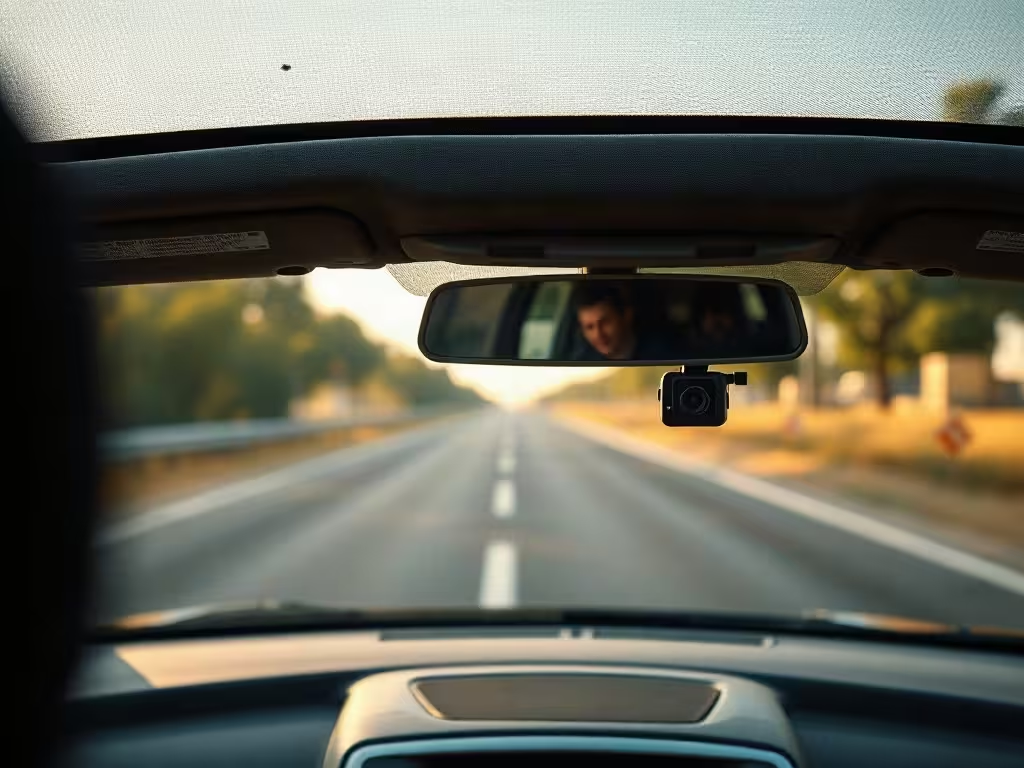
Keep the windshield and side-window view clear
Vehicle Code §26708 separately bars driving with an object or material placed in or on the vehicle when it obstructs or reduces the driver’s clear view through the windshield or side windows.
That rule can reach more than the lens. A mount, power cable, dangling connector, or screen may reduce visibility, although the statute does not prescribe component-specific dash cam standards.
When an operating screen may create a separate issue
Vehicle Code §27602 generally restricts an operating television, video monitor, or similar display that shows entertainment or business video within the driver’s view while the vehicle moves. The statute lists exceptions, including a display that supplements the driver’s view for maneuvering.
A live rear or side view may fit an exception depending on its function. The reviewed source does not establish that every dash cam preview screen qualifies, so switching off a nonessential display while driving reduces that risk.
What a noncompliant California dash cam installation may cost
A noncompliant windshield installation can lead to a traffic citation. The court schedules reviewed list a base fine for the cited violations of Vehicle Code §26708.
The final amount is not uniform across the 2026 county schedules reviewed. Those are county examples, not a single statewide total.
Court assessments and the applicable schedule can change what a cited driver must pay.
Audio Recording Rules for California Dash Cams
California Penal Code §632 prohibits intentionally recording a confidential communication without the consent of every party. A first violation can bring a fine of up to $2,500, imprisonment for up to one year in county jail or state prison, or both, subject to the statute’s terms and exceptions.
Material obtained through a violation is generally inadmissible outside an action or prosecution concerning the unlawful recording itself.
When a conversation is confidential
A communication qualifies as confidential when the circumstances reasonably indicate that a participant wants it confined to the people involved. A private conversation between occupants can meet that standard even though it takes place inside a moving vehicle.
The rule turns on the circumstances. The label “two-party consent state” can obscure that required analysis because §632 requires all-party consent only for a confidential communication within the statute.
Why public sound is not automatically treated the same way
Section 632 excludes communications made at public gatherings and in circumstances where participants may reasonably expect to be overheard or recorded. That means the statute does not automatically treat all street noise, horns, or speech captured through an open window as confidential.
Context still controls. The available sources do not settle every mixture of public sound and an occupant’s private conversation.
The visible passenger-notice requirement
A vehicle equipped with a §26708 video event recorder must carry a notice in a visible location stating that a passenger’s conversation may be recorded. The statute does not prescribe a sticker size or fuller script.
The notice applies to passengers generally. Post it where an entering or seated passenger can see it.
Why notice does not replace consent when §632 applies
Section 26708 requires notice, while Penal Code §632 requires every party’s consent when an intentionally recorded communication is confidential. The cited provisions do not say that posting the notice alone supplies that consent.
Treat them as separate duties.
The safer practical choice when consent is uncertain
Disable audio before recording occupants unless every participant has consented to recording a confidential conversation. For a rideshare trip, rental arrangement, employee vehicle, or other fact-specific setting, consult a California civil-rights attorney rather than relying on a generic recording notice.
Once the audio setting fits those rules, readers can check the DashOne Pro merchant page for the current package description. The merchant’s page, not an independent Audit Faction test, supplies any claim about the camera’s recording functions.
Match the camera to the recording rules
Review the current package, then confirm mounting and audio rules before recording in your state.
California dash cam video and reasonable expectations of privacy
California’s visual-privacy statutes address narrower conduct than routine forward-facing roadway recording. They do not supply a blanket rule covering every scene visible from a public road.
Secret recording in bedrooms, bathrooms, and similar private areas
Penal Code §647 reaches specified secret camera recording of an identifiable person in a bedroom, bathroom, changing room, fitting room, dressing room, tanning booth, or another place where that person reasonably expects privacy. The cited offense also requires the statutory purpose and intent to invade privacy.
An ordinary road view presents different facts. A camera pointed into a private space may not.
Trespass and device-assisted intrusion into private activity
The Civil Code can impose liability when a person knowingly trespasses to capture private, personal, or familial activity in a manner offensive to a reasonable person. It also addresses certain device-assisted captures that could not have occurred without trespass absent the device.
The provision turns on private activity, intrusion, the device’s role, and offensiveness. Merely owning a dash cam does not answer those questions.
Limits of the available authority on ordinary public video
The reviewed authorities do not establish a complete public-versus-private rule for every outward-facing recording. They also do not resolve every issue involving publication of identifiable passengers, bystanders, homes, or license plates.
Assess the location and circumstances before publishing sensitive footage. Seek legal advice when the recording exposes private activity or creates a plausible privacy claim.
How California dash cam rules differ by vehicle and camera type
The statutes draw several limited distinctions, but the available sources do not produce a complete rulebook for private cars, rentals, rideshare vehicles, and fleets.
Registered owners and lessees
Section 26708 assigns the recorded data to the vehicle’s registered owner or lessee. That person may disable the recorder.
The reference to a lessee covers leased vehicles within the provision. It does not, by itself, settle every contractual or privacy issue involving a short-term rental car.
Employees driving for hire
When an employee drives for hire in a vehicle fitted with a video event recorder, the employer must provide an unedited copy of the recordings after a request from the employee or the employee’s representative. The copy must arrive free of charge within five days.
That rule depends on an employment relationship. The reviewed authority does not establish that every app-based driver counts as an employee.
Specified commercial vehicles
Section 26708 contains another mounting pathway for federally defined vehicle-safety technology installed on specified California commercial vehicles. The technology must comply with the cross-referenced federal rule, and the pathway applies only to the cross-referenced vehicle classes.
A private passenger-car installation cannot borrow that exception without meeting its terms.
Manufacturer-included cabin cameras
The California Business and Professions Code governs certain cameras included by a vehicle manufacturer that can record inside the cabin. Within that chapter, recordings cannot be sold or used for advertising, and third-party sharing, off-vehicle retention, or access generally requires affirmative prior consent or a statutory exception.
A consent-based recipient must stay within the consented purpose, refrain from retransmitting the material, and retain it no longer than reasonably necessary. After consent is revoked, covered recordings outside the vehicle must be deleted as soon as practicable and no later than 30 days.
That chapter does not establish equivalent duties for an ordinary aftermarket camera. Its definition covers a manufacturer-included cabin camera, and the chapter excludes cameras installed in vehicles used primarily for specified commercial purposes.
What remains unverified for rental and rideshare vehicles
The reviewed sources do not establish a complete comparison among personally owned cars, short-term rental cars, rideshare vehicles, and fleets. Contract terms, employment status, the camera’s manufacturer-installed or aftermarket character, and whether it records the cabin can change the analysis.
Do not treat a rule for one category as a universal fleet or rideshare rule.
Can California dash cam footage be used as evidence?
Yes. Dash cam footage may be offered in a California proceeding, but its existence does not make it automatically admissible. The proponent must establish relevance and authentication, satisfy original-or-permitted-secondary-evidence requirements, and overcome any independent ground for exclusion.
Authentication and what the recording claims to show
In People v. Goldsmith (2014), the California Supreme Court described photographs and video recordings with imprinted data as writings under the Evidence Code. Authentication requires enough evidence to support a finding that the recording is what its proponent claims.
A witness can testify that the video fairly and accurately depicts the scene. Circumstances, contents, and location may also authenticate a recording.
Original recordings and admissible secondary evidence
A party generally needs the original writing or secondary evidence that the Evidence Code permits. Preserve the native file when an incident may lead to a claim, citation, criminal case, or civil lawsuit.
Exporting a viewing copy need not replace the source file.
Timestamps, context, and witness testimony
Goldsmith addressed automated enforcement images, video, timestamps, and related data. Its general authentication principles show why a timestamp can support a record but does not authenticate every detail by itself.
Keep the surrounding footage, file information, and any account of how the camera created and stored the recording. These steps may strengthen authentication, though the cited authorities do not impose them as universal statutory duties for aftermarket cameras.
Completeness and selective editing
In Malinowski v. Martin (2024), the California Court of Appeal upheld exclusion where an incomplete and selectively edited record contributed to the trial court’s concerns under Evidence Code §352.
The decision does not make every edited clip inadmissible. It shows why missing context and selective cuts can weaken the usefulness of dash cam evidence.
When police, courts, or opposing parties may obtain dash cam footage

Government access, consent, warrants, and listed exceptions
The California Penal Code generally regulates government access to electronic-device information. Access through physical interaction or electronic communication ordinarily requires a warrant, an authorized possessor’s specific consent, or another listed route.
One listed exception covers a good-faith emergency involving danger of death or serious physical injury. The statute contains other conditions and exceptions, so its full text matters in a particular investigation.
Civil subpoenas and document demands
Under California Code of Civil Procedure §1985, a subpoena may require a witness to produce documents, electronically stored information, or other things within that witness’s control. A pretrial subpoena duces tecum carries requirements concerning good cause, specificity, and materiality.
Courts can enforce valid demands. Objections and protective procedures may still apply.
Discovery requests for electronically stored information
A party to a California civil action may demand inspection or copying of relevant electronically stored information in another party’s possession, custody, or control. The request must identify individual items or reasonably particularize the requested category, and it may specify a production format.
A dash cam file, related metadata, and stored copies may fall within such a request when the governing discovery rules cover them.
Unresolved questions about insurers and physical seizure
The reviewed sources do not give an insurer an independent power to compel production merely because it handles a claim. An insurer may request footage, but a request differs from a subpoena, court order, or discovery demand.
The sources also do not fully resolve every circumstance in which police may physically seize a camera or storage card. Get fact-specific legal advice before refusing or complying with a disputed demand.
A practical California dash cam compliance check
Separate what the cited law requires from steps that may protect privacy or evidentiary value.
Required before you drive
For a device relying on the §26708 video event recorder exception:
- Confirm that the device actually fits the statutory definition.
- Mount it within one of the three permitted windshield zones.
- Keep the camera, bracket, cables, and screen from reducing the driver’s clear view.
- Keep the driver-side installation outside an airbag deployment zone.
- Do not run a driver-visible video display unless its use fits an applicable exception.
- Post the required passenger-conversation notice in a visible location.
Required before recording confidential occupant audio
Obtain consent from every party before intentionally recording a confidential communication. If you cannot establish consent, turn off audio.
A visible passenger notice satisfies the express notice rule for a qualifying video event recorder. The cited law does not establish that the sign alone supplies every participant’s consent under Penal Code §632.
Optional steps that may preserve evidentiary value
After a crash, traffic stop, or other dispute:
- Preserve the unedited native file.
- Retain available metadata and surrounding footage.
- Make a working copy before clipping or converting the video.
- Record how and when you exported the copy.
- Avoid overwriting the original while a claim or proceeding remains reasonably possible.
These steps can help establish authenticity and context. The cited sources do not impose them as a universal retention protocol.
Sharing and deletion rules the sources do not establish for aftermarket cameras
The reviewed authorities do not create a comprehensive statewide retention, publication, redaction, or deletion rule for every aftermarket dash cam recording that shows passengers, bystanders, or license plates.
Manufacturer-included cabin cameras may fall under the separate statutory chapter described above. For aftermarket footage, privacy, court orders, discovery duties, and the specific recording circumstances may control what you can safely save, publish, or delete.
DashOne Pro offer and compatibility check
What the merchant claims
The DashOne Pro merchant page presents the current camera offer and package details. Those statements remain merchant claims, not independent test findings by Audit Faction.
Readers can view the current DashOne Pro offer. Audit Faction has not independently tested its image quality, recording behavior, storage logic, mount, or California compliance.
What buyers must verify before purchase
Use the merchant page to verify the live price, shipping terms, package contents, and return terms. Also confirm whether the actual device:
- meets California’s narrow video event recorder definition;
- follows the triggering and event-storage conditions;
- fits entirely within an authorized mounting zone;
- can run with audio disabled when consent remains uncertain; and
- can operate without an obstructing or prohibited driver-visible display.
Retail availability does not establish that a particular installation complies with California law.
Before you buy
Verify the package before you rely on it
- Confirm what the current package includes
- Check shipping and return terms
- Test storage and footage retrieval after delivery
Start with the device manual and California Vehicle Code §26708
Start with the device manual and California Vehicle Code §26708. Check the recorder’s actual storage behavior, choose a statutory mounting zone, secure every cable, and shut off any unnecessary screen before driving.
Disable audio when consent to a confidential recording remains uncertain. After an incident, preserve the complete original file and its available metadata because the footage may document conduct by any person involved, including the camera owner.
A lawful setup starts with the statute, while a useful recording depends on context and preservation. Consult a California civil-rights attorney for advice tied to a specific recording, police demand, lawsuit, or publication decision.
Related reading on Audit Faction
Audit Faction has not supplied a verified internal URL inventory for this article. We have therefore left this block free of invented destinations; verified links to the site’s recording, traffic-stop, evidence-preservation, and police-access coverage can be added after their URLs are confirmed.
This post may contain affiliate links. If you click them, I might earn a small commission (it costs you nothing and helps me keep shipping quality articles every day for your reading pleasure).