
Sommaire
TL;DR
- Wisconsin dash cam laws do not expressly authorize or prohibit ordinary private dash cams. Use is conditionally lawful when the installation does not materially block your view and the recording complies with audio law.
- Mount the camera securely outside your sightline. Wisconsin gives private drivers no general size-based safe harbor or automatic exception for devices behind the rearview mirror.
- Wisconsin generally follows one-party consent for protected oral communications, but privacy expectations, interstate travel, and the recording’s purpose can change the analysis.
- After a crash or dispute, save the original file and stop automatic deletion if a claim or lawsuit becomes reasonably likely.
A camera can record the road and still create a legal problem if its mount blocks the windshield or its microphone captures a protected conversation unlawfully. That is the practical answer under wisconsin dash cam laws as reviewed against the cited legal sources on October 16, 2026.
Wisconsin does not appear to have a statute that expressly licenses ordinary private dash cams. Instead, several rules meet at the device: the windshield-obstruction law governs placement, the interception statute governs some audio, and evidence rules govern whether a court can use the resulting file.
The legal question comes first. Dash-cam use in a private vehicle is conditionally lawful as an inference from those rules, provided the installation does not materially obstruct your clear view and the recording itself complies with applicable law.
DashOne Pro appears later in this guide as a merchant offer, not an independently tested recommendation. An affiliate button cannot be inserted until an editor supplies the approved /v/ slug.
Check DashOne Pro before deciding
What Wisconsin Dash Cam Laws Actually Regulate
Wisconsin has no identified statute expressly authorizing ordinary private dash cams. In State v. Houghton (2015), however, the Wisconsin Supreme Court held that Wisconsin law does not ban every object near a windshield. An object violates the provision when it materially obstructs the driver’s clear view, so conditional legality remains an inference rather than express permission.
That distinction matters. Camera operation, physical placement, and audio recording raise separate questions.
Private motorists: no dash-cam-specific permission or prohibition found
The reviewed authorities neither name ordinary private dash cams nor create a permit for them. A private motorist therefore has to work from the rules that regulate visibility, equipment, and recorded communications.
State v. Houghton, Case No. 2013AP1581-CR, decided July 14, 2015, concerned an air freshener and GPS unit. The Wisconsin Supreme Court’s opinion interpreted the obstruction statute, but it did not decide a dash-cam case.
Heavy trucks: Trans 305.34 windshield rules apply
Wisconsin’s administrative windshield provisions also apply to covered heavy trucks. That brings the clear-vision rule into the commercial-vehicle setting, though the available materials do not establish a separate general dash-cam permission for those vehicles.
School buses: a separate forward-facing-camera placement rule
Wisconsin’s school-bus guidance addresses forward-facing windshield cameras directly. It places such a camera no more than two inches below the upper edge of the wiper-swept area, to the right of the bus centerline, and outside the driver’s sightlines to the road, mirrors, signs, and signals.
That rule belongs to the school-bus context. Private motorists should not treat it as a safe harbor for a passenger car.
Law-enforcement vehicles: no complete installation or retention rule established by the available sources
The reviewed sources do not supply a complete Wisconsin rule for mounting, operating, or retaining law-enforcement dash-camera recordings. An unpublished 1997 appellate decision, State v. Netzer, addressed privacy during a recorded traffic stop, but it did not establish a statewide equipment or retention framework.
Where Can You Mount a Dash Cam in Wisconsin?
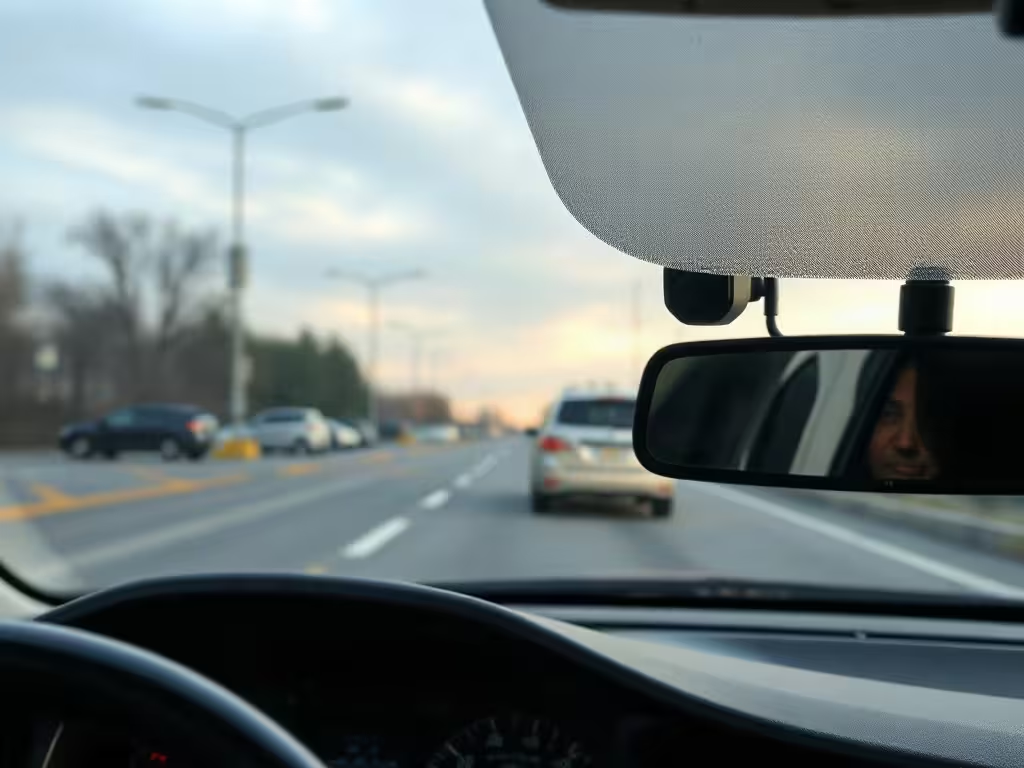
Wisconsin law restricts specified nontransparent material on vehicle windows. It also bars an object placed or suspended in or on a vehicle when that object obstructs the driver’s clear view through the front windshield.
The Wisconsin Supreme Court read the latter provision to require a material obstruction, even when the obstruction is minor. A de minimis object does not automatically violate the statute merely because it sits within the windshield area.
Wisconsin’s administrative rules likewise say nothing may sit or hang in or on the vehicle or windshield so as to obstruct clear vision. A securely mounted camera on the dashboard, outside your sightline and clear of the windshield view, follows conservatively from that rule. No cited authority guarantees that every dashboard position complies.
Why hanging a camera from the rearview mirror is risky
WisDOT’s enforcement FAQ says operating with items hanging from the rearview mirror creates an obstruction-of-view problem. A suspended camera can also swing, occupy more of the sightline during turns, or block a changing portion of the road.
The legal question still turns on material obstruction. The agency guidance nevertheless gives drivers a clear reason to avoid a dangling mount.
Why placement behind the mirror is not automatically exempt
State v. Houghton explains that the law exempts certain government-issued certificates and stickers, not any otherwise prohibited object placed behind the mirror. Wisconsin law supplies no general behind-the-mirror exception for a private dash cam.
A camera hidden from your seated view may reduce obstruction. Its location alone does not settle compliance.
A dashboard position still requires a clear-view assessment
Sit in your normal driving position before fixing the mount. Check the camera body, bracket, power cable, and anything displayed on its screen against your view of the road, traffic signals, pedestrians, and the lower corners of the windshield.
A low dashboard location outside the sightline is the conservative approach supported by the non-obstruction rule. Device size, windshield angle, seating position, and cable routing can change the result from one vehicle to another.
Forfeiture ranges under Wis. Stat. § 346.95
A violation of the windshield-obstruction law may carry a statutory forfeiture, with a higher range for a second or later conviction within one year. Court costs, deposits, or surcharges can increase the amount ultimately paid beyond those statutory ranges.
Audio Recording Rules for Wisconsin Dash Cams
Wis. Stat. § 968.31 generally gives a private person a one-party-consent exception when that person participates in the communication or one participant previously consented. The exception does not cover an interception undertaken to commit a criminal, tortious, or other injurious act.
This does not mean every sound entering a dash-cam microphone receives statutory privacy protection. The communication must fall within the statute’s definition of an oral communication, which turns on whether the speaker actually expected freedom from interception and whether society would recognize that expectation as reasonable.
Why a vehicle interior is not automatically private or public
A closed vehicle may support an expectation of privacy under some circumstances. Other circumstances can defeat it, such as loud speech near open windows or words addressed directly to someone standing beside the vehicle.
The analysis follows the conversation and its setting. The car’s doors do not decide the issue by themselves.
The privacy factors identified in the State v. Duchow annotations
Wisconsin statutory annotations summarizing State v. Duchow identify several nonexclusive considerations:
- How loudly the person spoke
- How close other people stood
- Whether someone could readily repeat the communication
- What the speaker did to protect privacy
- Whether hearing the words required technological enhancement
- Where the communication occurred
No single factor controls. A court considers the total circumstances.
Passengers, employees, and rideshare customers: no category-specific rule established by the available sources
The reviewed authorities do not create separate consent rules solely because the recorded person is a passenger, employee, or rideshare customer. Their participation, notice or consent, privacy expectations, and the recorder’s purpose may matter under the general statute.
Employment policies, platform terms, and other laws may add obligations, but the available sources do not establish those additional rules. If you routinely record customers or workers, consult a civil-rights attorney in your state before leaving the microphone active.
Interstate trips: check the law where the recording occurs
A Wisconsin appellate court separately examined whether a recording made in Michigan was lawful where it occurred and whether Wisconsin law permitted its use in a Wisconsin proceeding. State v. Egerson does not announce a universal choice-of-law rule, but it shows why Wisconsin’s one-party-consent provision cannot safely answer every interstate question.
Check the law of each state in which recording occurs. This matters when a trip crosses a state line while the microphone remains on.
Class H felony exposure and the civil remedies listed in Wis. Stat. § 968.31
A person who intentionally intercepts, or knowingly uses or discloses, a covered communication unlawfully is generally guilty of a Class H felony under Wis. Stat. § 968.31.
The statute also creates a civil claim for a person whose covered communication was unlawfully intercepted, disclosed, or used. Available relief includes actual damages subject to liquidated damages of $100 per day or $1,000, whichever is higher, plus punitive damages, reasonable attorney fees, and litigation costs. Recovery depends on proving a violation.
The second affiliate surface belongs here, but the editor has not supplied the required DashOne Pro /v/ slug. No destination has been invented.
Match the camera to the recording rules
Review the current package, then confirm mounting and audio rules before recording in your state.
When Wisconsin Courts Can Use Dash Cam Footage
Footage does not enter a Wisconsin court merely because it looks relevant. Under Wisconsin’s authentication rule, the party offering it must produce enough evidence to support a finding that the recording is what that party claims.
In State v. Johnson (Wis. Ct. App. 2025), the court applied that threshold to body-worn camera footage. A knowledgeable witness, the recording’s distinctive content, surrounding circumstances, circumstantial evidence, or proof of a reliable recording process can support authentication. Other objections may still keep evidence out.
Authentication under Wis. Stat. § 909.01
Authentication asks whether sufficient evidence could support the claimed identity of the file. The judge does not have to decide that every visible or embedded detail accurately represents the underlying event before admitting it.
The party contesting the footage can still challenge its reliability, completeness, or meaning. Those disputes may reach the jury.
Original files, unedited copies, metadata, and copying history
Wisconsin law does not impose a universal dash-cam authentication checklist. Still, preserving the source file, an unedited copy, available metadata, and a record of exports or edits makes it easier to explain where the footage came from and what happened to it.
Keep the memory card or original downloaded file intact when practical. Work from a copy if you must trim a clip for an insurer or attorney, and record when and how you created that copy.
Why an existing timestamp discrepancy does not automatically defeat authentication
In State v. Willingham, a timestamp difference already present in an original security recording did not automatically invalidate a duplicate. The court left the question of which clock showed the correct time to the jury.
That result was case-specific. An inaccurate dash-cam clock can still complicate the chronology, so document the discrepancy instead of silently changing it.
Why alleged alteration may affect evidentiary weight rather than threshold authentication
Johnson explains that a fabrication allegation can affect the weight assigned to evidence rather than the initial authentication decision. That does not grant edited footage blanket admission.
Saving the original gives the court and opposing party something against which to check an exported or shortened version. It also helps a witness explain the recording process without guessing.
Police Requests, Insurance Claims, Warrants, and Subpoenas
A request for footage can arrive as a conversation, a policy demand, a subpoena, or a warrant. Those instruments do different legal work.
Wisconsin civil procedure permits a subpoena to designate electronically stored information for production, inspection, copying, testing, or sampling. A dash-cam file can fall within that category when the subpoena properly reaches it and no valid objection or privilege applies.
Wisconsin warrant law requires approval from a neutral magistrate, probable cause tying the requested evidence to a particular offense, and a particular description of the place and items. Because Wisconsin’s statutory concept of documents includes recordings and electronic data, those principles can reach a dash-cam device or file when a warrant identifies it properly. That application follows by inference from electronic-evidence law rather than a dash-cam-specific holding.
An informal request is not the same as a subpoena or warrant
The reviewed sources do not establish that every informal request from a police officer, insurer, or another driver compels production. Ask who seeks the file, under what authority, and whether the requester wants the original device, a copy, or a particular time segment.
Do not delete the footage while deciding. If the request concerns a serious crash, criminal investigation, subpoena, or anticipated civil claim, obtain legal advice before handing over the only copy.
Commercial-policy cooperation guidance does not establish a rule for every private auto policy
Wisconsin’s Office of the Commissioner of Insurance advises businesses with company cars or trucks to supply documents required under the policy and cooperate with the insurer’s claim investigation. The guidance does not prove that every private motorist must surrender dash-cam footage whenever any insurer asks.
The insurance contract controls much of that relationship. A refusal to cooperate can carry policy consequences where a valid cooperation clause applies, but the brief does not establish a universal outcome for private auto policies.
Why the policy language and facts of the claim matter
Read the notice, proof-of-loss, and cooperation provisions in your own policy. The identity of the requester, the scope of the demand, pending litigation, and whether the footage includes protected audio can all affect the response.
Send a preserved copy if disclosure is appropriate and keep the source file. A civil-rights attorney or insurance attorney can assess a disputed demand.
Preserving and Sharing Wisconsin Dash Cam Footage
Once litigation is pending or distinctly possible, Wisconsin law can impose a duty to preserve relevant evidence. Deleting or altering footage after that point may support sanctions, though loss does not automatically amount to spoliation.
Recognized remedies can include discovery sanctions, monetary sanctions, exclusion of evidence, an adverse-inference instruction, and, for egregious conduct, dismissal of claims. The sanction turns on the facts and the governing proceeding.
Stop routine deletion when a relevant claim is reasonably anticipated
Turn off loop-recording deletion or lock the relevant clip after a crash, use-of-force encounter, road dispute, or other event likely to produce a claim. Export the full relevant period, including the minutes before and after the incident, while preserving the source recording.
Wisconsin’s preservation duty does not demand indefinite retention of every uneventful trip. It attaches when evidence matters to pending or reasonably anticipated litigation.
Keep the source recording and record any edits or exports
Preserve the original file in its original format. Make a working copy, note the export date, retain any available metadata, and document cuts, redactions, compression, or format conversions.
If someone else handles the file, record who received it and when. That history can help explain the recording process, though Wisconsin law does not impose a universal dash-cam chain-of-custody checklist.
Do not promise indefinite retention for every uneventful drive
Routine deletion does not automatically trigger sanctions. Wisconsin decisions distinguish ordinary loss from conduct that warrants a spoliation remedy.
When relevant destruction serves a legitimate purpose, Wisconsin law describes a process involving reasonable notice of the possible claim, the claim’s basis, the existence of relevant evidence, and a reasonable opportunity to inspect it. Get legal advice before relying on that process.
Consider privacy before publishing crash footage
Posting a clip publicly creates risks separate from giving it to an attorney, court, insurer, or investigator. Wisconsin’s private-facts law may apply when someone broadly publicizes private information that would be highly offensive to a reasonable person without adequate regard for a legitimate public interest.
Information already available as a public record falls outside that statutory category. Liability remains fact-specific, based on the footage, audience, offensiveness, and public interest, so preserve first and obtain advice before publishing sensitive audio, injuries, medical information, or identifying details.
DashOne Pro Offer: What the Merchant Says to Verify
The DashOne Pro merchant page presents the current camera offer. Audit Faction has not independently tested the product, and no specification from that page should be read as our performance finding.
The editor reviewed the merchant page on October 13, 2026. The required affiliate CTA cannot be completed until the editor supplies the approved /v/ slug, so we have not invented a link.
Check the live merchant terms before purchasing
Use the live merchant page to verify the current price, shipping terms, package contents, and return terms before paying. Those details can change, and the supplied facts do not establish any particular price or included component.
This is where CTA surface three should appear once the approved cloaked destination is available.
Do not treat merchant specifications as an Audit Faction test
Any DashOne Pro characteristic stated on the sales page remains a merchant claim. The supplied materials contain no Audit Faction road test, low-light comparison, heat test, audio review, durability assessment, or verification of recording quality.
Before you buy
Verify the package before you rely on it
- Confirm what the current package includes
- Check shipping and return terms
- Test storage and footage retrieval after delivery
Wisconsin conditionally permits ordinary dash-cam use as an inference from its equipment and recording rules
Wisconsin conditionally permits ordinary dash-cam use as an inference from its equipment and recording rules. Keep the camera securely outside your sightline, because a material obstruction can violate Wisconsin law and placement behind the rearview mirror carries no automatic exemption.
Treat the microphone as a separate legal choice. Wisconsin’s one-party-consent exception can cover a private recorder who participates or has one participant’s prior consent, but protected oral communications, harmful purpose, and interstate travel can change the analysis.
After an incident, stop automatic deletion and preserve the original file before exporting a copy. Consult a civil-rights attorney in your state if you face an audio dispute, interstate recording issue, subpoena, warrant, or reasonably anticipated claim.
Your immediate check takes less than a minute: sit in the driver’s position, inspect the camera’s sightline, and confirm the audio setting before driving.
Related reading on Audit Faction
Verified Audit Faction article titles and URLs were not supplied with the brief. We have left this block free of invented internal links; the editor should add three to five descriptive links from the site before publication.
This post may contain affiliate links. If you click them, I might earn a small commission (it costs you nothing and helps me keep shipping quality articles every day for your reading pleasure).