
Table of Contents
TL;DR
- West Virginia dash cam laws do not broadly prohibit a private driver from using a device dedicated to continuous video recording.
- Mount the camera and route its cable so neither blocks your view nor interferes with vehicle controls.
- West Virginia permits one-party audio consent, subject to privacy expectations and the criminal-or-tortious-purpose exception.
- Footage offered in court must matter to the case and be authenticated as genuine.
Private drivers may use a continuously recording dash cam in West Virginia if the installation does not obstruct vehicle operation. The governing statutes still require you to drive with due care, avoid distraction, keep a clear view, and maintain control of the vehicle.
We reviewed every legal point in this guide against current West Virginia primary sources on October 23, 2026. These west virginia dash cam laws address several distinct questions: what the camera records, where you place it, whether it captures protected conversations, and how you preserve footage that may become evidence.
West Virginia Dash Cam Check
Répondez à quatre questions pour repérer les risques liés au montage, à l’audio, à la vie privée et à la conservation de vos images.
Votre profil
Les circonstances comptent, surtout lorsque la caméra capte une conversation à laquelle vous ne participez pas. Consultez un avocat spécialisé en droits civils en Virginie-Occidentale avant de publier, transmettre ou utiliser un enregistrement contesté.
Textes officiels : W. Va. Code §17C-15-36 et W. Va. Code §62-1D-3.
Check the current DashOne Pro offer
The DashOne Pro merchant page is the live source for its current price, shipping, package contents, and return terms. The merchant supplied those details, and the page was reviewed on October 13, 2026. We have not independently tested the camera or verified its performance.
Check the current DashOne Pro offer through Audit Faction’s /v/ link before ordering. Confirm each term on the checkout page because the verified brief does not establish a fixed price, package, or return period.
west virginia dash cam laws: Are private dash cams legal?
West Virginia does not broadly prohibit private dash cams. West Virginia Code §17C-14-15 excepts devices used solely for continuous video recording inside or outside a vehicle from its recording prohibition. You must still exercise due care, avoid distraction, and comply with vehicle-equipment rules.
What the continuous-recording exception covers
The exception applies to an electronic device used solely to record or broadcast continuous video inside or outside the motor vehicle. That language covers the ordinary recording function of a dedicated dash cam.
It does not excuse conduct that distracts you from driving. Section 17C-14-15 separately requires due care and bars actions involving a stand-alone electronic device or wireless telecommunications device that distract the driver.
West Virginia Code §17C-15-1(b) also permits additional vehicle parts and accessories only when they remain consistent with Article 15. Mounting rules therefore still apply.
Why §17C-6-7a does not prohibit a private dash cam
Section 17C-6-7a addresses a defined traffic law photo-monitoring device: an automated camera system paired with a means of sensing a vehicle. It restricts police use of that system to determine or prove motor-vehicle violations.
An ordinary driver-operated dash cam does not match that statutory use. Subsection (e) also permits photo-monitoring devices for lawful purposes other than obtaining proof of traffic-law violations covered by the section.
Why §62-1A-12 governs police surveillance cameras rather than private motorists
Section 62-1A-12 regulates a law-enforcement officer’s installation of a surveillance camera on private land. Its definition expressly excludes a law-enforcement vehicle dash camera or body camera.
That statute does not govern a private motorist’s camera. Its dash-camera language explains the reach of a police-surveillance provision, not the rules for personal recording equipment.
Where West Virginia drivers can mount a dash cam
West Virginia sets a functional standard. The statutes do not designate a required dashboard position or create a dash-cam-specific windshield zone.
The full installation matters. Camera body, mount, and cable must leave you with the view and physical control required by law.
Windshield and window obstructions under §17C-15-36
Section 17C-15-36(a) bars driving with a sign, poster, or other nontransparent material on the front windshield, side wings, or side or rear windows when it obstructs the driver’s clear view of the highway or an intersecting highway.
The subsection supplies no camera-specific location, exemption, or size limit. Whether a windshield-mounted camera violates the rule turns on obstruction, based on the statutory text.
Dashboard placement and control of the vehicle
Section 17C-14-4 prohibits driving a vehicle loaded in a way that obstructs the view to the front or sides or interferes with control of the driving mechanism. Applied to a dash-cam installation, that outcome-based rule reaches the camera, mount, power cable, and anything else placed around the controls.
Check the installation from your normal driving position. The lens needs a clear view, but so do you.
Why the five-inch sun-screening allowance is not a dash-cam exemption
Section 17C-15-36a permits a defined sun-screening device along the top of the windshield, no lower than the ASI line or five inches from the top, whichever lies closer to the top.
The statute defines that device as film or material designed to reduce the effects of the sun. It does not extend the five-inch allowance to a camera, so drivers should not treat that measurement as a dash-cam safe harbor.
What the statutes do not specify about camera position or wiring
The cited statutes do not prescribe a dashboard location or a cable-routing formula. They also do not identify a maximum camera size.
That leaves an unresolved installation judgment. Place the camera and secure the wire where neither obstructs your view, crosses a control, catches on the steering mechanism, nor interferes with operating the vehicle.
Audio Recording Rules for West Virginia Dash Cams
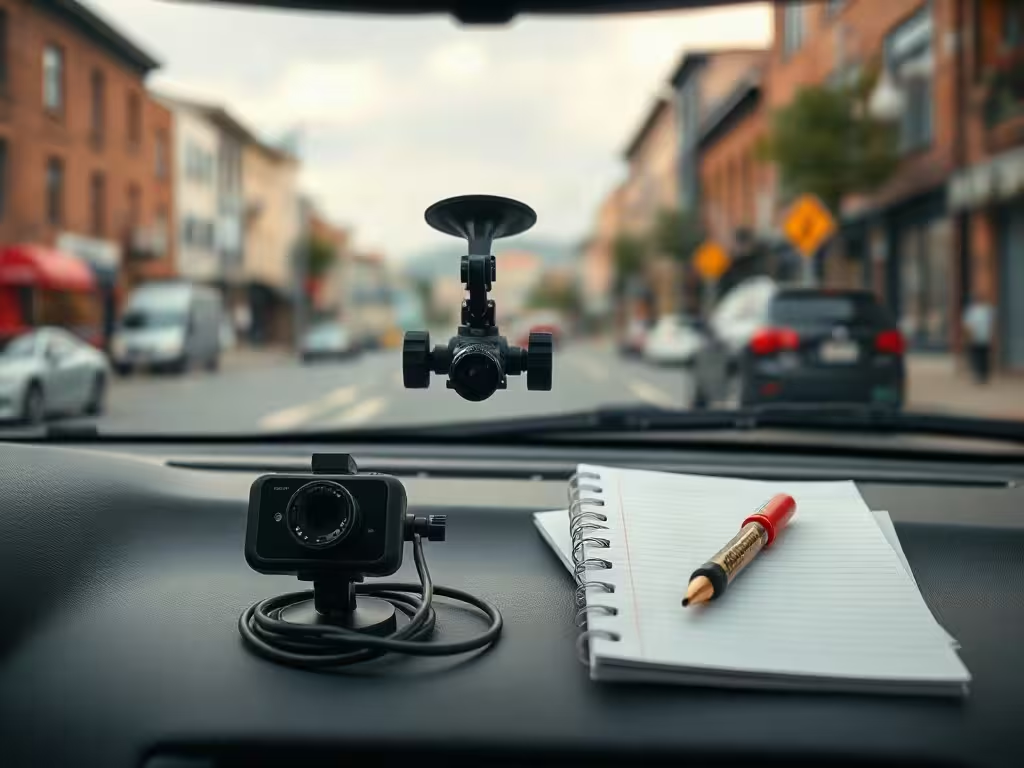
A dash cam microphone raises a separate legal issue from silent video. Under the West Virginia Wiretapping and Electronic Surveillance Act, recording a protected oral communication generally remains lawful when you are a party to it or one party gave prior consent, unless you intercept it to commit a criminal or tortious act.
When an in-cabin conversation is a protected oral communication
Section 62-1D-2 defines an oral communication as one spoken by a person who exhibits an expectation that it will not be intercepted, under circumstances that justify that expectation.
Context controls. The definition does not make every sound captured near a vehicle a protected oral communication, nor does it establish that every in-cabin conversation lacks protection.
Whose consent the statute requires
Under West Virginia Code §62-1D-3(e), you may intercept a communication when:
- You are a party to it; or
- One party gave prior consent; and
- The interception is not undertaken to commit a criminal or tortious act in violation of federal or state law.
This is a qualified one-party consent rule. It applies to interception under the West Virginia statute, while another state’s law may become relevant when conversations or travel cross state lines.
Criminal penalties and civil remedies for unlawful interception or disclosure
Intentional unlawful interception, disclosure, or use under §62-1D-3(a) can constitute a felony. A conviction carries up to five years of imprisonment, a fine of up to $10,000, or both.
Section 62-1D-12 also creates a civil claim for a person whose communication or identity was intercepted, disclosed, or used in violation of the act. Available recovery includes:
- Actual damages of at least $100 for each day of violation;
- Punitive damages when found proper; and
- Reasonable attorney fees and litigation costs.
Those consequences require a statutory violation. The act’s definitions, intent requirements, and exceptions remain part of the analysis.
When to consult a West Virginia civil-rights attorney
Consult a civil-rights attorney licensed in West Virginia before recording conversations in circumstances where a passenger, employee, customer, or person near the vehicle may reasonably expect privacy. Seek advice as well before publishing disputed audio or using it across state lines.
If you do not need cabin audio, disabling the microphone can remove one layer of risk. Confirm that choice against the facts of your intended use rather than treating this article as individualized legal advice.
Match the camera to the recording rules
Review the current package, then confirm mounting and audio rules before recording in your state.
Verify DashOne Pro package and return terms
The merchant’s page supplies the live DashOne Pro price, shipping information, package contents, and return terms. We do not infer any audio function or other camera characteristic from the product name, and we have not independently tested the device.
Verify the current DashOne Pro package and return terms before payment. Treat every offer detail shown there as a merchant claim.
Privacy limits when a dash cam records people or property
Silent video, audio interception, and publication trigger different questions. A lawful public-road recording can still create a separate dispute if the camera reaches into a private place or the footage later exposes private facts.
Silent video of a car and driver in a public place
In O’Dell v. Stegall (2010), No. 35488, the Supreme Court of Appeals of West Virginia held that the plaintiff had no privacy right against having his car photographed while driving in a public place.
That holding directly supports visual capture of a car and its driver in the public setting before the court. It does not establish a comprehensive rule for every person, window, yard, or activity visible on private property from a public road.
Recording in places carrying a reasonable expectation of privacy
West Virginia Code §61-8-28 targets a narrow form of visual recording. It prohibits knowingly recording another person without that person’s knowledge while the person is fully or partially nude in a place where a reasonable person would expect that nudity not to be recorded.
The statute separately prohibits knowingly displaying or distributing an image obtained through that violation. Each listed element matters.
West Virginia also recognizes civil claims for intrusion upon seclusion, appropriation of name or likeness, unreasonable publicity about private life, and false-light publicity. Courts apply those claims to the particular location, conduct, and claimed expectation of privacy.
An April 7, 2026, appellate decision found allegations about cameras in common workplace hallways insufficient where supporting facts did not establish a justified privacy expectation. The court contrasted those hallways with private offices and restrooms, but the decision did not concern a dash cam or create a rule covering every roadside view.
Why publishing footage creates different privacy questions
Keeping video as a personal record or giving it to counsel, an insurer, or police differs from publishing it to a broad audience. West Virginia’s civil privacy law can reach unreasonable publicity about private life or publicity that unreasonably places someone in a false light.
A 2025 West Virginia appellate opinion described a private-facts claim as requiring public disclosure of private facts, offensiveness to a reasonable person, and no legitimate public interest in the disclosed facts. Whether published dash-cam footage meets those elements depends on the recording and the surrounding facts.
Using dash-cam footage after a crash or traffic stop
Dash-cam footage can support a crash claim, traffic-stop account, or defense, but possession alone does not guarantee admission in court. The proponent must connect the recording to a consequential issue and establish that the file is what the proponent says it is.
Relevance and authentication under the West Virginia Rules of Evidence
Under Rule 401, evidence qualifies as relevant when it tends to make a consequential fact more or less probable. Other rules, including Rule 403, can still exclude relevant material.
Rule 901 requires enough evidence to support a finding that an item is genuine. West Virginia’s Rules of Evidence list nonexclusive methods, including testimony from a knowledgeable witness, distinctive characteristics, and evidence that a recording system produces accurate results.
Rule 1002 generally requires an original recording to prove its content, subject to exceptions. Rule 1003 generally admits an accurate duplicate unless someone raises a genuine authenticity question or the circumstances would make admission unfair.
What State v. Goard and State v. Boyd show about authenticating video
In State v. Goard (2018), No. 17-0712, a witness explained how he obtained copied surveillance footage. The video carried date-and-time stamps, and the witness testified that he had not tampered with or altered it. The Supreme Court of Appeals upheld authentication while stressing that no single prescribed form of testimony governs every video.
In State v. Boyd (2017), Nos. 15-0878 and 15-0894, testimony came from the officer responsible for maintaining cruiser recordings and an officer who observed the recorded chase. The court found that testimony sufficient to authenticate the dash-camera video in that case.
Neither decision creates a universal checklist for privately owned dash cams. Both illustrate how witnesses and file history can connect a recording to the event it depicts.
Practical steps for preserving a recording without overstating legal requirements
When footage may matter, you can strengthen its documented history by:
- Retaining the source file when possible.
- Making an accurate, unaltered copy before editing or sharing anything.
- Preserving available date-and-time information.
- Recording how and when you exported or copied the file.
- Identifying people who witnessed the event or understand how the camera stores video.
West Virginia law does not impose a dash-cam-specific rule requiring date-and-time metadata in every case. The cited decisions show that such information, non-alteration testimony, copying history, and knowledgeable witnesses supported authentication on their facts.
Why the automated traffic-camera statute is a separate issue
Section 17C-6-7a restricts police use of an automated camera-and-vehicle-sensing system to determine or prove traffic violations. Its wording does not exclude all private dash-cam recordings from evidence.
Private footage still faces the ordinary rules governing relevance, authentication, originals, duplicates, and any other applicable objection. A court decides admissibility from the particular record before it.
Review the live DashOne Pro terms before buying
Review the live DashOne Pro terms through Audit Faction’s /v/ link. Confirm the current price, shipping, package contents, and return terms directly on the merchant page.
Those offer details come from the merchant. We have not independently tested DashOne Pro or verified performance claims.
Before you buy
Verify the package before you rely on it
- Confirm what the current package includes
- Check shipping and return terms
- Test storage and footage retrieval after delivery
west virginia dash cam laws 2026: Mounting, Audio, Evidence
West Virginia permits a device dedicated to continuous video recording, but the complete installation must preserve your view and control of the vehicle. Protected audio requires compliance with the state’s qualified one-party consent statute, including its privacy definition and criminal-or-tortious-purpose limitation.
Sit in the driver’s seat and check the camera, mount, and cable before driving. Decide whether you need audio. If a recording captures a consequential crash or traffic stop, preserve the source file when possible, make an unaltered copy, and document how you handled it.
Related reading on Audit Faction
The brief supplies no verified Audit Faction URLs or confirmed article titles for civilian recording, traffic-stop documentation, body-camera evidence, or video preservation. We have therefore left this block free of invented internal links.
Affiliate disclosure
This post may contain affiliate links. If you click them, I might earn a small commission (it costs you nothing and helps me keep shipping quality articles every day for your reading pleasure).