
Table of Contents
TL;DR
- Texas dash cam laws do not expressly prohibit ordinary aftermarket cameras, but the equipment must remain consistent with Transportation Code Chapter 547.
- A camera or mount cannot obstruct or reduce the driver’s clear view. Texas law creates no five-inch mounting zone for dash cams.
- Texas generally follows one-party consent for covered conversations, subject to privacy and unlawful-purpose limits.
- Footage can enter evidence, but relevance, authentication, completeness, hearsay, preservation, discovery, and subpoena rules still apply.
Texas dash cam laws conditionally permit private drivers to install and use an aftermarket camera when the device does not obstruct or reduce the driver’s clear view. Separate traffic, interception, privacy, and evidence rules control where you place the camera, whether you record sound, and what happens to the file after an incident.
We reviewed the cited primary legal sources on October 25, 2026. This article supplies general information, not advice about a particular recording, insurance claim, or court case.
Texas Dash Cam Rule Check
Répondez à cinq questions pour obtenir une liste de vérifications adaptée à votre installation et à vos trajets.
Votre profil
Votre liste de vérifications
Ce résultat fournit des repères généraux, pas un avis juridique. Pour une situation précise — surtout après un contrôle, un accident ou une saisie — consultez un avocat texan spécialisé en droits civils.
DashOne Pro offer and live purchase terms
The DashOne Pro merchant describes its current camera offer, package contents, price, shipping, and return terms on its sales page. Audit Faction has not independently tested the camera, so we treat every product characteristic as a merchant claim.
The brief does not supply the required Audit Faction /v/ affiliate slug. The editor must insert that verified cloaked URL before publication. Readers should use the completed link to check the merchant’s live terms because price, stock, package contents, shipping, and returns can change.
What texas dash cam laws cover in 2026
No stand-alone Texas statute expressly authorizes ordinary dash cams
Texas Transportation Code § 547.003 says Chapter 547 does not prohibit an accessory that remains consistent with the chapter and its rules. That gives aftermarket equipment conditional protection. It does not name or expressly authorize dashboard cameras.
Section 547.615, despite its “Recording Devices” title, addresses manufacturer-installed features that retrieve vehicle information after a collision. Its definition does not cover an ordinary aftermarket camera merely because that camera records the road.
Traffic, interception, privacy, and evidence rules govern different parts of their use
The Texas Transportation Code controls vehicle equipment and visibility. Penal Code §§ 16.02 and 21.15 govern different recording and privacy concerns, while the Texas Rules of Evidence determine whether a court may consider footage.
No single dash-cam statute answers every question. The legal result turns on what the camera captures, where it sits, who speaks, and what the owner does with the recording.
Where Texas drivers can mount a dash cam
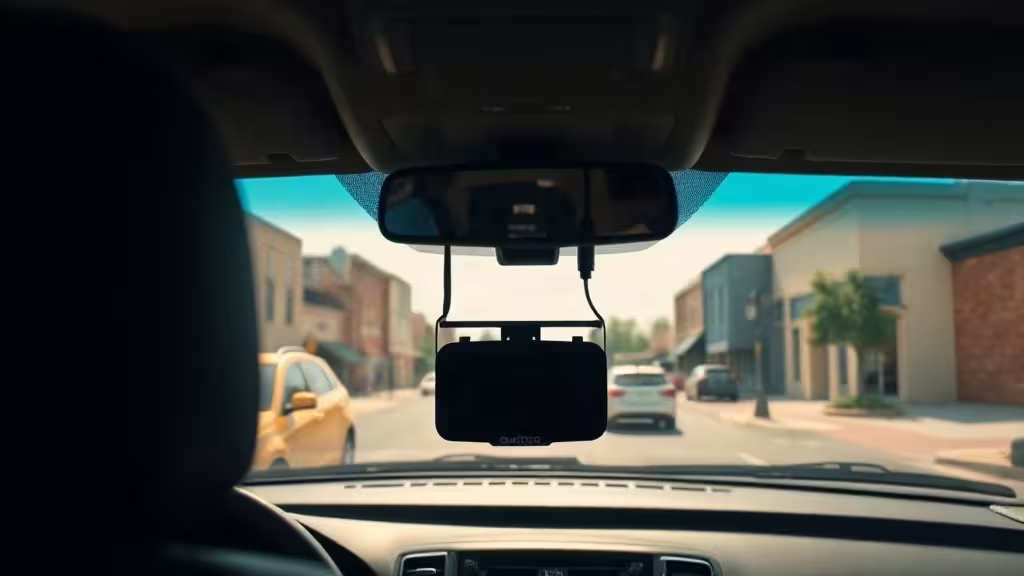
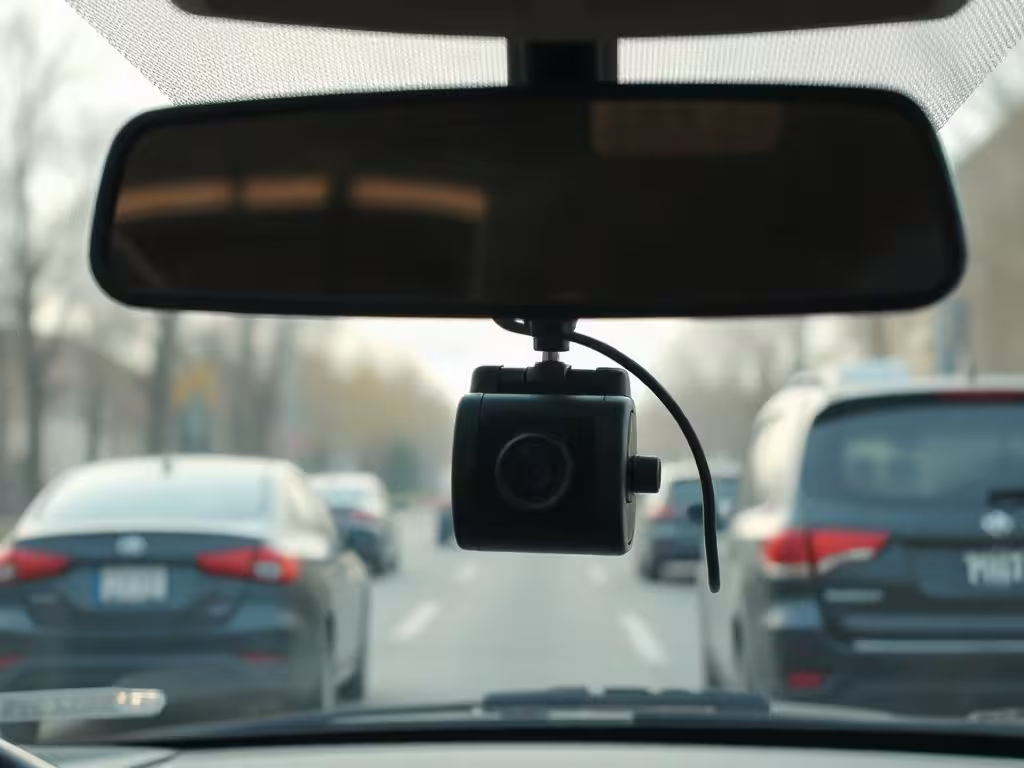
Keep the camera and mount outside the driver’s clear view
Transportation Code § 547.613 makes it a misdemeanor to operate a motor vehicle with an object or material attached to the windshield, side window, or rear window when it obstructs or reduces the operator’s clear view. The camera body, adhesive plate, suction cup, and hanging cable can each affect that assessment.
Section 542.401 supplies the general penalty when the subtitle establishes no different one: a fine from $1 to $200. Whether a particular installation violates the windshield-obstruction rule depends on the view it actually blocks or reduces.
Texas law provides no verified dash-cam zone or mounting dimensions
The reviewed Texas authorities establish a clear-view standard. They do not designate a universally legal dash-cam square, corner, or measurement for private passenger vehicles.
The five-inch and AS-1 language in § 547.613 covers a qualifying sunscreening device. It does not create a five-inch safe harbor for a camera or its mount.
Do not present behind-mirror or airbag placement as a Texas legal requirement
The reviewed Texas sources do not require every camera to sit behind the rearview mirror. They also do not establish a dash-cam-specific rule about airbag deployment zones.
A low-profile position near the mirror may preserve more of the road view in some vehicles, but the camera, mirror, sensors, and housing vary by model. Check the vehicle and camera instructions before attaching anything near an airbag, sensor, or driver-assistance camera.
Treat rearview-mirror and manufacturer guidance as model-specific safety information
Texas DPS inspection criteria require at least one mirror to give a clear rearward view for 200 feet, and a mirror cannot interfere with the driver’s forward vision. Those criteria concern mirrors rather than dash-cam placement.
Garmin’s instructions for its Dash Cam Tandem tell owners to protect the driver’s road view and avoid placing that model behind or very close to the mirror when the mirror could block its interior camera. That guidance belongs to one product. It does not create a statewide mounting rule.
Audio Recording Rules for Texas dash cams
When the driver is part of the conversation
Texas Penal Code § 16.02 supplies an affirmative defense for a private person who intercepts a covered wire, oral, or electronic communication when that person participates in it or one party gave prior consent. The exception does not cover interception undertaken for the purpose of committing an unlawful act.
A driver taking part in an in-car conversation ordinarily supplies the necessary party status. That is the core of Texas one-party consent, but the statute’s definitions and the facts surrounding the communication still matter.
When passengers are recorded without the driver present
Ownership of the camera does not make its owner a party to every conversation near it. If a driver leaves a camera recording while absent, the driver cannot rely solely on owning the device to satisfy § 16.02.
One participant’s prior consent may satisfy the Texas provision. When no participant consents, consult a Texas-licensed civil-rights attorney before using or distributing the audio.
Reasonable expectations of privacy for audio and video
Texas interception law covers oral communications spoken with an expectation against interception when the circumstances justify that expectation. A plainly public conversation may fall outside that definition, but location alone does not settle every case.
Visual recording follows a different analysis. Penal Code § 21.15 addresses specified intimate images and recordings made without consent and with intent to invade privacy, including recordings in a bathroom, bedroom, or changing room. For that offense, a posted recording sign alone does not establish the required consent.
Why crossing a state line can change the analysis
Federal law, 18 U.S.C. § 2511, also generally permits interception when the recorder participates or one party consents, unless the interception serves a criminal or tortious purpose. Another state may impose stricter consent, mounting, notice, storage, or sharing rules.
Courts do not apply one universal rule to every interstate communication. The location of the device and participants may affect which law controls, so consult a civil-rights attorney in the relevant state before relying on Texas law outside Texas.
Match the camera to the recording rules
Review the current package, then confirm mounting and audio rules before recording in your state.
Check audio controls before choosing a dash cam
Decide whether you need cabin audio before buying. Then confirm on the DashOne Pro merchant’s live page whether the current version has the audio controls you need and what the package contains.
The merchant’s specifications remain merchant claims. Audit Faction has not independently tested its microphone, controls, recording quality, or included components. The editor must place the verified /v/ affiliate URL here before publication.
Using Texas dash-cam footage as evidence
Dash-cam evidence does not enter a Texas courtroom automatically. The Texas Rules of Evidence, effective July 2, 2026, apply ordinary evidentiary requirements to recordings in proceedings within their scope.
Relevance and authentication
Rules 401 and 402 require the footage to make a consequential fact more or less probable. An unrelated recording will not qualify merely because it came from a dash cam.
Rule 901 requires enough evidence to support a finding that the exhibit matches what its proponent claims. A knowledgeable witness, the file’s distinctive characteristics, or evidence showing that the camera system produced an accurate result may help authenticate it.
Completeness and recorded statements
Under Rule 106, an opposing party may introduce another portion of a recorded statement that fairness requires the court to consider at the same time. A short clip can therefore draw in surrounding material when the omitted portion changes its meaning.
Keep the full event. Exporting only the decisive seconds may create an avoidable completeness dispute.
Hearsay questions concern statements rather than automatically excluding the video image
Rule 801 defines hearsay through a person’s out-of-court statement offered to prove what the statement asserts. A voice captured inside the vehicle can raise that issue.
The video image itself does not automatically become hearsay. Courts assess the recorded conduct and recorded statements separately, then apply any exclusions or exceptions supported by the circumstances.
Why the original file and accurate duplicates matter
Rules 1002 through 1004 govern proof of the contents of recordings and photographs. The original generally proves its contents, while an accurate duplicate ordinarily receives the same treatment unless authenticity or fairness creates a problem.
Do not trim, filter, caption, or overwrite the only copy. Preserve the source file, metadata, storage card when practical, and an accurate duplicate.
Preserving and producing footage after an incident
Preserve the original when a claim becomes more than an abstract possibility
In Brookshire Brothers, Ltd. v. Aldridge (2014), the Supreme Court of Texas explained that a preservation duty arises when a party knows or reasonably should know there is a substantial chance of a claim and that evidence under its control will be material and relevant. The court described that chance as more than an abstract possibility or unwarranted fear.
After a material crash, traffic stop, or alleged crime:
- Stop the camera from automatically overwriting the event.
- Retain the original file and available metadata.
- Create an accurate working copy.
- Leave the preserved version unedited.
- Record how and when you copied or transferred it.
Civil discovery and nonparty subpoenas
Texas civil discovery reaches relevant electronic and videotape recordings within a party’s possession, custody, or control, subject to privilege and other valid objections. Rule 205 also lets a party seek documents or tangible things from a nonparty through notice and a subpoena that describes the requested material with reasonable particularity.
Rule 176 can compel testimony, production, or inspection within its scope and geographic limits. A recipient who believes a request exceeds those limits should obtain legal advice rather than delete, conceal, or alter the footage.
Criminal subpoenas and search warrants
Under Texas Code of Criminal Procedure Article 24.02, a subpoena duces tecum may direct a witness to bring a specified item sought as evidence into court. Article 18.01 separately permits a magistrate to issue a search warrant upon sufficient facts establishing probable cause.
The language and scope of the legal demand control. If police seek a device or file and you do not understand the demand, preserve the material and contact counsel.
Insurance requests depend on the request, the policy, and the claim investigation
The Texas Department of Insurance says an auto insurer may ask for a proof-of-loss form or other information needed to evaluate a claim. TDI also states that refusal to cooperate or remaining unreachable during a claim investigation can support nonrenewal.
The cited sources establish no blanket duty to volunteer every recording to an insurer or law-enforcement agency. A contractual request, discovery demand, subpoena, warrant, court order, or another law may require production in a particular matter.
Commercial vehicles, rideshare drivers, and interstate trips
Federal windshield rules for qualifying commercial safety technology
Commercial motor vehicles can face an additional federal placement rule. Under 49 CFR § 393.60, qualifying vehicle-safety technology mounted inside the windshield must remain outside the driver’s sight lines to the road, signs, and signals.
The dimensional limits apply only when the equipment qualifies under the federal definition:
| Placement boundary | Maximum distance |
|---|---|
| Below the upper edge of the wiper-swept area | 8.5 inches |
| Above the lower edge of the wiper-swept area | 7 inches |
Antennas and similar devices follow a separate rule: no more than 6 inches below the windshield’s upper edge, outside the wiper-swept area and the driver’s sight lines. The consulted e-CFR displayed Title 49 as current through October 22, 2026.
Uber notice, registration, and public-sharing policies
Uber says drivers may use dash cams and recommends registering a camera so the platform can notify riders. Registration may also simplify sharing a recording with Uber Support.
Uber requires drivers to comply with local consent law and bars public or social-media sharing of a person’s image, audio, or video under its Community Guidelines. Those conditions represent platform policy, not a substitute for Texas law.
Recheck mounting, consent, and privacy law before crossing state lines
Texas rules do not travel with the license plate. Before entering another state, check that jurisdiction’s current primary law for:
- Windshield placement
- Audio consent
- Passenger notice
- Visual privacy
- Storage and disclosure
- Rideshare or fleet requirements
A stricter state may govern even when the trip began in Texas.
Do not add state-specific examples unless the current primary statute is verified at drafting
Out-of-state rules change and often use narrow device definitions. A provision covering a “video event recorder,” for example, may not cover every continuously recording consumer camera.
Check the operative statute and effective date before travel. Secondary summaries can point you toward the law, but they should not carry the final legal conclusion.
Verify the current DashOne Pro offer before buying
Check the DashOne Pro merchant’s live page for the current price, shipping terms, package contents, and return conditions before placing an order. Treat those details and all product characteristics as merchant representations.
Audit Faction has not independently tested the camera. The editor must replace this publication note with the verified /v/<slug> cloaked affiliate link because the brief supplies no slug.
Before you buy
Verify the package before you rely on it
- Confirm what the current package includes
- Check shipping and return terms
- Test storage and footage retrieval after delivery
Use this four-step check:
Use this four-step check:
- Mount the camera and cable without reducing your clear view.
- Decide whether audio should run, based on who will speak and where the vehicle will travel.
- After a material incident, stop overwriting and preserve the original file, metadata, and an accurate duplicate.
- When another state, a private conversation, an insurance demand, discovery, or law enforcement enters the picture, check current primary law or consult a state-licensed civil-rights attorney.
Texas conditionally permits ordinary aftermarket dash cams. Careful placement, deliberate audio settings, and prompt preservation determine whether the device helps without creating a separate legal problem.
Related reading on Audit Faction
No eligible Audit Faction titles or URLs were supplied in the brief. The editor must add three to five verified internal links with descriptive anchor text before publication.
This post may contain affiliate links. If you click them, I might earn a small commission (it costs you nothing and helps me keep shipping quality articles every day for your reading pleasure).