
Table of Contents
TL;DR
- Pennsylvania dash cam laws generally permit road-facing video, provided the camera does not materially obstruct your view or create a safety hazard.
- Disable a live-view screen while driving unless a statutory exception applies, and do not hold, reach for, or operate a covered mobile device on the road.
- If your microphone captures a protected conversation, the ordinary private-person exception requires prior consent from all parties.
- After a crash, save the full native recording before loop recording overwrites it. Keep the filename and metadata, then make a backup.
Pennsylvania generally permits you to use a road-facing dash cam. The pennsylvania dash cam laws reviewed here on October 25, 2026, focus on how you install and operate the camera, what its screen shows, what its microphone captures, and how you preserve a recording.
The Pennsylvania State Police says a small camera may sit on the windshield only when it does not obstruct the driver’s view. Separate rules govern driver-visible video, handling certain devices while driving, and recording private conversations.
Audit Faction did not independently test DashOne Pro. The merchant’s current price, shipping terms, package contents, and return terms should be checked through its live offer page before purchase. An editor-verified /v/ affiliate slug was not included in the brief, so we have not invented or inserted one.
Check Your Pennsylvania Dash Cam
Answer four questions about your setup. You will receive a practical checklist based on Pennsylvania’s obstruction, display, and audio-recording rules.
Your setup profile
Apparent compliance points
Legal risks
Changes to consider
This checklist is general information, not legal advice. Pennsylvania’s audio law depends in part on whether a speaker has a justified expectation that the conversation will not be intercepted. Consult a Pennsylvania civil-rights attorney about your specific use.
Legal basis: 75 Pa. C.S. § 4524, 75 Pa. C.S. § 4527, and 18 Pa. C.S. § 5703.
pennsylvania dash cam laws: What is legal in 2026?
Pennsylvania State Police treats ordinary dash-cam use as conditionally lawful. The clearest statutory limit comes from 75 Pa.C.S. § 4524, which bars an object placed or attached where it materially obstructs, obscures, or impairs the driver’s view through the windshield, or creates a safety hazard.
That rule regulates placement while you drive. It does not impose a general ban on a private driver recording the public road ahead.
Road-facing video versus separately restricted conduct
Routine road video differs from recording conduct covered by other laws. Pennsylvania’s invasion-of-privacy offense in 18 Pa.C.S. § 7507.1 reaches specified images involving nudity or intimate parts when the statute’s purpose, consent, and privacy elements exist.
That narrow offense does not prohibit ordinary forward-facing roadway footage. Recording inside a private place or directing a camera toward people in circumstances involving privacy requires a separate analysis.
Passive recording versus handling a device while driving
A mounted camera can record without driver input. Pennsylvania’s distracted-driving rule instead examines a defined device and the way the driver uses it, including holding it, pressing more than one button to dial or answer it, or reaching in a way that pulls the driver from a properly restrained seated position.
Application to a particular dash cam depends on its design and your conduct. Set the camera before moving and pull safely off the highway before changing settings or retrieving a clip.
Why private-place recording requires a separate analysis
Public-road video does not settle every privacy question. A camera aimed inside a home, changing area, or another private setting may capture facts that ordinary traffic footage does not.
Audio also follows a different statute. A lawful camera position does not automatically make every recorded conversation lawful.
Where Pennsylvania drivers may mount a dash cam
Your installation must preserve the driver’s clear windshield view. Pennsylvania does not supply a universal dash-cam mounting rectangle in the authorities reviewed for this article.
The material-obstruction test
Section 4524 asks whether the object materially obstructs, obscures, or impairs the driver’s windshield vision, or creates a safety hazard. The Pennsylvania State Police dash-cam guidance applies that test directly: a small windshield-mounted camera may be used only when it does not obstruct the driver’s view.
Check the installation from your normal seated position. A camera that looks unobtrusive from the passenger seat may cover a pedestrian, traffic signal, or approaching vehicle from behind the steering wheel.
Windshield, dashboard and mirror-area placement
Neither a windshield mount nor a dashboard mount receives blanket approval. Position and effect control.
Keep the camera body, mount, cable, and any hanging component outside the driver’s road view. Do not hang the unit from the inside rearview mirror or place it where it blocks that mirror.
What the inspection rule does and does not establish
Under 67 Pa. Code § 175.80, a passenger vehicle can fail inspection when opaque material impairs the driver’s clear highway view or an object hangs from or blocks the inside mirror. The rule also defines an acute windshield area in the driver’s normal line of vision measuring 8 1/2 inches wide and 5 1/2 inches high.
That measurement addresses windshield defects and vision interference. The cited text does not create a universal 8 1/2-by-5 1/2-inch dash-cam exclusion zone.
We found no authoritative Pennsylvania rule in the supplied research that expressly governs dash-camera placement within an airbag deployment area. Follow the vehicle and camera manufacturers’ installation instructions, but do not present that precaution as a Pennsylvania dash-cam statute.
Pennsylvania dash-cam screen and distracted-driving rules
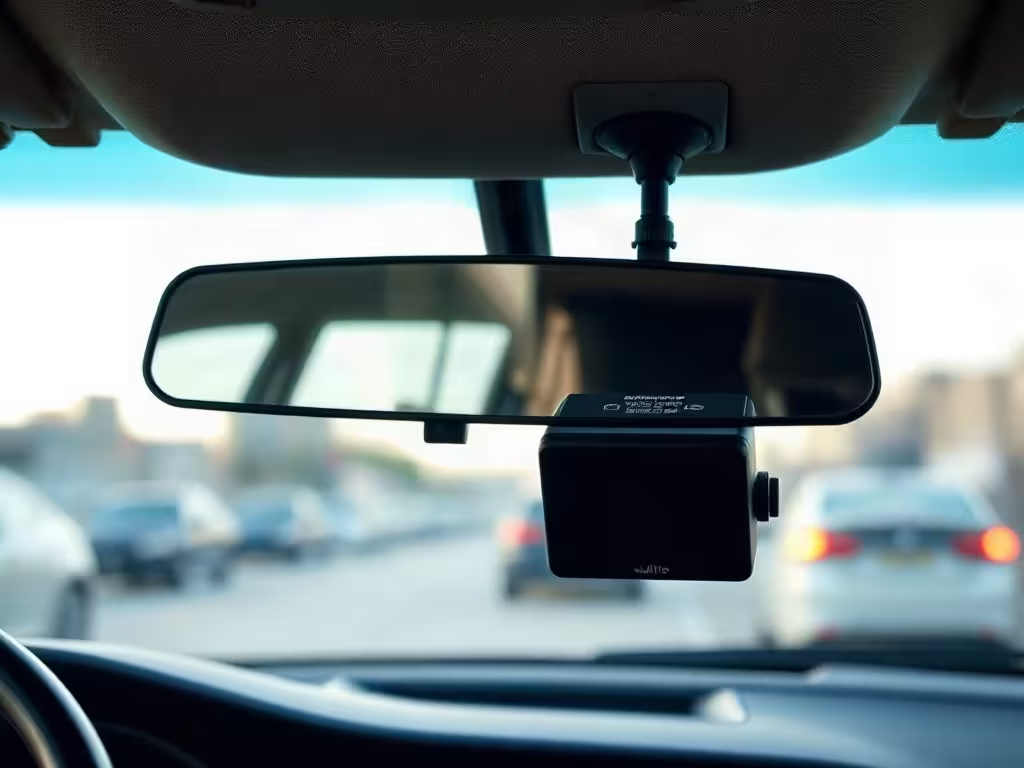
The camera and its display perform different jobs. Pennsylvania law may permit the device to record while restricting what the driver can watch.
Why recording may continue while live view is disabled
Under 75 Pa.C.S. § 4527, a moving vehicle generally may not carry an image display visible to the driver when it shows a broadcast image, specified live-stream video, or prerecorded video. The statute lists exceptions for such functions as vehicle information, mapping, maneuvering views, occupant views, safety information, and interlocked screens.
Pennsylvania State Police specifically advises turning off a dash cam’s live-view feature. Its guidance does not say that you must stop the camera from recording.
When touching or holding a device creates a separate issue
Section 3316.1 bars a driver from using an interactive mobile device while driving, subject to its emergency exception. The definition covers holding or supporting the device, pressing more than one button to dial or answer it, and certain reaches that pull the driver out of a properly restrained seated position.
The underlying device definition includes handheld or similar equipment capable of recording or broadcasting video, while excluding qualifying hands-free use. A passive, mounted dash cam does not by itself answer whether the statute applies. The camera’s design and the driver’s actions matter.
Audio Recording Rules for Pennsylvania Dash Cams
When a private person relies on Pennsylvania’s ordinary consent exception, 18 Pa.C.S. § 5704(4) requires prior consent from all parties to the communication. A secondary article found during research called Pennsylvania a one-party-consent state, but the official statute says otherwise.
Pennsylvania is not a general one-party-consent state
The Pennsylvania Wiretapping and Electronic Surveillance Control Act contains specialized exceptions, including provisions for certain law-enforcement activity. Those exceptions do not turn the ordinary private-person rule into one-party consent.
If you plan to record an in-car conversation, tell every occupant before audio begins and obtain each person’s agreement. When consent remains uncertain, mute or disable the microphone and consult a civil-rights attorney in Pennsylvania for advice tied to your circumstances.
Private conversation versus ambient road noise
Section 5702 defines an “oral communication” through the speaker’s justified expectation that the communication will not be intercepted. Tire noise, horns, and other non-speech road sounds do not become protected conversations merely because the microphone captures them.
Spoken words require closer attention. A conversation may carry a justified expectation against interception even when it occurs in a public place, so location alone does not decide the issue.
Consent before recording and the microphone-off option
Consent must come before interception when you rely on § 5704(4). A clear notice followed by each occupant’s agreement creates a cleaner record than silence or assumption.
If you cannot obtain everyone’s prior consent, switch off audio before the conversation begins. Controls differ by model, so confirm that the microphone is actually muted rather than relying on an unfamiliar icon.
Audit Faction did not independently test DashOne Pro or verify a particular microphone control on that camera. Because the brief supplied no confirmed /v/ slug, no affiliate link appears here.
Match the camera to the recording rules
Review the current package, then confirm mounting and audio rules before recording in your state.
Using Pennsylvania dash-cam footage after a crash
You may give relevant footage to police, an insurer, or an attorney. A party may also offer it in court, but possession of a clip does not make the clip automatically admissible or conclusive.
What authentication requires
Under Pa.R.E. 901, the proponent must produce enough evidence to support a finding that the item is what the proponent claims. A knowledgeable witness, distinctive details, the recording process, and surrounding circumstances may help establish that connection.
The Superior Court addressed digital-video authentication in Commonwealth v. Anderson, No. 2868 EDA 2024, memorandum filed March 24, 2026, under docket J-A25036-25. The court treated authentication as a threshold inquiry and explained that content disputes may also proceed through relevance and Rule 403. The memorandum is nonprecedential and involved cellphone recordings of surveillance footage, not a private crash camera, so it supplies limited guidance rather than a universal dash-cam rule.
Why an edited clip may face added scrutiny
A shortened clip can omit the seconds that explain speed, traffic signals, braking, or what occurred before impact. Editing may also trigger questions about authenticity, context, or misleading presentation.
Keep the source file intact. If you need a shorter viewing copy, create it from a duplicate and retain the complete native recording.
What footage can and cannot establish
A dash cam may document lane position, signal phases, vehicle movement, spoken words, or weather within its field of view. It may miss conduct outside the frame, distort distance, carry an inaccurate timestamp, or lose detail in poor light.
Police, insurers, lawyers, and courts assess the recording alongside other evidence. The video does not decide fault merely because it exists.
How to preserve dash-cam evidence
Act before the camera’s loop function overwrites the clip. Once you are safe, secure the recording and storage media.
Save the full native file
Preserve the complete file generated by the camera. Do not trim, rename, filter, recompress, or export over the only copy.
Pennsylvania Rule of Evidence 1002 may require an original when a party seeks to prove a recording’s content, but its application turns on the issue and proceeding. The rule’s commentary recognizes that recordings often serve as evidence of an event rather than as operative or dispositive material.
Retain metadata and make a backup
Keep the original filename and available metadata. Make at least one backup on separate storage, then record the date, time, location, weather, and traffic conditions while your memory remains fresh.
Pa.R.E. 1003 generally treats an accurate duplicate like the original. A genuine authenticity question or unfair circumstances may still lead a court to require the original.
Do not overwrite or misleadingly edit the recording
Preserve the minutes before and after the event, not only the impact. That surrounding footage can explain movement, signals, traffic flow, or later statements.
Share a copy when practical and retain the source file. If litigation or an investigation has begun, ask counsel before publishing, editing, or distributing the footage.
Why unlawful audio creates a separate evidence problem

A lawful road-facing image does not cure unlawfully intercepted speech. Video and audio can raise separate statutory questions within the same file.
Video legality does not decide audio legality
Under 18 Pa.C.S. § 5703, intentional interception, disclosure, or use of a protected communication can create criminal exposure unless an exception applies. Whether captured speech qualifies as an oral communication depends on the justified-expectation test in § 5702.
That means later sharing can present a problem distinct from the original recording. Do not assume that muting the soundtrack in an edited copy resolves how the source audio was acquired or used.
Potential interception, disclosure and exclusion issues
Section 5721.1 supplies a procedure through which an aggrieved party in a Pennsylvania court, board, or agency proceeding may seek exclusion of an interception made without an applicable exception or authorization. The statute sets out grounds, burdens, and procedures.
No general article can predict how a court will treat a particular file. If your existing recording contains a private conversation, consult a Pennsylvania civil-rights or evidence attorney before giving it to an insurer, police agency, opposing party, or public platform.
DashOne Pro offer: What to verify before buying
The DashOne Pro merchant page reviewed by the editor on October 13, 2026, is the live source for the offer. Audit Faction did not independently test the camera, and no editor-verified /v/ slug was supplied for publication, so we have omitted the purchase link rather than inventing one.
Merchant claims rather than independent test findings
Treat every camera characteristic, included item, and sales term on that page as a merchant claim. The supplied facts do not support an independent finding about image quality, durability, audio controls, installation, or performance.
A product claim also does not establish legal compliance. You remain responsible for placement, screen settings, device handling, consent, and preservation.
Live price, shipping, package contents and return terms
Check the merchant’s live page for the current price, shipping terms, package contents, and return terms before ordering. Those details can change, and the editor’s review confirms only where buyers can verify them.
Also confirm that the model lets you disable its live screen and mute its microphone. The brief does not establish that DashOne Pro includes either control.
Before you buy
Verify the package before you rely on it
- Confirm what the current package includes
- Check shipping and return terms
- Test storage and footage retrieval after delivery
A lawful setup begins in the driver’s seat
A lawful setup begins in the driver’s seat. Mount the camera where its body, cable, and screen do not materially obstruct the road or create a safety hazard, then disable any driver-visible live view that does not fall within a statutory exception.
Set the device before driving. Obtain every party’s prior consent before recording a protected conversation under the ordinary private-person exception, or mute the microphone when consent remains uncertain.
After an incident, secure the full native file, keep its filename and metadata, and create a backup. Contact a Pennsylvania attorney when the recording contains private speech or may become evidence in a pending claim.
Related reading on Audit Faction
The brief supplied no confirmed Audit Faction article titles or URLs. We have left this block free of fabricated internal links so an editor can insert three to five verified related articles before publication.
This post may contain affiliate links. If you click them, I might earn a small commission (it costs you nothing and helps me keep shipping quality articles every day for your reading pleasure).