
Table of Contents
TL;DR
- Illinois dash cam laws generally permit video-only recording on public roads.
- Section 12-503 bars objects that materially obstruct the driver’s view. It names no required dash-cam position or camera-size limit.
- Secretly recording a private conversation generally requires every participant’s consent under the Illinois Eavesdropping Act.
- A court still needs a foundation showing that footage is authentic. We reviewed the cited primary sources on October 26, 2026.
Illinois dash cam laws let you record video on public roads so long as the camera does not materially block your view. Audio raises a separate question because an in-car conversation may qualify as a private conversation under Illinois law.
That distinction should drive your setup. Position the camera outside critical sight lines, decide whether to disable its microphone before passengers enter, and keep the original file if the camera captures an incident.
The primary Illinois statutes and evidence rules cited below were reviewed on October 26, 2026. This article gives general information, not legal advice about a particular recording.
Check DashOne Pro before deciding
illinois dash cam laws: What the current statute actually says
Illinois law generally permits a private driver to operate a video-only dash cam. The controlling placement rule comes from 625 ILCS 5/12-503, which bars objects placed or suspended between the driver and certain windows when they materially obstruct the driver’s view.
The statute does not expressly name dash cams. It also does not assign them a mandatory windshield corner or impose a dash-cam-specific size limit.
Why the lower-corner and five-inch claim should not be presented as statutory text
Some secondary guidance says an Illinois camera must sit in the lower driver-side corner and measure less than five inches. That language does not appear in the current text of Section 12-503.
The statute does contain a six-inch measurement, but it governs nonreflective tinted film along the uppermost portion of the windshield. It does not state a six-inch camera rule.
What materially obstructing the driver’s view means for placement
Section 12-503 does not supply a dash-cam diagram or a numerical obstruction test. Its standard turns on whether the object materially blocks the driver’s view through the front windshield, rear window, or side windows immediately adjacent to the driver.
Keep the camera, power cord, suction cup, and any hanging accessories outside the sight lines you use to detect traffic, pedestrians, cyclists, signals, and mirrors. The statute’s lack of a camera dimension does not make every placement safe.
Dashboard, Windshield, and Rear-Window Mounting Rules
The Illinois Vehicle Code regulates visibility rather than creating separate technical specifications for dashboard, windshield, and rear-facing cameras. The physical position still matters because each setup can interfere with a different sight line.
Dashboard-mounted cameras
A camera resting on the dashboard does not fall neatly within language about an object placed “between” the driver and the windshield in every conceivable setup. It can still rise into the driver’s field of view, however, and the available statutory text creates no blanket dashboard exception.
A low, stable placement that leaves the road and signals visible fits the law’s visibility standard more closely than a camera mounted near eye level.
Windshield-mounted cameras
Section 12-503 addresses objects between the driver and the front windshield when they materially obstruct the view. It does not prescribe a particular corner or maximum dash-cam dimension.
Mounting near the windshield edge may reduce interference, but location alone does not settle compliance. Camera size, mount height, cable routing, and the driver’s seating position all affect the actual sight line.
Rear-facing cameras and rear-window visibility
Objects placed or suspended between the driver and the rear window or adjacent side windows also fall under the material-obstruction rule. A rear-facing unit should not block the driver’s view through those windows.
The current statute does not create a distinct size rule for a rear camera. Apply the same practical test: preserve the sight lines needed to drive safely.
Audio Recording Rules Under the Illinois Eavesdropping Act
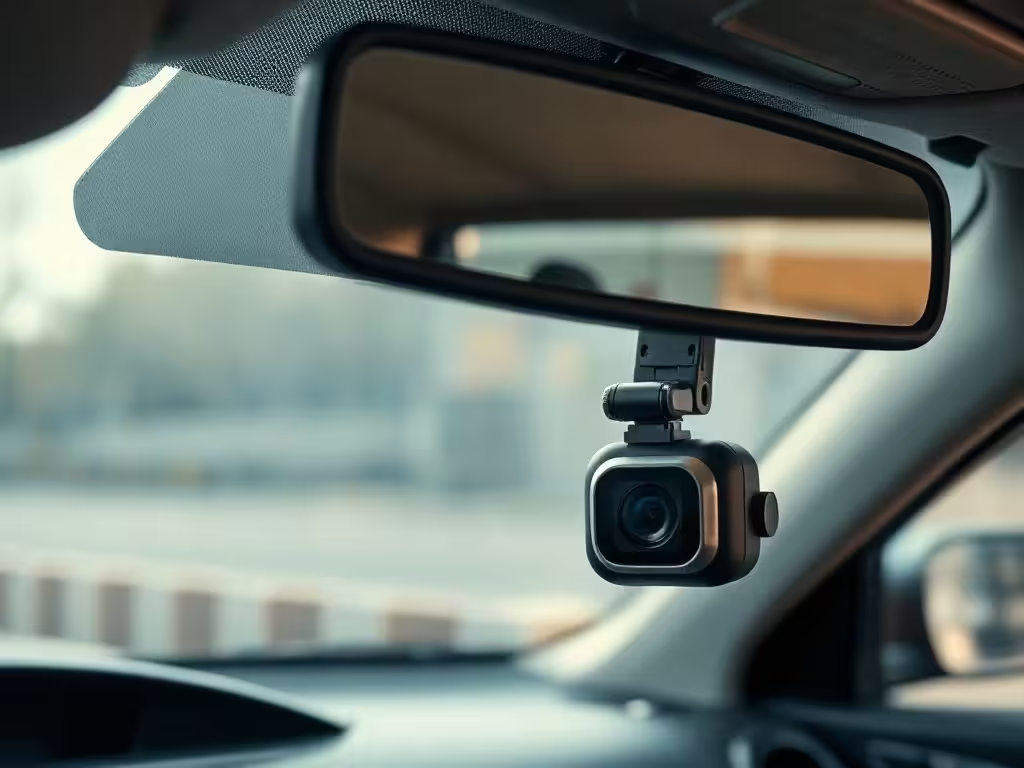
The Illinois Eavesdropping Act does not treat every voice picked up by a microphone as protected private audio. It covers a conversation between at least two people when one or more participants intended privacy and the surrounding circumstances reasonably justified that expectation.
“Surreptitious” means obtained through stealth, deception, secrecy, or concealment. When a dash cam secretly captures a private conversation, Section 14-2 generally requires consent from every participant.
When an in-car conversation is private
A closed vehicle can support an expectation of privacy, but location alone does not answer the question. Illinois law asks whether a participant intended the exchange to remain private and whether the circumstances reasonably supported that intent.
A passenger’s quiet personal conversation inside a closed car presents different facts from words directed at people on a crowded public street. The statutory definition requires a circumstance-specific assessment.
Whose consent a driver or nonparticipant needs
A driver who participates in a private conversation generally needs the consent of every other participant before secretly recording it. A person who is not part of the conversation generally needs every participant’s consent.
Notice can matter because the eavesdropping offense requires knowing, intentional, surreptitious conduct. Whether a particular warning or visible camera defeats that element depends on the facts, so drivers with recurring passengers should seek advice from an Illinois civil-rights attorney rather than assume that the camera’s presence resolves consent.
The participant crime-suspicion exemption in 720 ILCS 5/14-3
Section 14-3 contains a narrow route for recording without every participant’s consent. A private person who participates in the conversation may record when that person reasonably suspects another participant has committed, is committing, or is about to commit a crime against the recorder or an immediate-household member, and there is reason to believe the recording may capture evidence.
The exception carries each of those conditions. A generalized safety concern does not automatically satisfy them.
Criminal, evidentiary, and civil consequences under Sections 14-4 through 14-6
Illinois attaches several consequences to unlawful eavesdropping:
- A first offense is a Class 4 felony.
- A second or later offense is a Class 3 felony.
- Evidence obtained in violation of Article 14 is generally inadmissible, subject to the statute’s stated exceptions.
- A person whose conversation was unlawfully recorded may seek an injunction and actual damages. A court or jury may also award punitive damages.
- Knowingly using or disclosing information obtained through an Article 14 violation is prohibited unless all parties consent.
These provisions make the microphone setting more than a product preference. If you cannot determine whether recurring in-car conversations will be private, disabling audio reduces that unresolved risk.
Match the camera to the recording rules
Review the current package, then confirm mounting and audio rules before recording in your state.
Recording Police Officers During Traffic Stops
Section 14-2(e) states that the Eavesdropping Act does not prohibit a private individual from recording a law-enforcement officer performing official duties in a public place or under circumstances where the officer has no reasonable expectation of privacy.
The same provision preserves an officer’s ability to take reasonable action to maintain safety and control, secure an accident or crime scene, protect an investigation’s integrity and confidentiality, and preserve public order. The right to record does not grant access to a restricted area or erase lawful scene-control instructions.
A traffic stop on a public road will often place an on-duty officer in the statutory setting described above. Keep the camera fixed when possible, do not reach toward equipment without explanation, and comply with lawful safety directions while preserving the recording.
Can Illinois Dash-Cam Footage Be Used as Evidence?
Yes, dash-cam footage may be admitted when its proponent supplies enough evidence to support a finding that the recording is what the proponent claims. Illinois Rule of Evidence 901 governs that foundation.
Admission remains case-specific. A recording can also influence a claim or investigation without ultimately reaching a courtroom, but the supplied primary sources do not establish a separate Illinois authentication standard for insurance claims.
Authentication by a witness with knowledge
A witness who saw the event may testify that the video accurately depicts it. Rule 901 identifies testimony from a knowledgeable witness as one method of authentication.
That route may fit a driver who watched the crash and can identify the road, vehicles, and sequence shown. The judge still decides whether the foundation clears the evidentiary threshold.
Device reliability, proper operation, and operator competence
When no witness can personally confirm the recording’s accuracy, Illinois courts may apply the silent-witness doctrine. People v. Taylor (2011) identifies factors that include:
- The recording device’s capability and general reliability
- The operator’s competence
- Proper operation of the device
- The method used to preserve the recording
- Identification of relevant people, places, or objects
- An explanation of copying or duplication
The factors are nonexclusive. People v. Marston (2014) treated the accuracy and reliability of the process that produced the video as the central question, with the necessary showing shaped by the individual record.
Chain of custody and the copying process
A party relying on a recording should be able to explain where the original came from, who handled it, and how later copies were produced. That history supports the chain of custody and gives the court a way to assess whether the file changed.
Record each transfer. If you export a clip for an insurer, lawyer, or police agency, retain the source file and note when and how you made the copy.
Editing, missing context, and Illinois Rule of Evidence 106
Unexplained cuts, deletions, or conversions can weaken the authentication foundation or reduce the recording’s weight. They do not create an automatic exclusion rule for every edited file, because Illinois courts evaluate the production process and surrounding facts.
Illinois Rule of Evidence 106 also lets an opposing party require contemporaneous introduction of another part of a recorded statement when fairness calls for that context. Preserve footage before and after the event rather than retaining only a dramatic excerpt.
The available sources do not assign a fixed legal consequence to an inaccurate or unclear timestamp. Treat timestamp uncertainty as something that may require explanation, not as an automatic rule of admission or exclusion.
Why unlawfully captured private audio may be excluded
Section 14-5 generally excludes evidence obtained in violation of the Illinois Eavesdropping Act from civil and criminal trials and several other proceedings. The section contains limited exceptions, including admission when all parties consent.
A valid video track does not necessarily cure unlawfully captured private audio. A lawyer may need to assess the tracks separately and determine whether the recording falls within the Act.
How to Preserve Dash-Cam Evidence
Preservation begins with the untouched recording. Illinois Rule of Evidence 1002 generally requires the original to prove recorded content, while Rule 1003 generally treats a duplicate as equally admissible unless a genuine authenticity question arises or substitution would be unfair.
Keep the original recording
Stop the camera from overwriting the relevant file. Save the original in its native form, then work from a copy.
Do not trim, rename, filter, recompress, or annotate your only copy. The consulted authorities do not impose a dash-cam-specific metadata rule, but preserving the native file avoids discarding information that may help explain when and how the device created it.
Document every copy and transfer
Keep a short log showing:
- The date you preserved the file
- The device or storage card from which it came
- Who received each copy
- How each copy was produced
- Whether any copy was trimmed, converted, blurred, or muted
Illinois cases identify preservation, chain of custody, and the duplication process as relevant authentication factors. The sources do not prescribe a universal log format.
Preserve surrounding footage for context
Save the lead-up and aftermath, including any continuous segment that explains vehicle movement or spoken statements. A short clip may omit facts that Rule 106 permits another party to supply for fairness.
Court evidence rules do not establish an Illinois insurance-retention standard. Ask the insurer what format it accepts, but keep the untouched original even after sending a duplicate.
Privacy and Disclosure Limits for Illinois Dash-Cam Video
Ordinary video of a public road differs from recording inside settings protected by Illinois law. Section 26-4 prohibits specified nonconsensual recording in restrooms, tanning beds or salons, locker rooms, changing rooms, and hotel bedrooms. It also covers certain remote recording into another person’s residence.
The statute prohibits knowingly disseminating video known to have been made in violation of those protected-location provisions. Incidental sound remains subject to the Illinois Eavesdropping Act.
Article 14 separately prohibits knowing use or disclosure of information that a person knows, or reasonably should know, came from an unlawfully recorded private conversation, unless all parties consent. Lawful creation of the visual track therefore does not establish lawful capture or disclosure of its audio.
The primary sources reviewed for this article do not establish one general Illinois rule governing publication of every lawfully recorded dash-cam video. Before publishing footage that identifies private individuals, exposes sensitive facts, or contains disputed audio, consult an Illinois attorney who can review the complete recording and its intended use.
DashOne Pro Offer: What the Merchant Page Can Establish
The DashOne Pro merchant page can establish only what the seller currently claims and offers. Audit Faction has not independently tested the camera, verified its performance, or confirmed individual specifications.
Details readers should verify before buying
Check the live merchant page for the current:
- Price
- Shipping terms
- Package contents
- Return terms
- Audio controls and whether recording can be disabled
- Mount dimensions and fit for your vehicle’s sight lines
Those details can change. The verified brief supplies no fixed price or individual product specification, so none should be inferred from this article.
What Audit Faction has not independently tested
We have not independently measured image quality, nighttime performance, recording reliability, microphone behavior, storage capacity, mount stability, or heat tolerance. Any such statement on the seller’s page remains a merchant claim.
The editor must insert the approved cloaked /v/ URL here before publication. No cloaked URL was supplied with the brief, and substituting the merchant’s direct address would violate the site’s tracking convention.
Before you buy
Verify the package before you rely on it
- Confirm what the current package includes
- Check shipping and return terms
- Test storage and footage retrieval after delivery
Mount your camera where the unit, bracket, and cable do not materially obstruct your view
Mount your camera where the unit, bracket, and cable do not materially obstruct your view. Before carrying passengers, decide whether the microphone should remain disabled, since private-conversation status turns on intent and circumstances.
If an incident occurs, protect the untouched original and document every copy or transfer. Drivers facing a live dispute, uncertain consent facts, or plans to publish sensitive footage should consult an Illinois civil-rights attorney for advice tied to the actual recording.
Related reading on Audit Faction
The editor must add three to five verified Audit Faction links covering civilian recording, recording traffic stops, evidence preservation, or police accountability. The supplied brief contains no eligible internal titles or URLs, so this draft does not invent them.
This post may contain affiliate links. If you click them, I might earn a small commission (it costs you nothing and helps me keep shipping quality articles every day for your reading pleasure).