
Sommaire
TL;DR
- Florida dash cam laws do not expressly prohibit video-only recording of public roads.
- Florida Statutes section 316.2952 lists permitted windshield attachments but contains no express dash-cam exception. A dashboard mount must still preserve your clear view of the road.
- A protected in-vehicle conversation ordinarily requires every party’s prior consent under Chapter 934. Disabling the microphone reduces that risk.
- Footage may serve as evidence, but relevance, authentication, lawful acquisition, and preservation affect whether a court admits it.
You have two decisions before the camera records its first mile: where to mount it and whether to switch on the microphone. Under the florida dash cam laws we reviewed on October 19, 2026, video-only recording of public roads is not expressly prohibited. The harder rules govern the hardware on your windshield, the conversations captured inside your vehicle, and the file you may later offer as evidence.
Florida does not grant blanket approval for every camera, location, or recording. The safer documented setup keeps the unit off the windshield, places it on the dashboard outside your sightline, and leaves audio disabled unless every speaker whose conversation is protected has consented.
Check DashOne Pro before deciding
Merchant offer: If you are comparing cameras after reviewing these rules, check the current DashOne Pro offer. The merchant controls the price, shipping terms, package contents, and return terms shown there. Audit Faction has not independently tested this camera.
TL;DR
Florida law does not expressly ban a private driver from recording video of public roads. Section 316.2952, however, bars products attached to or located upon a windshield unless they fit a listed exception, and the statute does not name dash cams among those exceptions.
Section 316.2004 separately bars material that materially obstructs, obscures, or impairs the driver’s clear highway view. Chapter 934 controls protected oral communications, while the Florida Evidence Code determines whether a recording can enter a court proceeding.
Are florida dash cam laws permissive in 2026?
Florida has no statute expressly prohibiting video-only dash-cam recording of public roads. That absence supports ordinary road recording, but it does not affirmatively authorize every use, every installation, or recording on private property.
The main statutes divide the issue into three parts:
- Section 316.2952 controls products attached to or located upon the windshield.
- Section 316.2004 protects the driver’s clear view.
- Chapter 934 governs interception of protected oral communications.
We reviewed the 2026 statutory text on October 19, 2026. The Florida Legislature’s current motor-vehicle statutes supply the controlling starting point for mounting.
What Florida law does and does not expressly regulate
Florida’s statutes regulate windshield attachments and obstructed views without naming dash cams as a separate device class. They also distinguish silent video from captured speech.
That distinction matters. A forward-facing lens may record traffic without capturing a legally protected conversation, while an active microphone can pull Chapter 934 into the same trip.
Why private property and nonpublic recording require separate analysis
The available sources address cameras recording public roads from private vehicles. They do not establish a general right to record on privately owned property or in every nonpublic setting.
Property rules, access restrictions, and the circumstances surrounding a recording can change the analysis. Consult a Florida civil-rights attorney before relying on the public-road rule in another setting.
Florida dash-cam mounting and windshield rules
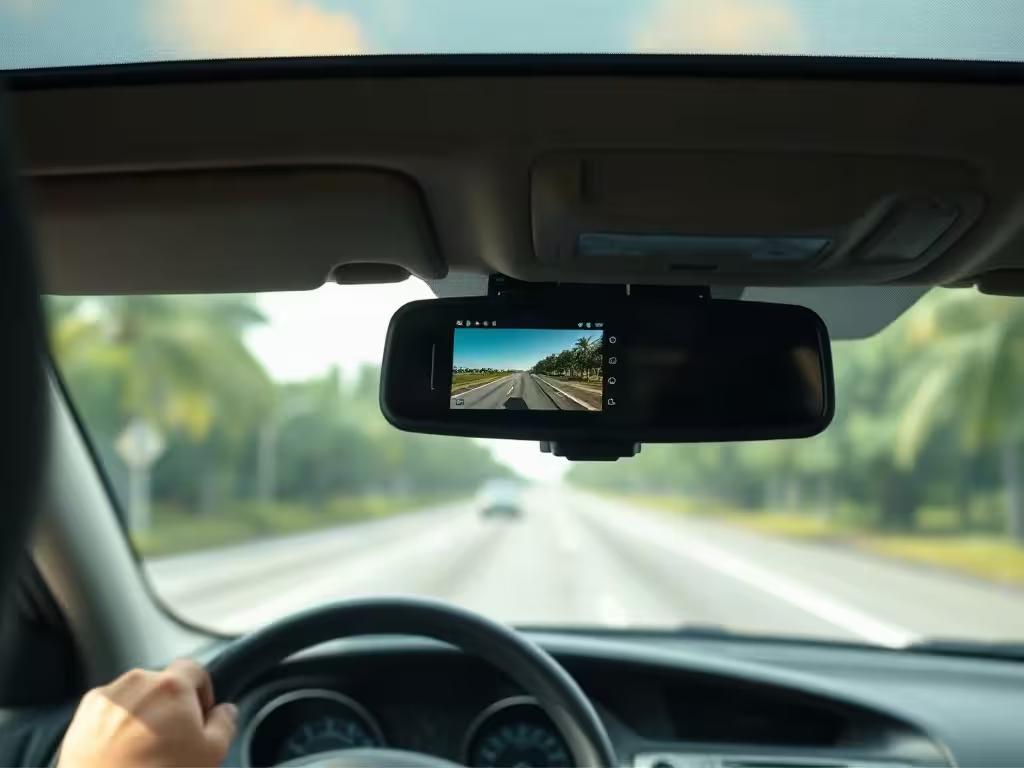
Florida Statutes section 316.2952 says a person may not drive on a public road with a product attached to, or located in or upon, the windshield unless the product fits a listed exception. Those exceptions cover specified items such as legally required papers, a permitted sunscreen strip, certain government-issued toll devices, and qualifying GPS or similar satellite-receiver devices.
The statute contains no express exception for a dash cam. On the statutory text alone, a camera fixed to the windshield carries legal risk even when it occupies little space.
Why mounting behind the rearview mirror is not a statutory safe harbor
Secondary sources split on this question. One applies a practical sightline test and reports that a small camera behind the rearview mirror rarely draws a citation. Another reads section 316.2952 to bar a windshield-mounted dash cam because no dash-cam exception appears in the statute.
The text resolves part of that disagreement: it supplies no safe harbor for a camera behind or near the mirror. No dash-cam-specific Florida appellate holding in the brief establishes that this location qualifies as lawful.
When dashboard placement can still impair the driver’s view
A dashboard mount avoids the windshield-attachment problem, but placement still matters. Section 316.2004 prohibits nontransparent material that materially obstructs, obscures, or impairs the driver’s clear view of the highway or an intersecting highway.
Keep the camera, cable, and mount below your working sightline. Florida’s statutes do not supply dash-cam dimensions or mark an approved dashboard zone, so the actual effect on your view controls the section 316.2004 question.
What the nonmoving-violation classification means
A violation of section 316.2004 is a noncriminal traffic infraction punished as a nonmoving violation under Chapter 318. The cited statute does not state a specific dollar amount, so we do not assign one here.
Audio Recording Rules for Florida dash cams
Chapter 934 does not protect every sound a microphone captures. Its definition of an oral communication turns on whether a speaker exhibited an expectation that the conversation would not be intercepted and whether the circumstances justified that expectation.
When a conversation meets that definition, the ordinary private-recording rule requires prior consent from every party. Statutory exceptions exist, but a driver should not assume that ordinary passenger conversation falls within one.
When an in-vehicle conversation may be protected
A conversation inside a closed vehicle can raise a different privacy question from words projected toward a public street. The speaker’s conduct and the surrounding circumstances both matter.
The statute does not declare every in-car statement private. It requires a fact-specific inquiry into the speaker’s exhibited expectation and whether that expectation was justified.
Consent from drivers, passengers, and other speakers
If your microphone could capture a protected conversation, obtain each speaker’s consent before recording. That may include the driver, passengers, and another person speaking within range.
Disabling the microphone offers a straightforward risk-control option when prior consent has not been secured. It is not a universal statutory command, but it removes the ordinary Chapter 934 issue tied to protected speech.
Criminal, civil, and evidentiary consequences of unlawful interception
An unlawful interception may carry several consequences:
- A violation may qualify as a third-degree felony, subject to the statute’s exceptions and narrower penalty provisions.
- Section 934.10 may support actual or statutory damages, punitive damages, attorney’s fees, and litigation costs when its conditions apply.
- Section 934.06 may exclude the communication and evidence derived from it when disclosure would violate Chapter 934.
Lawful video does not cure unlawfully captured audio. A court can treat the two components differently.
Merchant offer: After choosing settings that fit Florida law, you can review the DashOne Pro merchant page. Treat every product description and package term there as a merchant claim, not an Audit Faction test result.
Match the camera to the recording rules
Review the current package, then confirm mounting and audio rules before recording in your state.
Can Florida dash-cam footage be used as evidence?
Yes, Florida dash-cam footage may be used as evidence, but admission is not automatic. The recording must address a material fact, carry enough proof that it is what its proponent claims, and comply with the rules governing original recordings and lawfully acquired content.
Section 90.401 defines relevant evidence as evidence tending to prove or disprove a material fact. Section 90.901 then requires authentication or identification before admission.
Relevance, authenticity, and the original recording
Authentication requires enough evidence to support a finding that the footage is what the offering party claims. That threshold does not guarantee admission because another evidence rule may still exclude some or all of the file.
Section 90.952 generally requires an original recording to prove its contents, subject to statutory rules for duplicates and unavailable originals. Preserve the native file even when you create shorter copies for an insurer or attorney.
Date, time, metadata, equipment capability, and possible manipulation
In R.V. v. State, a Florida appellate court identified nonexclusive factors for authenticating video under the silent-witness theory. They include:
- The date and time of capture
- Evidence of possible image manipulation
- The equipment’s condition and capability
- Procedures involving the equipment’s preparation, testing, operation, and security
- Testimony identifying people shown in the recording
R.V. did not concern a private dash cam. Its factors still show what may matter when no witness can authenticate every moment from personal observation.
Why lawful acquisition of audio matters
A clear and relevant soundtrack can still fail if its interception violated Chapter 934. Section 934.06 bars unlawfully disclosed protected communications and derivative evidence in covered Florida proceedings.
Keep video-only and audio questions separate when reviewing a file. One may survive even if the other raises a statutory problem.
How much footage can matter after a Florida crash?
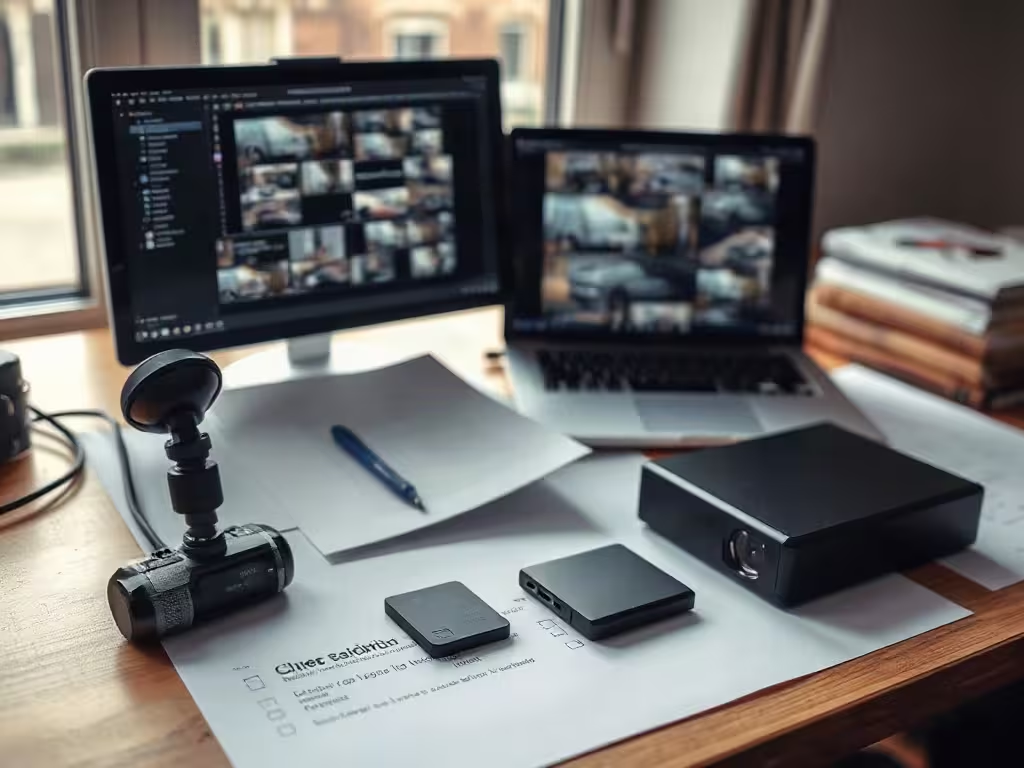
Relevance can change from one second to the next. A camera may capture road conditions, a maneuver, impact, and the immediate aftermath, then continue recording material that proves nothing about liability or damages.
What Jenkins says about footage before and after impact
In Jenkins v. W.L. Roberts, Inc. (Fla. 5th DCA 2023), the parties agreed that the first 48 seconds of silent dash-cam footage were relevant. That segment showed conditions, the drivers’ maneuvers, the collision, and events soon afterward.
The appellate court held that footage after the 48-second point shed no light on liability or damages and should have been excluded. The holding turns on that record. It does not create a universal 48-second limit.
Why the complete file should be reviewed before making claims about what it proves
A recording may support your account by showing a traffic signal, lane position, or the sequence before impact. It can also undermine your account if it records speed, distraction, a missed warning, or conduct after the crash that conflicts with a later statement.
Review the entire native file with counsel before describing what it proves. Preserve everything even if only one segment looks useful.
Preserving dash-cam evidence in Florida
Loop recording can erase the evidence while you exchange information at the roadside. Stop the overwrite process as soon as you can do so safely.
A practical preservation sequence is:
- Protect the original SD card or native file from automatic overwrite.
- Export cloud footage at the highest available quality.
- Retain the original filename and associated metadata.
- Create an unedited working copy.
- Record who handled or copied the file and when.
- Preserve footage before, during, and after the incident.
Save the native file before loop recording overwrites it
Remove or lock the relevant card if the device instructions permit safe removal. If the camera uses cloud storage, download the native-quality version before retention limits expire.
Avoid working directly on the only copy. Section 90.952’s original-recording rule makes the source file important even where a duplicate may later qualify.
Keep metadata and an unedited copy
Metadata can help establish when a file was created, its technical properties, and whether later processing changed it. Preserve the original filename, directory information, and any companion files generated by the device.
Make edits only on a duplicate. A cropped clip may help someone review the collision, but it should not replace the complete file.
Do not delete footage when litigation is reasonably anticipated
Florida Rule of Civil Procedure 1.380(f) addresses electronically stored information that should have been preserved for anticipated or pending litigation but was lost because a party failed to take reasonable steps.
A court may order measures no greater than necessary to cure demonstrated prejudice. The strongest measures, including an adverse presumption or jury instruction, dismissal, or default judgment, require a finding that the party intended to deprive another party of the information’s use.
When police, insurers, or another driver may obtain the recording
Voluntary disclosure and compulsory production follow different routes. The available sources do not establish that every Florida driver must surrender footage during a routine roadside interaction or every insurance inquiry.
Consent and roadside requests
A traffic stop alone does not establish voluntary consent to a search. An official Florida Courts compilation reports an appellate decision affirming suppression where the record supported the trial court’s finding that the stopped driver had not voluntarily consented.
That principle does not settle every dash-cam demand or every exception to the warrant requirement. If an officer asks to inspect or take your device, you can ask whether the request is voluntary and whether you are free to decline. Do not physically interfere with an officer.
Search warrants for an electronic device and its data
Florida Statutes section 933.05 supplies a mechanism for a warrant covering an electronic device and its data. A warrant must rest on probable cause and particularly describe what will be searched and what property will be seized.
The warrant’s scope, constitutional requirements, statutory grounds, and any asserted exception still matter. Seek legal advice if police seize your camera or storage media.
Party discovery and nonparty subpoenas
Once civil litigation begins, Rule 1.350 permits a party to request relevant electronically stored information and audio, visual, or audiovisual recordings within another party’s possession, custody, or control.
Rule 1.351 permits document production from a nonparty by subpoena. Relevance, objections, privilege, notice, protective orders, and other procedural limits can shape either route.
Why an insurer request depends on the policy and the claimant’s status
The Florida Department of Financial Services warns that failure to cooperate with an insurer’s claim investigation may, in some cases, breach policy conditions. That guidance does not establish that every policy requires dash-cam production.
An insured’s contract may differ from the duties of a third-party claimant. The sources do not resolve routine production obligations across every policy and claimant status, so review the policy and consult a Florida insurance attorney before refusing or producing the only copy.
DashOne Pro offer and merchant-stated package details
DashOne Pro enters this article as a commercial option, not as evidence about Florida law. Audit Faction did not independently test its image quality, audio controls, storage behavior, durability, mounting hardware, or legal suitability.
What the merchant currently claims
The DashOne Pro merchant page presents the current camera offer and package details. Any feature, price, shipping term, package component, or return term displayed there comes from the merchant.
The verified brief supplies no fixed feature list or price that we can reproduce responsibly. Those details may change.
What buyers should verify on the live offer page
Before ordering, check:
- The current total price
- Shipping charges and delivery terms
- Every item included in the package
- The mount type and whether it requires windshield attachment
- Microphone controls
- Storage and file-export options
- Return deadlines and conditions
You can verify the live DashOne Pro offer through Audit Faction’s tracked link. A product that ships with a windshield mount may still require a different installation method to reduce legal risk in Florida.
What Audit Faction has not independently tested
We have not confirmed the merchant’s performance claims or inspected the camera. We also have not verified how easily a user can disable audio, retrieve native files, preserve metadata, or prevent loop overwrite.
Those functions affect the legal and evidentiary questions covered above. Confirm them on the current offer page and in the product documentation before purchase.
Before you buy
Verify the package before you rely on it
- Confirm what the current package includes
- Check shipping and return terms
- Test storage and footage retrieval after delivery
florida dash cam laws: 2026 Mounting, Audio, and Evidence Rules
A cautious Florida setup keeps the camera off the windshield and places a dashboard mount where neither the unit nor its cable materially impairs your view. Leave the microphone disabled unless every speaker whose conversation qualifies for Chapter 934 protection has given prior consent.
After a crash or disputed stop, protect the native file, original storage media, metadata, filename, and an unedited copy. Do not let loop recording erase footage once litigation is reasonably anticipated.
Your camera works best when its placement, audio settings, and original files can withstand legal scrutiny before a crash or traffic stop occurs. Take fact-specific questions about recording, searches, insurance duties, or litigation to a Florida civil-rights or evidence attorney.
Related reading on Audit Faction
The brief does not supply verified Audit Faction URLs for the required internal topics. Add three to five confirmed internal links covering civilian recording, traffic-stop searches, preservation of video evidence, and police requests for electronic devices before publication. We have not fabricated URLs.
This post may contain affiliate links. If you click them, I might earn a small commission (it costs you nothing and helps me keep shipping quality articles every day for your reading pleasure).