
Table of Contents
TL;DR
- Connecticut dash cam laws generally permit private cameras, but placement, distraction, audio, and privacy rules still apply.
- Conn. Gen. Stat. § 14-99f uses an unobstructed-view and driver-distraction standard. It sets no dash-cam dimensions or designated mounting zone.
- Connecticut audio law cannot safely be reduced to a blanket one-party or all-party label.
- Preserve relevant footage in its original, complete form when you foresee a claim, investigation, or lawsuit.
Connecticut dash cam laws do not prohibit a private driver from using a camera on public roads. The legal questions begin with where you mount it, what its microphone captures, and what you do with the file after an incident.
We reviewed the cited legal sources on November 2, 2026. This article gives general information, not legal advice for a particular recording or dispute.
If you are comparing cameras, the live DashOne Pro offer lists the merchant’s current terms. Check those terms on the seller’s page before buying.
Check DashOne Pro before deciding
connecticut dash cam laws permit private cameras with conditions
What the law does and does not prohibit
The cited Connecticut statutes contain no general ban on a private driver owning, installing, or operating a dash cam. A Connecticut law firm likewise describes private dash-cam use as lawful when the device sits securely and does not obstruct the driver’s view.
That conclusion has limits. A legal installation must still satisfy the state’s visibility and distraction rule, while recordings may trigger separate audio, privacy, employment, evidence, and discovery laws.
Why the police dashboard-camera statute is different
Connecticut has a statute titled “Use of body-worn recording equipment and dashboard cameras,” but Conn. Gen. Stat. § 29-6d defines and regulates law-enforcement units, police officers, police patrol vehicles, and their recording equipment.
It does not supply the rules for an ordinary private vehicle. Reading that statute without its definitions can lead a driver to apply police retention or operating requirements to a personal camera.
Where Connecticut dash-cam mounting rules allow placement
The unobstructed-view and distraction standard
The 2026 text of Conn. Gen. Stat. § 14-99f bars an article or device placed anywhere on or in a vehicle when its manner or location significantly blocks a reasonable person’s view of the highway or distracts the operator.
That is a functional test. The Connecticut windshield obstruction law does not list dash-cam dimensions, draw an approved windshield zone, or grant an automatic exception for a camera.
Windshield, dashboard, and rearview-mirror-area mounts
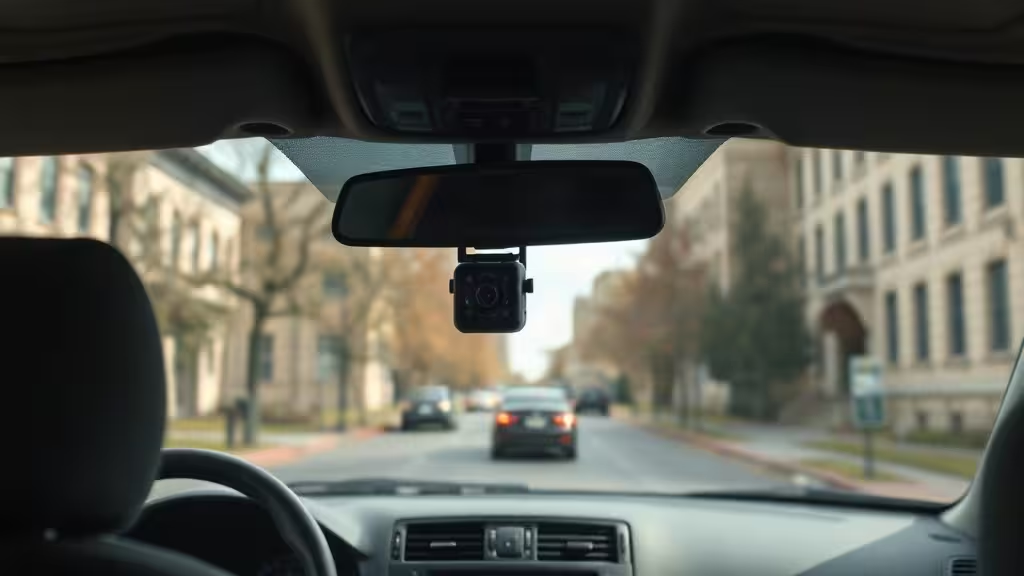
Any of the common mounting locations may comply if the device and its hardware leave the highway view open and do not distract you. Each location needs its own check:
- Sit in your normal driving position and inspect the full road view.
- Check whether the camera, suction cup, adhesive plate, cable, or screen conceals traffic, pedestrians, signs, or signals.
- Secure the unit so it cannot swing, slide, or fall.
- Dim or turn off a display that pulls your eyes from the road.
- Repeat the check after adjusting the seat or rearview mirror.
A compact camera can still violate the standard if it blocks a critical part of the view. Size alone does not settle the issue.
Why placement advice is not a statutory safe harbor
One Connecticut legal source suggests placing a camera in front of the rearview mirror to preserve visibility. That may work in some vehicles, but the suggestion does not create a statutory safe harbor.
A mirror-area mount must still pass § 14-99f’s fact-specific test. Windshield angle, sensor housings, camera cables, and the driver’s seating position can change the result.
Audio Recording Rules for Connecticut dash cams
In-person conversations and participant consent
Connecticut’s criminal eavesdropping definitions do not support a simple claim that every audible person must consent. Under Conn. Gen. Stat. § 53a-187, “mechanical overhearing” concerns intentional recording by a person who is absent from the conversation and lacks consent from at least one participant.
If you participate in an ordinary in-person conversation, your participation matters under that definition. If you leave a camera running to capture a conversation among other people, consent from at least one participant may become necessary.
The statutory wording does not make the vehicle’s interior or exterior decisive by itself. Whether the person operating the recorder was present and participating can control the criminal-law analysis.
Private telephone calls and civil liability
A separate civil rule covers oral private telephonic communications. Under Conn. Gen. Stat. § 52-570d, recording such a call can create civil exposure unless:
- all parties consent in the manner the statute describes;
- the recording begins with recorded verbal notice; or
- an automatic warning tone sounds at intervals of approximately 15 seconds.
Statutory exceptions also apply. This separate civil rule explains why sources that label Connecticut simply “one-party” or “all-party” leave out material law.
Passengers, rideshare customers, and people outside the vehicle
A driver participating in an in-person exchange may occupy a different legal position from a camera owner who records remotely. Location alone does not create a special dash-cam consent rule.
Tell passengers and rideshare customers when the microphone runs. That step can reduce disputes, but it does not replace a statute-specific assessment when the camera captures telephone calls, private conversations, or people whom you cannot hear from the driver’s seat.
A dash cam may also capture a person speaking outside the vehicle. The same questions remain: Was the recording intentional? Was the camera operator present? Did the operator participate? Did the device capture a private telephone communication or material protected by another privacy law?
When disabling audio is the lower-risk choice
Turn off the microphone when you cannot determine who may speak, whether a private call may play through the vehicle, or whether you will record conversations while absent. Commercial driving, employee monitoring, and recurring passenger recording deserve separate legal review.
Consult a civil-rights or recording-law attorney in Connecticut before relying on audio from an uncertain setting.
The DashOne Pro merchant page is the live source for the camera’s current offer and any merchant-described recording settings. Verify the microphone controls there rather than assuming that a listed feature fits your intended use.
Match the camera to the recording rules
Review the current package, then confirm mounting and audio rules before recording in your state.
Recording employees and police from a vehicle
Employee-facing cameras need separate employment-law review
Conn. Gen. Stat. § 31-48d generally requires qualifying employers that conduct covered electronic monitoring on their premises to give affected employees prior written notice. The statute defines its scope and includes exceptions involving certain misconduct and criminal investigations.
A camera aimed at workers, used in a company vehicle, or connected to an employer’s monitoring system raises questions beyond ordinary private driving. Obtain Connecticut employment-law advice before deploying it.
Video recording police is protected but not unrestricted
Conn. Gen. Stat. § 52-571j creates a civil remedy in certain cases when a peace officer interferes with someone taking a photographic, digital still, or video image of an officer performing official duties.
The statute preserves exceptions involving lawful enforcement activity, public safety, crime-scene integrity, privacy, and Judicial Branch rules. Keep a safe distance, obey lawful scene-control directions, and do not physically interfere with police work.
Audio remains a separate legal question
A right concerning still or video images does not answer every audio question. Apply the recording rules to the conversation and to your role as participant or nonparticipant.
If an officer requests your camera or footage, that also raises access and search questions distinct from your right to record.
How Connecticut courts may treat dash-cam footage
Relevance
Dash-cam footage does not enter evidence automatically. Under the Connecticut Code of Evidence, a recording must tend to make a material fact more or less probable, and other exclusion rules can still apply.
A clip showing traffic signals, vehicle positions, road conditions, spoken statements, or the sequence of a collision may meet that threshold when those details bear on a disputed fact. Relevance does not make the recording conclusive.
Authentication and original-file integrity
The Connecticut Code of Evidence, 2023 Edition requires enough evidence to support a finding that the offered item is what its proponent claims.
Preserving the source file, metadata, file name, time information, and storage medium can help establish that foundation. A witness with personal knowledge may also explain where the camera sat, how it operated, and how the file moved from the device to storage.
Context and completeness
When a party introduces part of a recorded statement, the court may require other necessary portions at the same time. That completeness rule does not force admission of every second of every dash-cam file, but a selective clip may omit context the court needs.
Save the recording from before and after the disputed event. Keep the unedited original even if you create a shorter working copy.
Use in an insurance claim
You may voluntarily send relevant footage to an insurer. The cited sources do not show that every insurer must accept the file, credit your interpretation, or treat it as decisive.
Before sending it, preserve the original and review the entire recording. Audio, speed data, timestamps, or earlier driving conduct may affect more than the moment you planned to highlight.
Who can obtain Connecticut dash-cam footage
Voluntary delivery to an insurer or police
You can choose to give footage to an insurer or police investigator. Voluntary delivery may help document an incident, but it also places the file in another party’s hands.
Preserve your own complete copy first. If the recording could expose you to criminal, civil, or employment consequences, speak with counsel before turning it over.
Civil discovery and subpoenas
In Connecticut civil litigation, a party may seek material electronically stored information that lies within another party’s possession or control and is not privileged. A subpoena can also command production of material documents or tangible things, subject to objections and other protections.
Dash-cam footage can fall within those mechanisms. Withholding discoverable material may prompt a production request, subpoena proceeding, or court order.
Police access during a traffic stop
For a vehicle stopped solely for a motor-vehicle violation, Conn. Gen. Stat. § 54-33o states that a police search of the vehicle or its contents must rest on probable cause or the operator’s unsolicited consent documented in writing or by police recording equipment.
That rule has a defined scope. Other circumstances may involve a warrant, subpoena, court order, another exception, or voluntary production, so it should not be read as a complete statement of every way police may lawfully obtain footage.
Preserving footage after a crash or traffic incident
Preserve the original and metadata
Take practical steps before the camera’s loop-recording function overwrites the event:
- Lock or protect the relevant file on the device.
- Copy the complete original to secure storage.
- Preserve metadata and the original file name.
- Make a separate working copy for viewing or sharing.
- Record when, how, and to whom you transfer a copy.
Do not rely on a social-media upload as your archive. Compression may strip information or reduce image and audio quality.
Avoid editing, selective clipping, or overwriting
Once litigation is pending or reasonably impending, intentional destruction or material alteration of relevant footage can support spoliation consequences. Connecticut’s adverse-inference standard is fact-dependent and addresses intentional spoliation, relevance, diligence by the requesting party, and notice that the evidence should be preserved.
Every accidental deletion does not automatically create liability. Once you anticipate a claim, however, ordinary overwrite settings can destroy material evidence, so stop the cycle and preserve the file.
Respond properly to requests and subpoenas
A request from an insurer, opposing party, or police officer does not carry the same legal force as a subpoena or court order. Identify what you received, note the deadline, and preserve the responsive material while you seek advice.
Do not ignore formal process. Counsel can assess scope, privilege, objections, and whether the requester seeks more than the law permits.
Consider recording and privacy law before publishing
The cited authorities do not categorically ban public sharing of every lawfully obtained road video. Separate exposure may arise if the file contains an unlawfully intercepted wire communication, voyeuristic material, private personal information, or evidence involved in a pending matter.
Publishing can also circulate a partial account before investigators, insurers, or courts examine the original. Preserve first, then obtain advice if the material carries legal or privacy risk.
Checking the current DashOne Pro offer
What the merchant currently claims
The DashOne Pro merchant page presents the camera offer and package details. Those descriptions remain merchant claims, not findings from an independent Audit Faction test.
The page was reviewed on October 13, 2026. Because commercial terms can change, we do not reproduce a price, shipping promise, package list, return period, or camera characteristic as a fixed fact here.
What buyers should verify on the live offer page
- the current price and any quantity-based terms;
- shipping charges and delivery representations;
- exactly what the package contains;
- return conditions and deadlines;
- the merchant’s stated camera and audio features; and
- whether the mount and controls suit your vehicle without blocking your view.
Save the terms that govern your purchase. The live page, rather than an older summary, supplies the merchant’s current representations.
No independent Audit Faction product test
Audit Faction has not independently tested DashOne Pro. We cannot confirm image quality, reliability, mounting stability, microphone behavior, or any other performance characteristic from hands-on use.
Before you buy
Verify the package before you rely on it
- Confirm what the current package includes
- Check shipping and return terms
- Test storage and footage retrieval after delivery
connecticut dash cam laws: Mounting, Audio, and Evidence in 2026
Private dash-cam use in Connecticut is generally lawful, but the camera must leave your highway view open and must not distract you. Audio requires closer analysis because in-person eavesdropping rules and civil rules for private telephone calls address different conduct.
Before driving, sit in your normal position and check the camera’s full field of view, mounting hardware, cable, screen, and audio setting. If an incident occurs, stop automatic overwriting and preserve the complete original file with its metadata.
Consult a Connecticut civil-rights or evidence attorney when audio recording, employee monitoring, police access, a subpoena, or expected litigation creates uncertainty.
Related reading on Audit Faction
No verified Audit Faction URLs or confirmed article titles were supplied for this block, so we have not invented internal links. Add three to five verified articles covering civilian recording, traffic-stop recording, evidence preservation, or police dashboard cameras before publication.
This post may contain affiliate links. If you click them, I might earn a small commission (it costs you nothing and helps me keep shipping quality articles every day for your reading pleasure).