
Table of Contents
TL;DR
- Hawaii dash cam laws do not expressly prohibit cameras in private vehicles, but they do not clearly authorize every windshield mount.
- Treat the lower five-inch driver-side square and seven-inch passenger-side square as conservative placement guides, not settled dash-cam exceptions.
- Record audio only when you participate in the conversation or an actual party gave prior consent.
- After a crash or disputed police encounter, preserve the complete, unedited file if you reasonably foresee a claim or investigation.
A driver installing a camera in Honolulu faces a practical choice: attach it high behind the mirror, place it in a lower corner, or keep it off the windshield. Hawaii dash cam laws supply no camera-specific answer, so the safer position keeps the device away from your sight line and driving controls.
Hawaii does not expressly prohibit owning or operating a dash cam in a private vehicle. Mounting, audio interception, privacy, and evidence laws still control how you use the camera.
The DashOne Pro merchant page lets buyers verify the live offer
The DashOne Pro offer page lists the camera package. Check the live price, shipping charge, included items, and return terms there before ordering because those details may change.
hawaii dash cam laws do not expressly authorize every windshield mount
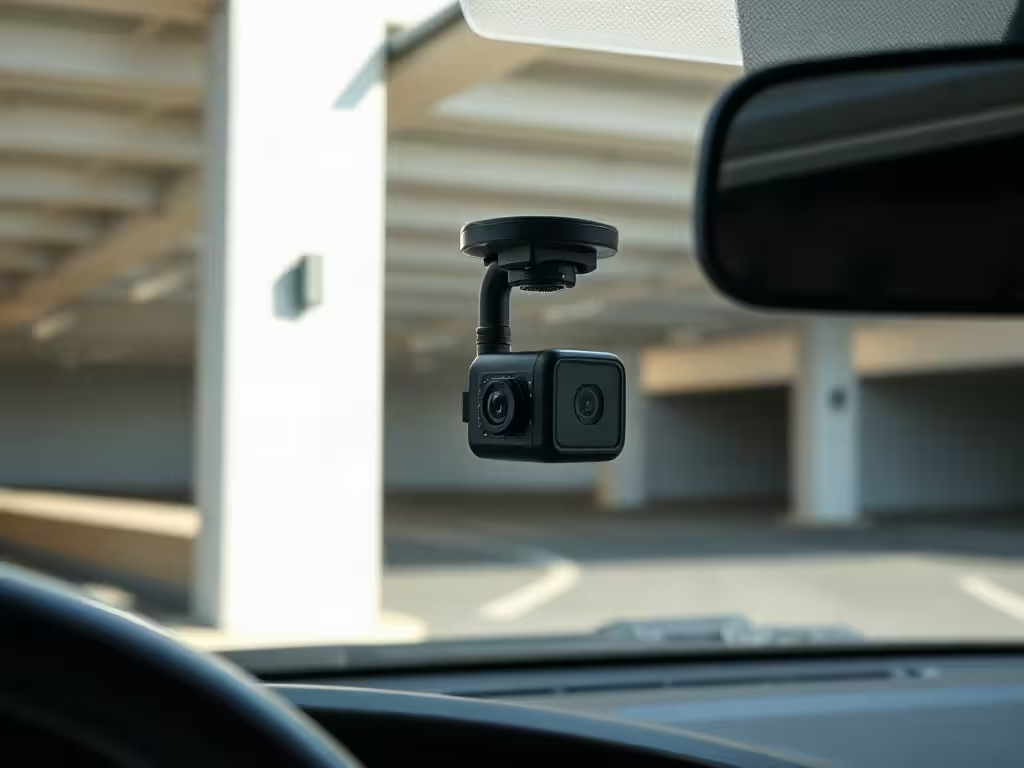
Hawaii law does not contain a statute dedicated to private-vehicle dash cams. Two provisions may affect placement, but neither expressly approves a camera or its mounting hardware.
HRS § 291C-124 governs interference with the driving mechanism
HRS § 291C-124 addresses vehicle loading and front-seat crowding that obstruct a driver’s view or control. It also bars carrying an object in the driver’s lap or immediate area when the object interferes with the driving mechanism.
The statute does not name windshield cameras. A mount that blocks controls or physically interferes with driving creates the clearest concern under this section.
The five- and seven-inch squares provide only a conservative mounting guide
HRS § 291-21.5 exempts signs, stickers, or other materials displayed within two lower-corner areas:
- A seven-inch square in the lower windshield corner farthest from the driver
- A five-inch square in the lower windshield corner nearest the driver
The text never identifies cameras or camera mounts as covered materials. Commercial compliance guidance treats dash cams as included, while other legal guidance says no Hawaii court or agency has squarely resolved that interpretation.
You can treat those squares as conservative placement guides. A small mount behind the rearview mirror or on the dashboard may also reduce obstruction, but no cited Hawaii authority expressly approves every dashboard, mirror, rear-window, or inward-facing configuration.
The $300 to $550 owner fine applies only if HRS § 291-21.5 governs the mount
The statute directs removal of a noncompliant sun-screening device and sets an owner fine of $300 to $550 for each violation. That penalty reaches a dash-cam mount only if the mount falls within HRS § 291-21.5, an issue the statutory text does not settle.
Federal rules place qualifying commercial-vehicle cameras within separate limits
Federal rules may govern a covered commercial motor vehicle even when the same dimensions do not govern an ordinary private car.
Commercial-vehicle coverage determines whether the federal dimensions apply
49 CFR § 393.60 places qualifying vehicle-safety technology within these limits:
- No more than 8.5 inches below the upper edge of the windshield-wiper-swept area
- No more than 7 inches above the lower edge of that area
- Outside the driver’s sight lines to the road, signs, and signals
Federal regulations include driver-camera systems among examples of vehicle-safety technology. Whether a consumer dash cam qualifies depends on what the device does and whether the vehicle falls under the commercial-motor-vehicle rules.
U.S. Army Garrison Hawaii has installation-specific traffic rules
U.S. Army Garrison Hawaii publishes local regulations, including Regulation 190-5, the U.S. Army Hawaii Traffic Code. Those rules apply to soldiers, civilian employees, contractors, family members, and visitors on the garrison’s installations.
The cited publication index does not state a particular dash-cam rule. Check posted instructions and the rules of the specific federal property before entering because one installation’s policy does not establish the rule for every military or federal site in Hawaii.
Audio Recording Rules allow capture by a party or with one party’s prior consent
HRS § 803-42 controls a private person’s interception of oral communications. It generally permits recording when the recorder participates in the communication or one actual party gave prior consent, unless the recording aims to facilitate a criminal or tortious act.
A participating driver can supply party consent
When you participate in a conversation inside your vehicle, your participation can satisfy the statute’s party requirement. This rule may cover a conversation with a passenger, rideshare customer, or employee when you take part in that exchange.
Participation in one conversation does not grant consent for unrelated conversations the camera captures later. The people who actually speak determine who counts as a party.
An absent owner still needs consent from an actual party
Owning the vehicle or camera does not make you a party to conversations recorded while you are absent. An unattended camera needs prior consent from someone who actually participates in the captured communication.
That distinction matters for parked vehicles, fleet cameras, and cameras left running when passengers remain inside. Disable audio when neither the owner nor another consenting party will participate.
Unlawful interception or disclosure can create criminal and civil exposure
Intentional unlawful interception, use, or disclosure under HRS § 803-42 constitutes a class C felony when the statutory elements apply. HRS § 803-48 also authorizes civil remedies, including:
- Actual damages or statutory damages, calculated as the greater of $100 per day of violation or $10,000
- Punitive damages where appropriate
- Reasonable attorney fees and litigation costs
- Preliminary or other equitable relief
Check the DashOne Pro offer for current package details. Before buying, confirm the package contents and whether the merchant’s listed controls fit the way you plan to handle dash-cam audio.
Hawaii privacy statutes distinguish public scenes from private places
HRS § 711-1100 defines a private place as one where a person may reasonably expect freedom from intrusion or surveillance. It excludes places open to the public or a substantial group.
Public roads generally differ from statutorily defined private places
Ordinary road footage generally captures places open to the public. HRS § 711-1111 reaches a different setting: intentionally installing or using a recording device in a private place without the consent of people entitled to privacy there.
The statute also covers equipment used outside a private place to capture sounds originating inside that would not ordinarily be audible or understandable outside. A violation constitutes a misdemeanor, and a court may order destruction of the unlawful recording.
Recording an officer in public remains subject to noninterference conditions
HRS § 711-1111 expressly protects video, audio, or photographs of a law enforcement officer performing public duties in a public place, or where the officer has no reasonable expectation of privacy, when the person recording does not interfere with:
- Safety and control
- A crime scene or accident site
- The integrity and confidentiality of an investigation
- Public safety and order
The statute recognizes civilian recording while preserving an officer’s ability to control a scene. Audio interception may still require separate analysis under HRS § 803-42.
HRS § 711-1110.9 separately protects intimate recordings and disclosures
HRS § 711-1110.9 addresses nonconsensual recording of undress or sexual activity in a private place. It also covers specified disclosures or threatened disclosures of identifiable intimate images when the statutory intent and consent elements apply.
That provision does not create a general publication rule for every identifiable person or license plate captured on a public road. Publication can raise separate legal questions, so obtain Hawaii-specific advice before sharing footage that exposes private conduct or makes contested claims about an identifiable person.
Hawaii evidence rules require relevant footage to be authenticated

A video must help prove or disprove a consequential fact, and its proponent must supply enough evidence for a factfinder to identify the recording as what the proponent claims.
A knowledgeable witness can help establish what the recording shows
A driver or passenger who knows the scene may explain when and where the camera recorded the event. A witness can also identify the vehicle, roadway, voices, or sequence shown in the file.
That testimony does not guarantee admission. It supplies part of the foundation while the court considers other evidentiary rules and objections.
System details and exact copies can support an authentication foundation
In State v. Luke, a Hawaii appellate court examined surveillance video rather than dash-cam footage. Testimony about the system’s operation, date and time stamps, download history, and confirmation that the exhibits exactly copied the viewed footage supported authentication.
The decision identifies useful foundation evidence. It does not declare that an original file or metadata must accompany every video.
An unedited original preserves information that may later help verification
Keep the complete file in the format created by the camera. Preserve the associated date, time, and metadata when available, and make a separate working copy before clipping or enhancing anything.
Those steps retain information that a witness, investigator, lawyer, or court may use to examine the recording’s source and accuracy. They do not guarantee admission.
Preservation duties can attach when litigation becomes reasonably foreseeable
Loop recording can overwrite the file that later becomes central to a claim. Once litigation becomes reasonably foreseeable, preserving relevant footage may become a legal duty.
Foreseeable litigation can trigger a duty to preserve footage
In Kwon v. Costco Wholesale Corp., the U.S. District Court for the District of Hawaii found spoliation after potentially relevant video was overwritten when the defendant knew or reasonably should have known it could matter to foreseeable litigation.
Available sanctions included excluding evidence, admitting evidence about the destruction, permitting an adverse inference, and potentially dismissing claims in a sufficiently culpable case. The proper sanction depends on the governing standard, prejudice, and responsibility for the loss.
A federal subpoena can require production of stored video
Federal Rule of Civil Procedure 45 permits a subpoena to demand electronically stored information. If the subpoena does not specify a format, the responding person ordinarily produces the information in the form in which it is maintained or in a reasonably usable form.
That federal rule does not establish Hawaii state-court procedures or every obligation arising from an insurance claim.
A federal warrant can authorize seizure or copying of electronic files
Federal Rule of Criminal Procedure 41 permits a judge to issue a warrant based on probable cause. A warrant may authorize seizure of electronic storage media or copying of electronically stored information, and the executing officer must provide the required warrant copy and receipt.
These federal rules do not create a blanket duty to surrender your dash cam voluntarily during every roadside encounter. Consent, a warrant, and recognized exceptions can produce different legal consequences, so obtain counsel when police seek footage and the basis for taking it remains disputed.
Current rules require a final check for the mount and the property
Confirm the current statutory text before installation, and check posted traffic or camera rules before driving onto military or other federal property.
Consult a Hawaii civil-rights attorney when audio consent, publication, compelled production, or a disputed mount could affect a case. The merchant’s DashOne Pro offer page lists the current price, shipping, included items, and return terms for buyers who want to assess that offer.
Key takeaways
Place the smallest workable mount where it does not block your sight line, touch driving controls, or distract you from the road. Disable audio unless the recorder participates or an actual party gave prior consent.
After a crash or disputed police encounter, export and preserve the complete, unedited file before loop recording overwrites it. If consent or compelled production could determine the outcome, preserve the recording and obtain Hawaii-specific legal advice before editing, publishing, or surrendering it.
Related reading on Audit Faction
This post may contain affiliate links. If you click them, I might earn a small commission (it costs you nothing and helps me keep shipping quality articles every day for your reading pleasure).