
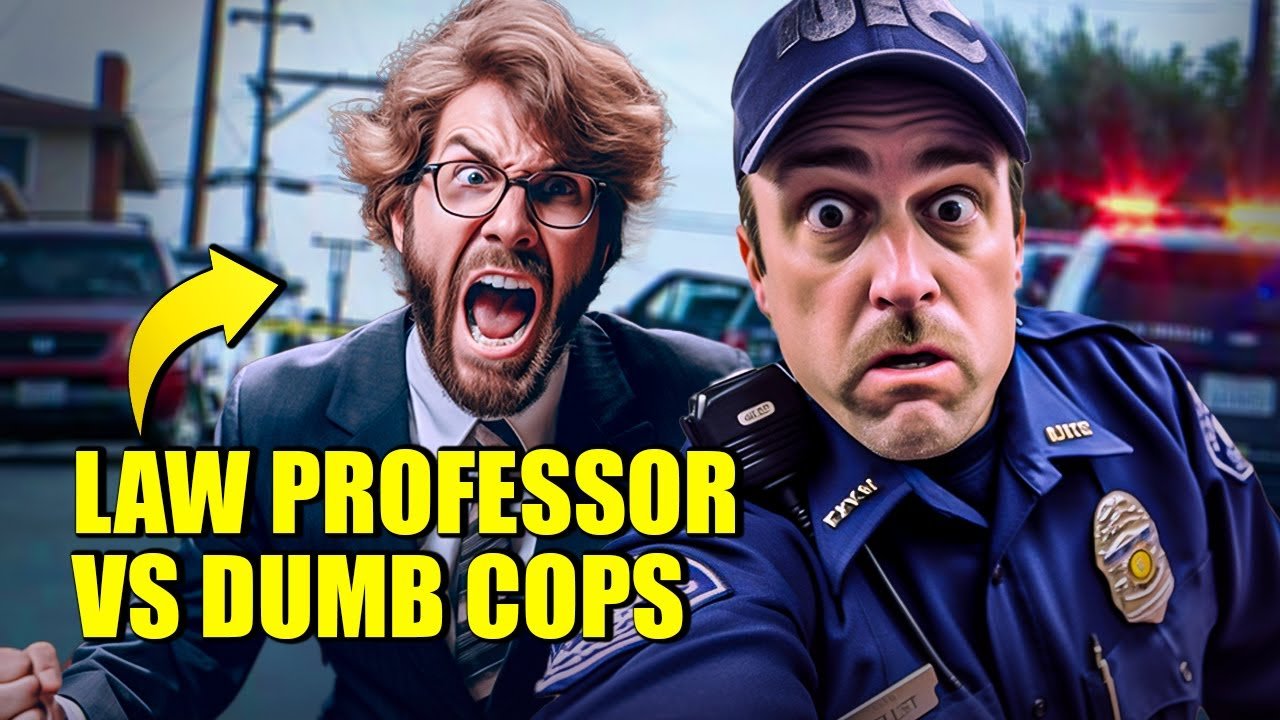
Do police officers really know the law well, or can they learn a lesson when dealing with legal experts? This question has only grown sharper heading into 2026, as first amendment auditing channels have racked up hundreds of millions of views and more states have codified the right to record law enforcement in public. In this compilation, we look into a series of captivating encounters where the roles of authority and lawyers become blurred. Law enforcement officers unexpectedly find themselves on the receiving end, being schooled by seasoned law professors.
When Legal Experts School Police Officers on the Law
In this compilation, we look at some captivating encounters where the roles of authority and legal experts become blurred. Law enforcement officers find themselves unexpectedly on the receiving end, being schooled by seasoned law professors. What stands out across every clip is not confrontation for its own sake, but the power of knowing the specific statute, the property boundary, or the constitutional clause before an officer can invoke it first.
Peaceful Protesters Assert Their Rights
In the first clip, two young women participate in a peaceful protest against a pigeon shooting club. This draws the attention of law enforcement officers, including a lawyer who takes a leadership role questioning the officers. She focuses on property boundaries and safety concerns, scrutinizing their actions through the lens of legality. Her legal expertise and composed demeanor lead to a measured exchange, highlighting the importance of knowledge and composure when asserting one’s rights, especially in protests.
Traffic Stop Leads to Debate on Legal Obligations
Next we meet Chile dCastro, a distinguished professor in constitutional law. His day takes an unexpected turn when he’s pulled over by two police officers. One officer claims the professor ran a red light and made an improper turn. Professor dCastro acknowledges the claims and invites the officer to explain. The professor then brings up a relevant detail – that the road was closed where he made a U-turn. This perspective stumps the officer, hinting at the power balance. Professor dCastro points out the absurdity of such police encounters, offering a glimpse into the tensions between law enforcement and the community.
Man Refuses to Provide ID on His Property
In another incident, an individual engaged in dumpster disposal is approached by officers. He politely declines providing identification, defending that he’s on his property and not violating laws. His confidence in his rights and legal knowledge serves as a test on the importance of asserting one’s rights in routine law enforcement encounters.
Individual Schools Officer on Unlawful Orders
Finally, we see an individual recording in public confronted by officers asking for ID. He strongly states the officer is giving an unlawful order against recording. With expertise as a constitutional law instructor, he advises the officer about issuing orders outside his legal authority. He refuses to comply with unlawful orders, emphasizing the significance of asserting one’s rights with law enforcement.
These encounters reveal the importance of knowledge and composure when dealing with law enforcement. Individuals well-versed in the law can thoughtfully yet firmly engage officers, highlighting the complex dynamics between citizens and authority.
Where Things Stand in 2026
The pattern visible in these clips reflects a broader national trend. According to data from Mapping Police Violence, a nonprofit that aggregates incident reports from across the country, accountability gaps between policy and practice remain significant in most jurisdictions, with fewer than 2% of officers involved in fatal use-of-force incidents facing any criminal conviction. That figure has remained largely stable through 2024 and into 2025, underscoring why citizen knowledge of rights continues to matter outside of formal oversight channels.
On the legislative side, the picture is shifting. As of 2025, at least 17 states have enacted explicit statutes protecting the right to record police in public spaces (National Conference of State Legislatures, 2025 session review). That is up from roughly 10 states five years ago. Several more have cases working through appellate courts. The practical consequence: officers in those states now have less legal cover when ordering a bystander or auditor to stop filming, which changes the dynamic in every clip above.
Peer intervention programs, which train officers to step in when a colleague is about to cross a legal or ethical line, have also expanded into roughly 40 U.S. departments by early 2026, following the Active Bystandership for Law Enforcement model developed at Georgetown University. Early evaluation data shows a measurable drop in use-of-force complaints at pilot sites, though independent replication is still limited. These programs address the institutional side of what the clips show from the citizen side: the law has to be understood by both parties before it can function as a check.